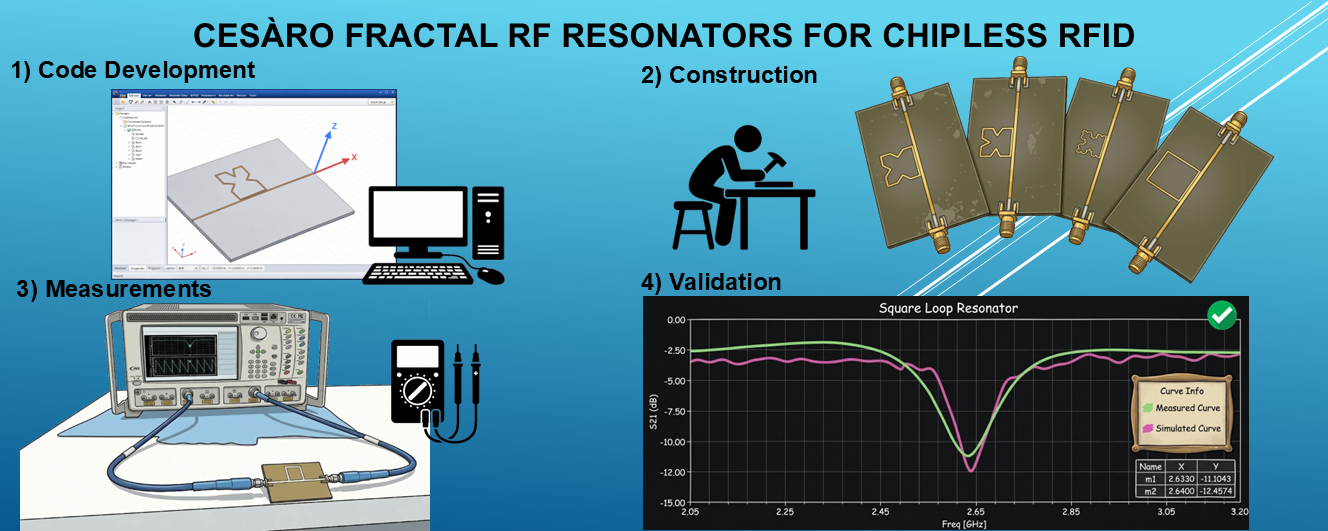
Automated Design and Miniaturization of RF Resonators Based on the Cesàro Fractal for Chipless RFID Tags
Keywords:
Chipless RFID, Fractal resonator, Cesàro fractal, miniaturization, electromagnetic simulation, HFSS, PythonAbstract
This paper presents an automated methodology for the design and miniaturization of novel resonators based on the modified Cesàro fractal. The resonators are generated using Python scripts integrated with the HFSS electromagnetic simulator and offer a compact alternative to conventional square-loop resonators for chipless RFID tags. A key advantage of the proposed approach is the ability to iteratively miniaturize the structures, resulting in a significantly reduced tag footprint. The Cesàro fractal, an adaptable derivative of the Von Koch curve, is explored here by treating the traditionally fixed 60° deformation angle as an adjustable parameter. This flexibility enables precise geometric optimization of the resonator for operation at target frequencies. The methodology encompasses theoretical analysis of fractal parameters such as the angle and fractal order. The script-based geometry generation, full-wave electromagnetic simulation, device fabrication, and experimental validation through comparison of simulated and measured results. The use of the Cesàro fractal is justified not only by its inherent miniaturization capability but also by the finer control it provides over the resonant frequency. We demonstrate that varying the structure’s perimeter allows for precise tuning of the resonant frequency without incurring an undesirable increase in resonator area. When a resonator is detuned, no energy coupling occurs, resulting in a high signal level at the output port, corresponding to a logical “1” state, which is essential for chipless RFID encoding. Experimental results confirm the efficiency of the Cesàro fractal as a viable alternative to conventional square-loop resonators, highlighting its potential for compact, high-performance RFID systems.
Downloads
References
K. Finkenzeller, RFID Handbook: Fundamentals and Applications in
Contactless Smart Cards, Radio Frequency Identification and Near-Field
Communication, 3rd ed. Wiley, 2010. doi :10.1002/9780470665121
S. Preradovic and N. C. Karmakar, ”Chipless RFID: Bar code of the
future,” IEEE Microwave Magazine, vol. 11, no. 7, pp. 87-97, Dec. 2010.
doi: 10.1109/MMM.2010.938571
R. K. Mishra, P. Sethy and S. K. Behera, ”Chipless RF Identification
Sensors for Product Tracking and Identification Applications: A Review,”
in IEEE Microwave Magazine, vol. 26, no. 8, pp. 64-86, 2025, doi:
1109/MMM.2025.3563058.
S. Preradovic, I. Balbin, N. C. Karmakar and G. F. Swiegers,
”Multiresonator-Based Chipless RFID System for Low-Cost Item Track-
ing,” in IEEE Transactions on Microwave Theory and Techniques, vol.
, no. 5, pp. 1411-1419, May 2009, doi: 10.1109/TMTT.2009.2017323.
D. H. Werner and S. Ganguly, ”An overview of fractal antenna engineer-
ing research,” IEEE Antennas and Propagation Magazine, vol. 45, no. 1,
pp. 38-57, Feb. 2003. doi: 10.1109/MAP.2003.1189650
H. Zeng, G. Wang, J. Liang, and X. Gao, ”Complementary split ring
resonators using equilateral triangular Koch fractal curves,” in 2009 3rd
IEEE International Symposium on Microwave, Antenna, Propagation and
EMC Technologies for Wireless Communications, 2009, pp. 911-913, doi:
1109/MAPE.2009.5355780.
N. Nantapanich et al., ”Miniaturization of Dimensions Based on Square
Loop Resonator with NP Fractal Model for Sensor Applications,” in 2025
th International Electrical Engineering Congress (iEECON), 2025, pp.
-4, doi: 10.1109/iEECON64081.2025.10987705.
A. Govindankutty et al., ”On Using Square-Shaped Fractal Patterns to
Reduce the Operating Frequency of Open Complementary Split Ring
Resonators on a Single Conducting Layer,” in 2024 IEEE International
Symposium on Antennas and Propagation and INC/USNC-URSI Ra-
dio Science Meeting (AP-S/INC-USNC-URSI), 2024, pp. 957-958, doi:
1109/AP-S/INC-USNC-URSI52054.2024.10686365.
H.-L. Peng et al., ”Compact Tunable Bandpass Filter With a Fixed
Out-of-Band Rejection Based on Hilbert Recent,” IEEE Transactions on
Components, Packaging and Manufacturing Technology, vol. 3, no. 3, pp.
-400, 2013, doi: 10.1109/TCPMT.2012.2222643.
N. Jankovi´c, R. Geschke, and V. Crnojevi´c-Bengin, ”Compact Tri-Band
Bandpass and Bandstop Filters Based on Hilbert-Fork Resonators,” IEEE
Microwave and Wireless Components Letters, vol. 23, no. 6, pp. 282-284,
June 2013, doi: 10.1109/LMWC.2013.2258005.
R. K. Abdulsattar, T. A. Elwi, and Z. A. A. Hassain, ”Microwave
Resonator based a Fractal Moore Structure for Modern Wireless Recon-
figurable Systems” in 2021 3rd International Conference on Research
and Academic Community Services (ICRACOS), 2021, pp. 98-102, doi:
1109/ICRACOS53680.2021.9701943.
A. S. A. Jalal and A. Ismail, ”A compact fractal-based asymmetrical
dipole antenna for RFID tag applications,” in 2018 Third Scientific
Conference of Electrical Engineering (SCEE), 2018, pp. 101-104. doi:
1109/SCEE.2018.8684136
L. A. C. Fonseca, H. E. Hernandez-Figueroa, G. T. Santos-Souza and L.
L. Bravo-Roger, ”Dielectric Properties Characterization: A Simple Inverse
Problem Approach,” 2017 IEEE MTT-S International Conference on
Numerical Electromagnetic and Multiphysics Modeling and Optimization
for RF, Microwave, and Terahertz Applications (NEMO), pp. 22-24, 2017,
doi: 10.1109/NEMO.2017.7964174.