IoT-Based Monitoring and Machine Learning Classification of Urban Water Consumption Patterns
Keywords:
Internet of Things, LPWAN, Machine learning classification, Smart metering, Urban water managemen, Water consumption monitoringAbstract
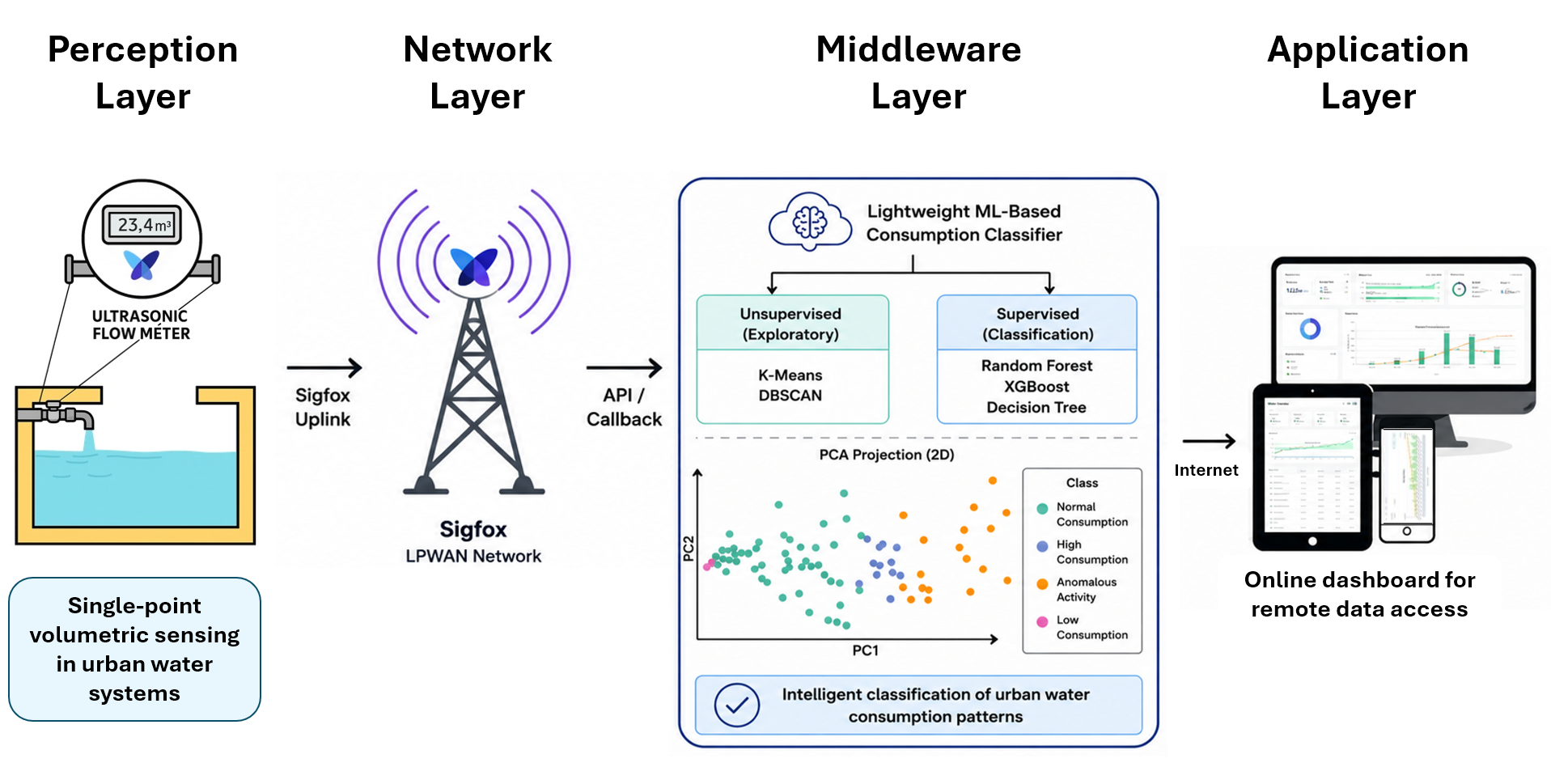
Efficient urban water management requires real-time monitoring and intelligent analytics to support both day-to-day operation and long-term resource optimization. This paper reports the design, deployment, and evaluation of an energy-aware LPWAN monitoring system implemented at a university facility in Mexico. Over five months, the system recorded hourly volumetric flow and transmitted a single daily burst, revealing clear circadian and weekly consumption patterns influenced by academic schedules and external events. To characterize consumption behavior, a percentile-based labeling strategy was employed to categorize daily water usage into four operational states: Low, Normal, High, and Anomalous. Using these labels, supervised machine learning models were evaluated for classification of consumption patterns, while unsupervised methods were used to explore natural groupings in the data. Among the tested models, Random Forest, Decision Tree, and XGBoost achieved
the highest classification performance under stratified 10-fold cross-validation. From an energy efficiency standpoint, once-per-day bursting delivered 3,816 hourly readings through 159 daily bursts (six 12-byte frames each; 954 frames total), reducing the number of daily transmissions by 75% relative to hourly uploads while preserving full hourly resolution. These results show that minimal sensing coupled with lightweight LPWAN telemetry can support scalable, pattern-driven water management and provide a practical foundation for context-aware decision support in smart urban distribution networks.
Downloads
References
United Nations (UN), the Department of Economic and Social Affairs, 2018. World Urbanization Prospects: The 2018 Revision, Key Facts. United Nations Department of Economics and Social Affairs, Population Division: New York, NY, USA.
C.J. Vörösmarty, P.B. McIntyre, M.O. Gessner, D. Dudgeon, A. Prusevich, P. Green, S. Glidden, S.E. Bunn, C.A. Sullivan, C.R. Liermann, P.M. Davies, "Global threats to human water security and river biodiversity," 2010, Nature, 467(7315), p.555. 10.1038/nature09549.
M. Rodell, et.al., "Emerging trends in global freshwater availability.", 2018 Nature, 557(7707), p.651.
A.Y. Rosinger, "Biobehavioral variation in human water needs: How adaptations, early life environments, and the life course affect body water homeostasis," American Journal of Human Biology, vol. 31, no. 5, Oct. 2019, e23338. doi: https://doi.org/10.1002/ajhb.23338
H. Pontzer, et.al., "Daily energy expenditure through the human life course," Science, vol. 373, pp. 808-812, Aug. 2021, doi: 10.1126/science.abe5017.
J.M. Luna-Rivera, J. Rufo, J. Rabadan et al. "Urban genome: a new paradigm for sustainable cities." npj Urban Sustain 5, 77, 2025. https://doi.org/10.1038/s42949-025-00265-1
I. Andrić, A. Vrsalović, T. Perković, M. Čuvić, p. Šolić, "IoT approach towards smart water usage," Journal of Cleaner Production, Vol. 367, pp. 133065, 2022, doi: 10.1016/j.jclepro.2022.133065.
E. Syrmos, V. Sidiropoulos, D. Bechtsis, F. Stergiopoulos, E. Aivazidou, D. Vrakas, P. Vezinias, I. Vlahavas, "An Intelligent Modular Water Monitoring IoT System for Real-Time Quantitative and Qualitative Measurements", Sustainability", Vol. 15, No. 3, pp 2127, 2023, doi:10.3390/su15032127
D. Arsene, A. Predescu, B. Pahonțu, C. Chiru, E. Apostol, C. Truică, "Advanced Strategies for Monitoring Water Consumption Patterns in Households Based on IoT and Machine Learning", Water, Vol. 14, No. 14, pp. 2187, 2022, doi:10.3390/w14142187
M. Pilotto Figueiredo and L. de Souza Oliveira, “AquOculus: A Cost-effective Advanced Metering Infrastructure for Urban Water Distribution Systems”, IEEE LAT AM T, vol. 24, no. 2, pp. 174–186, Jan. 2026.
M. K. Benhaoua et al., "SW3T-IoT: Smart Water Monitoring Based on a Three-Tier IoT Architecture," in IEEE Access, vol. 13, pp. 206331-206354, 2025, doi: 10.1109/ACCESS.2025.3640507.
A. Morain, P. Vilar, L. Chen, “Artificial Intelligence for Water Consumption Assessment: State of the Art Review,” Water Resources Management, vol. 38, pp. 3113-3134, 2024, doi: https://doi.org/10.1007/s11269-024-03823-x
K. Görenekli, A. Gülbağ, "Comparative Analysis of Machine Learning Techniques for Water Consumption Prediction: A Case Study from Kocaeli Province," Sensors 2024, 24, 5846. https://doi.org/10.3390/s24175846
J. V. Filho, A. Scortegagna, A. P. de Sousa Dias Vieira y P. A. Jaskowiak, “Machine learning for water demand forecasting: case study in a Brazilian coastal city,” Water Practice and Technology, vol. 19, no. 5, pp. 1586-1602, 2024. doi: 10.2166/wpt.2024.096
M. Kavya, M. Aneesh, P. R. Shekar, Sarwesh P, "Short term water demand forecast modelling using artificial intelligence for smart water management," Sustainable Cities and Society, Vol. 95, 2023, 104610, doi: https://doi.org/10.1016/j.scs.2023.104610
L. Cao, X. Yuan, F. Tian, H. Xu, and Y. Zhang, "Forecasting of water consumption by integrating spatial and temporal characteristics of short-term water use in cities,"Physics and Chemistry of the Earth, Parts A/B/C, Vol. 130, 2023, pp. 103390, doi: 10.1016/j.pce.2023.103390
J. Kim, H. Lee, M. Lee, H. Han, D. Kim, H.S. Kim, "Development of a Deep Learning-Based Prediction Model for Water Consumption at the Household Level, Water, Vol. 14, no. 9, 2022, pp. 1512, doi: 10.3390/w14091512.
J. Adrian SOMONTINA and E. Queen MACABEBE, "A Non-Intrusive Water Consumption Monitoring System," 2020 IEEE Global Humanitarian Technology Conference (GHTC), Seattle, WA, USA, 2020, pp. 1-6, doi: 10.1109/GHTC46280.2020.9342898.
M. Wang, Z. Li, Y. Liu, Lu Lin, C. Wang, "A hybrid model of machine learning for classifying household water-consumption behaviors," Cleaner and Responsible Consumption, Vol. 16, 2025, pp. 100252, doi: https://doi.org/10.1016/j.clrc.2025.100252.
N. Gourmelon, et al., "Implications of Experiment Set-Ups for Residential Water End-Use Classification," Water 2021, 13, 236. https://doi.org/10.3390/w13020236
A. Dahesh, et al., “Classification of water subscribers by machine learning algorithms,” Water and Environment Journal, vol. 38, pp. 45-58, 2024. doi: 10.1111/wej.12892.
H. Guo, X. Liu y Q. Zhang, “Identifying daily water consumption pat- terns based on K-means Clustering, Agglomerative Hierarchical Clustering, and Spectral Clustering algorithms,” Journal of Water Supply: Research and Technology–Aqua, vol. 73, no. 5, pp. 870-887, 2024. doi: 10.2166/aqua.2024.294.
S. Lee, B. Kim, "Machine Learning Model for Leak Detection Using Water Pipeline Vibration Sensor," Sensors 2023, 23, 8935. https://doi.org/10.3390/s23218935
S. Pei, L. Hoang, G. Fu y D. Butler, “Real-Time Pump Scheduling in Water Distribution Networks Using Deep Reinforcement Learning,” Journal of Water Resources Planning and Management, vol. 151, n.o 6, 2025. doi: 10.1061/JWRMD5.WRENG-6476
C. Maußner, M. Oberascher, A. Autengruber, A. Kahl, R. Sitzenfrei, "Explainable artificial intelligence for reliable water demand forecasting to increase trust in predictions," Water Research, vol. 268, Part B, 2025, 122779, doi: https://doi.org/10.1016/j.watres.2024.122779.
C. Luciani, F. Casellato, S. Alvisi, M. Franchini. "Green Smart Technology for Water (GST4Water): Water Loss Identification at User Level by Using Smart Metering Systems" Water vol. 11, no. 3, 2019. https://doi.org/10.3390/w11030405
R. Zese, E. Bellodi, C. Luciani and S. Alvisi, "Neural Network Techniques for Detecting Intra-Domestic Water Leaks of Different Magnitude," in IEEE Access, vol. 9, pp. 126135-126147, 2021, doi: 10.1109/ACCESS.2021.3111113.