Use of Radio Frequency Identifiers in Autonomous Mobility Systems
With a Focus on Safety
Keywords:
Autonomous mobility, RFID, traffic sign identification, redundant perception, intelligent transportation systemsAbstract
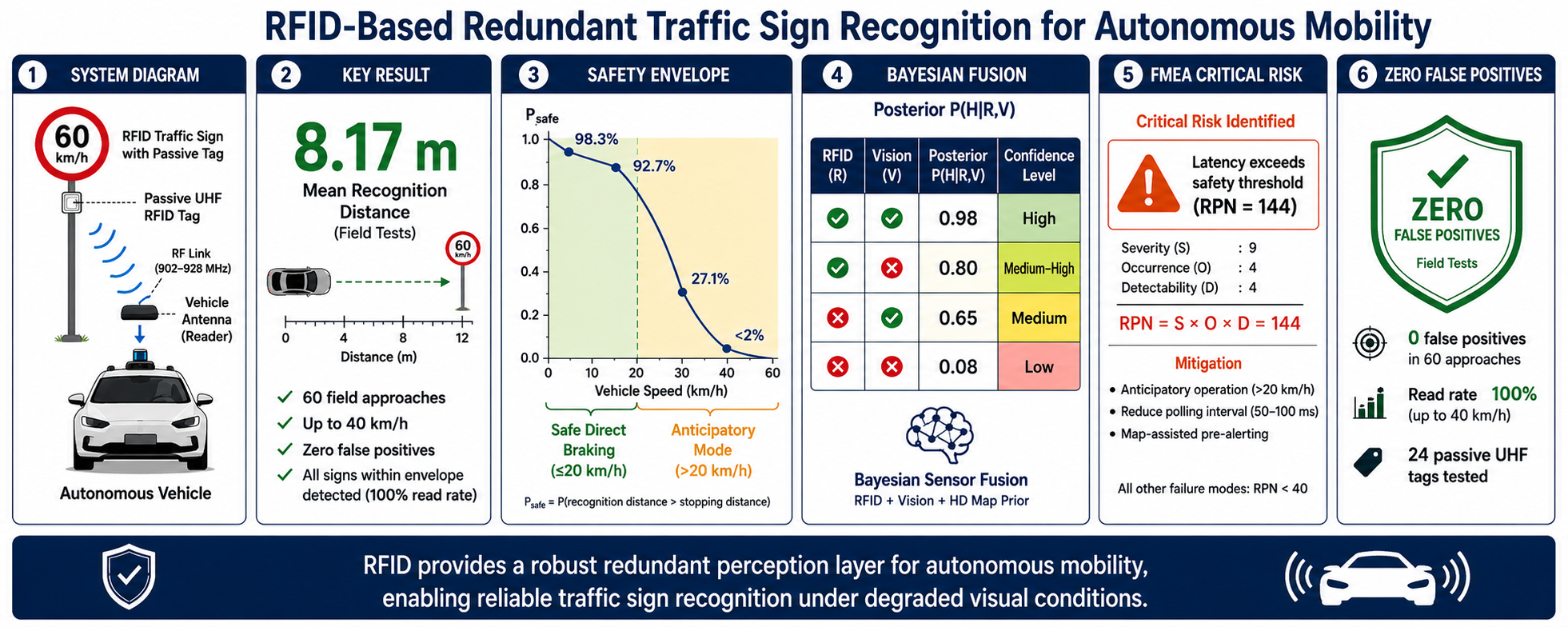
Autonomous mobility systems rely heavily on perception technologies to interpret road infrastructure and make driving decisions without human intervention. Among these technologies, camera-based traffic sign recognition systems are widely employed; however, their performance is significantly degraded under adverse conditions such as sign deterioration, partial occlusion, poor lighting, and vandalism. In countries with limited infrastructure maintenance, these conditions represent a critical safety risk. This work proposes and experimentally evaluates the use of Radio Frequency Identification (RFID) technology as a redundant perception layer for traffic sign identification in autonomous mobility systems. Passive UHF RFID tags were integrated into traffic signs and detected using a vehicle-mounted reader system. The experimental evaluation was conducted in two stages: controlled bench tests and field tests in a real campus environment. Bench tests resulted in a mean recognition distance of 10.35 m with a 95 \% confidence interval of ±0.40 m, while field tests yielded a mean distance of 8.17 m with a confidence interval of ±1.05 m, influenced primarily by lateral sign offset and road geometry. All tagged signs positioned within the antenna’s effective coverage area were detected during dynamic tests conducted at speeds of up to 40 km/h. The results demonstrate reliable identification within a defined operational envelope, with recognition distances primarily influenced by lateral offset and road geometry, indicating that RFID-based perception is particularly suitable for controlled or semi-controlled environments.
Downloads
References
S. Sivaraman and M. M. Trivedi, “Looking at vehicles on the road a survey of vision-based vehicle detection, tracking, and behavior analysis,” IEEE Transactions on Intelligent Transportation Systems, vol. 14, no. 4, pp. 1773–1795, Dec. 2013, doi: 10.1109/TITS.2013.2266661.
C. Olaverri-Monreal and T. Jizba, “Autonomous vehicles and smart mobility-related technologies,” Journal of Advanced Transportation, vol. 2021, p. 9111820, 2021, doi: 10.1155/2021/9111820.
SAE International, Taxonomy and Definitions for Terms Related to Driving Automation Systems for On-Road Motor Vehicles (J3016), Std., 2021, doi: 10.4271/J3016 202104.
M. Buehler, K. Iagnemma, and S. Singh, The DARPA Urban Challenge: Autonomous Vehicles in City Traffic. Berlin, Germany: Springer, 2009, doi: 10.1007/978-3-642-03991-1.
J. e. a. Su, “Traffic sign recognition using vision-radar sensor fusion for autonomous vehicles,” IEEE Transactions on Intelligent Transportation Systems, vol. 25, no. 3, pp. 2116–2129, 2024, doi: 10.1109/TITS.2023.3317242.
K. e. a. Eykholt, “Robust physical-world attacks on deep learning visual classification,” in Proceedings of the IEEE/CVF Conference on Computer Vision and Pattern Recognition (CVPR), 2018, doi: 10.1109/CVPR.2018.00175, pp. 1625–1634.
Confederac¸ ˜ao Nacional do Transporte, “59,2% das rodovias brasileiras apresentam problemas de sinalizac¸ ˜ao,” Feb. 2018, accessed on Apr. 10, 2026. [Online]. Available: https://www.cnt.org.br/agencia-cnt/ sem-saber-o-que-vem-pela-frente
B. Pawłowicz, M. Salach, and P. Jankowski-Mihułowicz, “Dynamic rfid identification in urban traffic management systems,” Sensors, vol. 20, no. 15, p. 4225, 2020, doi: 10.3390/s20154225.
S. C. M. de Alencar, K. H. D. de Lima, I. R. de S. Meireles, and Y. P. de Assis, “Estudo da influˆencia da orientac¸ ˜ao espacial na potˆencia do sinal rf irradiado por tags rfid uhf passivas,” Igap´o, vol. 19, no. 1, p.
, 2025, doi: 10.31417/irecitecifam.v19.700.
E. Uhlemann, “Introducing connected vehicles,” IEEE Vehicular Technology Magazine, vol. 10, no. 1, pp. 23–31, 2015, doi: 10.1109/MVT.2015.2390920.
J. Contreras-Castillo, S. Zeadally, and J. A. Guerrero-Ibanez, “Internet of vehicles: Architecture, protocols, and security,” IEEE Internet of Things Journal, vol. 5, no. 5, pp. 3701–3709, 2018, doi:
1109/JIOT.2017.2690902.
L. e. a. Bariah, “A prospective look: Key enabling technologies, applications and open research topics in 6g networks,” IEEE Access, vol. 8, pp. 174 792–174 820, 2020, doi: 10.1109/ACCESS.2020.3019590.
R. Molina-Masegosa and J. Gozalvez, “Lte-v for sidelink 5g v2x vehicular communications,” IEEE Vehicular Technology Magazine, vol. 12, no. 4, pp. 30–39, 2017, doi: 10.1109/MVT.2017.2752798.
R. Rajamani, Vehicle Dynamics and Control, 2nd ed. New York, NY, USA: Springer, 2012, doi: 10.1007/978-1-4614-1433-9.
C. M. Patino and P. Onarden, “Intervalos de confianc¸a: uma ferramenta ´util para estimar o verdadeiro tamanho de efeito,” Jornal Brasileiro de Pneumologia, vol. 41, no. 5, pp. 485–485, 2015, doi: 10.1590/S1806-37562015000000314.
H. Durrant-Whyte and T. Bailey, “Simultaneous localization and mapping: Part i,” IEEE Robotics & Automation Magazine, vol. 13, no. 2, pp. 99–110, 2006, doi: 10.1109/MRA.2006.1638022.
H. Kopetz, Real-Time Systems: Design Principles for Distributed Embedded Applications, 2nd ed. New York, NY, USA: Springer, 2011, doi: 10.1007/978-1-4419-8237-7.
A. Zanella, N. Bui, A. Castellani, L. Vangelista, and M. Zorzi, “Internet of things for smart cities,” IEEE Internet of Things Journal, vol. 1, no. 1, pp. 22–32, 2014, doi: 10.1109/JIOT.2014.2306328.
S. Thrun, W. Burgard, and D. Fox, Probabilistic Robotics. Cambridge, MA, USA: MIT Press, 2005, doi: 10.1007/978-3-031-11992-7.
M. Agrawal and D. Bhurke, “Security threats in rfid-based systems: A comprehensive review,” Journal of Network and Computer Applications, vol. 188, p. 103560, 2021, doi: 10.1016/j.jnca.2021.103560.