IoT-Driven Inclusive Education: Mapping the Evidence and Research Gaps
Keywords:
Internet of Things, Inclusive Education, Smart Learning Environments, Systematic Literature ReviewAbstract
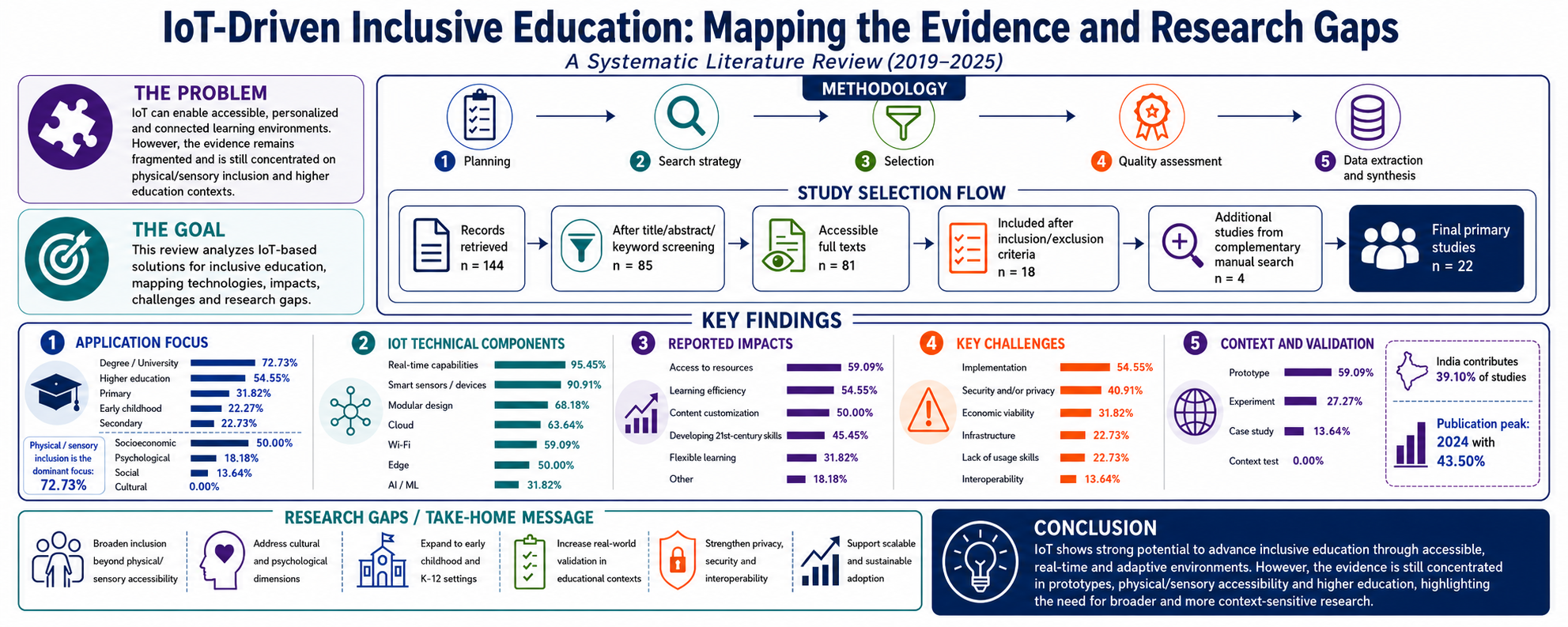
The Internet of Things (IoT) has emerged as a transformative force in education by enabling personalized and accessible learning environments. These environments are particularly effective in addressing students’ functional and cognitive diversity, thereby advancing the goals of inclusive education. Although scholarly interest in educational IoT has increased, a cohesive understanding of its role in fostering inclusion remains fragmented. This study presents a Systematic Literature Review (SLR) of publications from 2019 to 2025, providing a comprehensive analysis of IoT applications, benefits, and challenges in inclusive education. The review maps existing technological solutions, evaluates their impact on pedagogical practices, and identifies systemic barriers to sustainable integration. The findings highlight the potential of IoT to democratize access to education, especially for students with physical disabilities, while revealing its predominant focus on higher education contexts. Finally, the study outlines critical research gaps that must be addressed to promote equitable and sustainable technology adoption.
Downloads
References
Ishteyaaq Ahmad, Sonal Sharma, Rajesh Singh, Anita Gehlot, Lovi Raj Gupta, Amit Kumar Thakur, Neeraj Priyadarshi, and Bhekisipho Twala. “Inclusive learning using industry 4.0 technologies: addressing student diversity in modern education”. In: Cogent Education 11.1 (2024), p. 2330235. DOI: 10.1080/2331186X.2024.2330235.
Igor Rodrigues. “IoT as Assistive Technology: Applications in Education as a Tool for Inclusion”. In: International Journal of Technology in Education 6 (Feb. 2023), pp. 100–112. DOI: 10.46328/ijte.357.
Stéphan Vincent-Lancrin, Cristóbal Cobo Romani, and Fernando Reimers, eds. How Learning Continued during the COVID-19 Pandemic: Global Lessons from Initiatives to Support Learners and Teachers. Paris: OECD Publishing, 2022. DOI: 10.1787/bbeca162-en.
Li Da Xu, Wu He, and Shancang Li. “Internet of Things in Industries: A Survey”. In: IEEE Transactions on Industrial Informatics 10.4 (2014), pp. 2233–2243. DOI: 10.1109/TII.2014.2300753.
Mohamed Abdel-Basset, Gunasekaran Manogaran, Mai Mohamed, and Ehab Rushdy. “Internet of things in smart education environment: Supportive framework in the decision-making process”. In: Concurrency and Computation: Practice and Experience 31.10 (2019). e4515 cpe.4515, e4515. DOI: 10.1002/cpe.4515. eprint: [https://onlinelibrary.wiley.com/doi/pdf/10.1002/cpe.4515](https://onlinelibrary.wiley.com/doi/pdf/10.1002/cpe.4515).
Ruth Nthenya Wambua. “Systematic Review of the Influence of Internet of Things (IoT) on the Education of Students with Disabilities”. In: 2023 IST-Africa Conference (IST-Africa). 2023, pp. 1–8. DOI: 10.23919/IST-Africa60249.2023.10187846.
Eddy Soeryanto Soegoto, Herman Soegoto, Dedi Sulistiyo Soegoto, Suryatno Soegoto, Agis Rafdhi, Herry Saputra, Dina Oktafiani, and Ijost Ijost. “A systematic Literature Review of Internet of Things for Higher Education: Architecture and Implementation”. In: Indonesian Journal of Science and Technology 7 (Dec. 2022), pp. 511–528. DOI: 10.17509/ijost.v7i3.51464.
Barbara Kitchenham, Stuart Charters, et al. Guidelines for performing systematic literature reviews in software engineering. Tech. rep. 2007.
Luigi Atzori, Antonio Iera, and Giacomo Morabito. “The Internet of Things: A survey”. In: Computer Networks 54.15 (2010), pp. 2787–2805. DOI: 10.1016/j.comnet.2010.05.010.
Charith Perera, Arkady Zaslavsky, Peter Christen, and Dimitrios Georgakopoulos. “Context Aware Computing for The Internet of Things: A Survey”. In: IEEE Communications Surveys Tutorials 16.1 (2014), pp. 414–454. DOI: 10.1109/SURV.2013.042313.00197.
Jeannette Chin and Vic Callaghan. “Educational Living Labs: A Novel Internet-of-Things Based Approach to Teaching and Research”. In: Proceedings of the 2013 9th International Conference on Intelligent Environments. IE ’13. USA: IEEE Computer Society, 2013, pp. 92–99. DOI: 10.1109/IE.2013.48.
Shadi Abou-Zahra, Judy Brewer, and Michael Cooper. “Web Standards to Enable an Accessible and Inclusive Internet of Things (IoT)”. In: Proceedings of the 14th International Web for All Conference. W4A ’17. Perth, Western Australia, Australia: Association for Computing Machinery, 2017. DOI: 10.1145/3058555.3058568.
Scott Hollier and Shadi Abou-Zahra. “Internet of Things (IoT) as Assistive Technology: Potential Applications in Tertiary Education”. In: Proceedings of the 15th International Web for All Conference. W4A ’18. Lyon, France: Association for Computing Machinery, 2018. DOI: 10.1145/3192714.3192828.
Simone Cirani, Gianluigi Ferrari, Marco Picone, and Luca Veltri. Internet of Things: Architectures, Protocols and Standards. Hoboken, NJ: Wiley, 2018.
Jie Ding, Mahyar Nemati, Chathurika Ranaweera, and Jinho Choi. “IoT Connectivity Technologies and Applications: A Survey”. In: IEEE Access 8 (2020), pp. 67646–67673. DOI: 10.1109/ACCESS.2020.2985932.
Ashkan Yousefpour, Caleb Fung, Tam Nguyen, Krishna Kadiyala, Fatemeh Jalali, Amirreza Niakanlahiji, Jian Kong, and Jason P. Jue. “All one needs to know about fog computing and related edge computing paradigms: A complete survey”. In: Journal of Systems Architecture 98 (2019), pp. 289–330. DOI: 10.1016/j.sysarc.2019.02.009.
Gartner. Market Guide for IoT Integration. Market Guide. Gartner, Oct. 2017.
R. Parasuraman, T.B. Sheridan, and C.D. Wickens. “A model for types and levels of human interaction with automation”. In: IEEE Transactions on Systems, Man, and Cybernetics - Part A: Systems and Humans 30.3 (2000), pp. 286–297. DOI: 10.1109/3468.844354.
Khaula Zeeshan, Timo Hämäläinen, and Pekka Neittaanmäki. “Internet of Things for Sustainable Smart Education: An Overview”. In: Sustainability 14 (Apr. 2022), p. 4293. DOI: 10.3390/su14074293.
Wael Issa, Nour Moustafa, Benjamin Turnbull, Nasrin Sohrabi, and Zahir Tari. “Blockchain-Based Federated Learning for Securing Internet of Things: A Comprehensive Survey”. In: ACM Comput. Surv. 55.9 (Jan. 2023). DOI: 10.1145/3560816.
Yanan Li, Congcong Li, Yijin Wang, and Guifa Teng. “Design and development of immersive 3D virtual simulation experiment teaching platform for internet of things”. In: Multimedia Tools and Applications 84 (Oct. 2024). DOI: 10.1007/s11042-024-20209-8.
Lulu Han, Xinliang Long, and Kunli Wang. “The analysis of educational informatization management learning model under the internet of things and artificial intelligence”. In: Scientific Reports 14 (Aug. 2024). DOI: 10.1038/s41598-024-68963-x.
John Bush Idoko and Rahib Abiyev, eds. Machine Learning and the Internet of Things in Education: Models and Applications. 1st ed. Studies in Computational Intelligence. Switzerland: Springer Cham, 2023. DOI: 10.1007/978-3-031-42924-8.
Awf Alhalaybeh, Ahmad A.A. Alkhatib, Rand N. AlbustanjI, Shorouq Elmanaseer, Tarek Kanan, and Rashed Alsakarnah. “Facilitating Metaverse Integration in Education via Extended Reality and the Internet of Things: AN OVERVIEW”. In: 2023 International Conference on Information Technology (ICIT). 2023, pp. 38–42. DOI: 10.1109/ICIT58056.2023.10226029.
Sura I. Mohammed Ali and Marwah Nihad. “Internet of Things for Education Field”. In: Journal of Physics: Conference Series 1897.1 (May 2021), p. 012076. DOI: 10.1088/1742-6596/1897/1/012076.
Panagiotis Gkotsiopoulos, Eleni Seralidou, and Christos Douligeris. “Augmented Reality and Internet of Things Trends in Education”. In: 2022 7th South-East Europe Design Automation, Computer Engineering, Computer Networks and Social Media Conference (SEEDA-CECNSM). 2022, pp. 1–7. DOI: 10.1109/SEEDA-CECNSM57760.2022.9932914.
Scott Hollier and Shadi Abou-Zahra. “Internet of Things (IoT) as Assistive Technology: Potential Applications in Tertiary Education”. In: Proceedings of the 15th International Web for All Conference. W4A ’18. Lyon, France: Association for Computing Machinery, 2018. DOI: 10.1145/3192714.3192828.
Malti Bansal and Samarth Garg. “Internet of Things (IoT) based Assistive Devices”. In: 2021 6th International Conference on Inventive Computation Technologies (ICICT). 2021, pp. 1006–1009. DOI: 10.1109/ICICT50816.2021.9358662.
Louis Hickman and Mesut Akdere. “Developing intercultural competencies through virtual reality: Internet of Things applications in education and learning”. In: 2018 15th Learning and Technology Conference (LT). 2018, pp. 24–28. DOI: 10.1109/LT.2018.8368506.
Jing He, Dan Chia-Tien Lo, Ying Xie, and Jonathan Lartigue. “Integrating Internet of Things (IoT) into STEM undergraduate education: Case study of a modern technology infused courseware for embedded system course”. In: 2016 IEEE Frontiers in Education Conference (FIE). 2016, pp. 1–9. DOI: 10.1109/FIE.2016.7757458.
Lorena Salazar, UNESCO Office Quito, Regional Bureau for Communication, Information in Latin America, and the Caribbean. Guía pedagógica para la aplicación del proceso de aprestamiento en el aula. Tech. rep. ED/2021/PI/1. Licencia CC BY-SA 3.0 IGO. Quito, Ecuador: UNESCO Office Quito, 2021.
Isa Abdullahi. “State of Physical Facilities of Higher Education Institutions in Nigeria”. In: International Journal of Scientific and Research Publication 5 (Apr. 2015), pp. 1–5.
UNESCO Institute for Statistics. International Standard Classification of Education: ISCED 2011. Statistical Framework. Montreal, Canada: UNESCO Institute for Statistics, 2012.
Karen Pilar Quijije-Quiroz, Edgar Alfredo Poggi-Cedeño, Stefany Ximena Palma-Zambrano, and Yanna Hohana Alcívar-Muñoz. “Impacto de la tecnología en la inclusión educativa: Un estudio en estudiantes de educación superior”. In: Revista Científica Multidisciplinaria HEXACIENCIAS 5.9 (Jan. 2025), pp. 395–413.
I. H. Khan, Mohd. I. Khan, and S. Khan. “Challenges of IoT Implementation in Smart City Development”. In: Lecture Notes in Civil Engineering. Springer, 2020, pp. 475–486. DOI: 10.1007/978-981-15-2545-2_40.
E. Metreau, K. E. Young, and S. G. Eapen. World Bank Country Classifications by Income Level for 2024–2025. World Bank Blogs. World Bank, July 2024. [https://blogs.worldbank.org/en/opendata/world-bank-country-classifications-by-income-level-for-2024-2025](https://blogs.worldbank.org/en/opendata/world-bank-country-classifications-by-income-level-for-2024-2025).
Susan P. Choy. Public and Private Schools: How Do They Differ? Tech. rep. NCES 97983. Washington, DC: U.S. Department of Education, National Center for Education Statistics, 1997.
Mario G. Piattini. Métodos de investigación en ingeniería del software. Colección Profesional. España: Rama Editorial, Sept. 2014, p. 314.
Aoibheann Sims, Zain Ali, and Kevin Meehan. “Exploring the Efficacy of an IoT Device as a Sensory Feedback Tool in Facilitating Learning for Neurodivergent Students”. In: 2023 IEEE World AI IoT Congress (AIIoT). 2023, pp. 0755–0761. DOI: 10.1109/AIIoT58121.2023.10174325.
Luc Nijs and Luca Turchet. “Internet of Musical Things for Children”. In: Sept. 2024, pp. 1–9. DOI: 10.1109/IS262782.2024.10704214.
Sachin K, Santhosh KMR, Srinivas Karthik D, Vaseekaran M, Felicia Lilian J, and Suganthi P. “I-PWA: IoT based Progressive Web Application For Visually Impaired People”. In: 2023 3rd International Conference on Innovative Practices in Technology and Management (ICIPTM). Feb. 2023, pp. 1–6. DOI: 10.1109/ICIPTM57143.2023.10117909.
Novian Anggis Suwastika, Paulus Berliz Sitohang, Rahmat Yasirandi, Maslin Masrom, and Qori Qonita. “Body-part Identification Learning for Preschool Children Using Internet of Things”. In: 2023 International Conference on Advancement in Data Science, E-learning and Information System (ICADEIS). 2023, pp. 1–6. DOI: 10.1109/ICADEIS58666.2023.10271068.
Aarthy S.T., Raveendra N. Amarnath, B. Gopi, R. Selvakumar, E.N. Ganesh, and S. Sujatha. “IoT-Embedded Smart Clothing with CNN for Improved Spatial Awareness in the Visually Impaired”. In: 2024 Second International Conference on Intelligent Cyber Physical Systems and Internet of Things (ICoICI). 2024, pp. 449–454. DOI: 10.1109/ICoICI62503.2024.10696649.
Chevella Anil Kumar, V. Sagar Reddy, Nainika Kandarpa, and Pallavi Sharma. “Smart IoT System for Indian Sign Language Translator”. In: 2024 Second International Conference on Intelligent Cyber Physical Systems and Internet of Things (ICoICI). 2024, pp. 254–258. DOI: 10.1109/ICoICI62503.2024.10696760.
Senthil G. A, Geerthik S, Kirthika K, and Sathyan H. “IoT Based Smart Educational Tool to Support Literacy Acquisition for Dyslexic and Autistic Children”. In: 2024 Second International Conference on Intelligent Cyber Physical Systems and Internet of Things (ICoICI). 2024, pp. 248–253. DOI: 10.1109/ICoICI62503.2024.10696212.
Sudha Arvind, C.H. Gayatri, G. Aravind Kumar, Rama Krishna, and Swapna. “Sign Language Conversion into Text and Speech using Flex Sensors”. In: 2024 International Conference on Intelligent Algorithms for Computational Intelligence Systems (IACIS). 2024, pp. 1–6. DOI: 10.1109/IACIS61494.2024.10721869.
A. Awouda, E. Traini, M. Asranov, et al. “Bloom’s IoT Taxonomy towards an Effective Industry 4.0 Education: Case Study on Open-Source IoT Laboratory”. In: Education and Information Technologies 29 (Aug. 2024), pp. 15043–15065. DOI: 10.1007/s10639-024-12468-7.
N. R. Kadham, P. G. Krishna, and K. S. Ravi. “IoT-Based Remote Monitoring as a Distance (Online) Laboratory for Applied Learning”. In: SN Computer Science 6 (2025), p. 114. DOI: 10.1007/s42979-024-03649-9.
Q. Li, P. Kumar, and M. Alazab. “IoT-assisted Physical Education Training Network Virtualization and Resource Management Using a Deep Reinforcement Learning System”. In: Complex & Intelligent Systems 8 (Apr. 2022), pp. 1229–1242. DOI: 10.1007/s40747-021-00584-7.
P. Wang. “A Fog-Assisted Transport System for Persons with Disabilities Using Wearable Networks”. In: Soft Computing 28 (Jan. 2024), pp. 829–845. DOI: 10.1007/s00500-023-09405-0.
Anshu Anshu. “Leveraging Internet of Things (IoT) to Enhance Accessibility and Independence for People with Disabilities”. In: LatIA 3 (Jan. 2025), p. 114. DOI: 10.62486/latia2025114.
Norzaila Nor, Shifa Zubir, and Muhammad Shahrudin. “Leveraging IoT to Enhance Real-Time Lecturer Accessibility in Higher Education”. In: International Journal of Academic Research in Business and Social Sciences 14 (Oct. 2024). DOI: 10.6007/IJARBSS/v14-i10/22959.
N. Tarek, M. A. Mandour, N. El-Madah, R. Ali, S. Yahia, B. Mohamed, D. Mostafa, and S. El-Metwally. “Morse Glasses: An IoT Communication System Based on Morse Code for Users with Speech Impairments”. In: Computing 104.4 (Apr. 2022). Epub June 14, 2021. PMCID: PMC8202051, pp. 789–808. DOI: 10.1007/s00607-021-00959-1.
Oscar I. Ramos-García, Anuar A. Vuelvas-Alvarado, Néstor A. Osorio-Pérez, Miguel Á. Ruiz-Torres, Fermín Estrada-González, Laura S. Gaytan-Lugo, Silvia B. Fajardo-Flores, and Pedro C. Santana-Mancilla. “An IoT Braille Display towards Assisting Visually Impaired Students in Mexico”. In: Engineering Proceedings 27.1 (2022), p. 11. DOI: 10.3390/ecsa-9-13194.
F. G. Xue and M. Caesar. “Towards Immersive Cloud-Based IoT Education”. In: ACM SIGCOMM Computer Communication Review 54.3 (July 2024), pp. 10–17. DOI: 10.1145/3711992.3711995.
Baoling Gao and Zhijuan Zhan. “Applications and Challenges of IoT and Cloud Computing in Distance Education”. In: Proceedings of the 2024 2nd International Conference on Internet of Things and Cloud Computing Technology. IoTCCT ’24. Association for Computing Machinery, 2024, pp. 99–107. DOI: 10.1145/3702879.3702897.
Abhishek Kumar, Abdul Khader Jilani Saudagar, and Muhammad Badruddin Khan. “Enhanced Medical Education for Physically Disabled People through Integration of IoT and Digital Twin Technologies”. In: Systems 12.9 (Aug. 2024), p. 325. DOI: 10.3390/systems12090325.
Adnan Adil, Noaman Mohammad Noaman, Zeyad Ismail, and Rajkumar Palaniappan. “Design and Implementation of Telepresence Robot”. In: 2023 IEEE 8th International Conference on Engineering Technologies and Applied Sciences (ICETAS). IEEE, 2023, pp. 1–7. DOI: 10.1109/ICETAS59148.2023.10346592.
Yassen Gorbounov and Hao Chen. “Low-Cost Remote Laboratory for Cyber-Physical Experiments”. In: 2021 29th National Conference with International Participation (TELECOM). 2021, pp. 149–152. DOI: 10.1109/TELECOM53156.2021.9659620.
Eshant Chandak, Mahesh Kothalkar, Pranali Raghatwan, and Y. Srinivasa Rao. “IoT-Based Smart Learning Management System on Cloud”. In: 2024 3rd International Conference for Innovation in Technology (INOCON). 2024, pp. 1–4. DOI: 10.1109/INOCON60754.2024.10511451.