Ontologies in Hearing Impairment
Structural Analysis and Perspectives on Semantic Interoperability
Keywords:
Hearing Health, Interoperability, OntologyAbstract
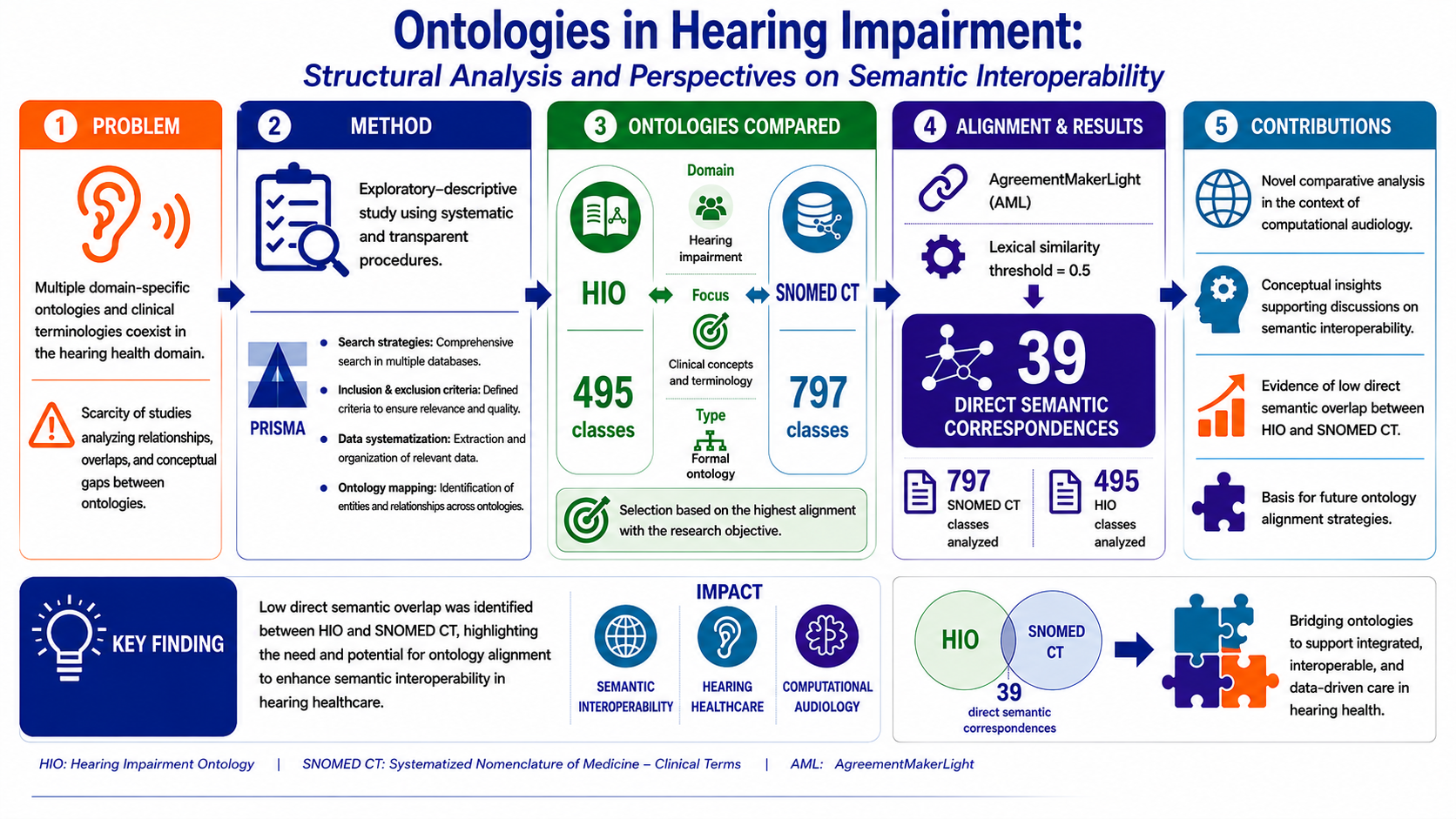
Hearing impairment requires solutions that promote semantic interoperability and clinical data integration. In this context, ontologies play a fundamental role in the formal representation and standardization of biomedical knowledge, supporting data sharing across heterogeneous health information systems. This study maps, characterizes, compares, and analyzes ontologies related to hearing impairment, aiming to identify conceptual overlaps and potential points of interoperability. An exploratory-descriptive approach was adopted, following PRISMA guidelines to identify and evaluate ontologies associated with hearing health. Based on thematic relevance and conceptual scope, the Hearing Impairment Ontology (HIO) and the Systematized Nomenclature of Medicine – Clinical Terms (SNOMED CT) were selected for comparative analysis. Ontology alignment was performed using AgreementMakerLight (AML) with a similarity threshold of 0.5. The comparison identified 39 valid correspondences among 797 classes in SNOMED CT and 495 classes in HIO, indicating a low direct semantic overlap between the ontologies. Correspondences were concentrated in established clinical concepts related to hearing loss, while differences were observed in genetic, phenotypic, and therapeutic domains. The results suggest complementarity between the ontologies and reinforce the importance of semantic alignment strategies to support interoperability among clinical and biomedical data in hearing healthcare and computational audiology.Downloads
References
REFERENCES
Instituto Brasileiro de Geografia e Estatística (IBGE), “Pessoas com deficiência auditiva, por sexo e situação do domicílio,” 2019. [Online]. Available: https://sidra.ibge.gov.br/tabela/8217
J. W. A. Wasmann, C. P. Lanting, W. J. Huinck, E. A. M. Mylanus, J. W. M. van der Laak, P. J. Govaerts, D. W. Swanepoel, D. R. Moore and D. L. Barbour, “Computational Audiology: New Approaches to Advance Hearing Health Care in the Digital Age,” Ear Hear., vol. 42, no. 6, pp. 1499–1507, 2021, doi: 10.1097/AUD.0000000000001041.
C. Bouton et al., “Ontologies in biomedical sciences and healthcare: a review,” Yearb. Med. Inform., vol. 30, no. 1, pp. 237–247, 2021, doi: 10.1055/s-0041-1726481.
D. W. Swanepoel and J. L. Clark, “Hearing healthcare in remote or resource-constrained environments,” J. Am. Acad. Audiol., vol. 30, no. 7, pp. 578–584, 2019, doi: 10.3766/jaaa.17064.
M. Lewis, W.-T. Yih, T. Rocktäschel, S. Riedel, and D. Kiela, "Retrieval-augmented generation for knowledge-intensive NLP tasks," in Proc. 34th Conf. Neural Inf. Process. Syst. (NeurIPS), Vancouver, Canada, 2020. [Online]. Available: https://proceedings.neurips.cc/paper/2020/file/6b493230205f780e1bc26945df7481e5-Paper.pdf
W. Ceusters, A. Michelotti, K. G. Raphael, J. Durham, and R. Ohrbach, “Perspectives on next steps in classification of oro-facial pain – part 1: role of ontology,” J. Oral Rehabil., vol. 42, no. 12, pp. 926–940, Dec. 2015, doi: 10.1111/joor.12340.
D. R. Moore, “Computational audiology: Big data and machine learning in hearing health care,” Front. Digit. Health, vol. 4, Art. no. 841735, 2022, doi: 10.3389/fdgth.2022.841735.
D. Moher et al., “Preferred reporting items for systematic reviews and meta-analyses: the PRISMA statement,” PLoS Med., vol. 6, no. 7, Art. no. e1000097, 2009, doi: 10.1371/journal.pmed.1000097.
G. K. Mazandu, N. Manyisa, S. M. Adadey, and A. Wonkam, “Ontology of Deafness and Related Auditory Disorders (ODRAH): Integrating clinical and genetic knowledge of hearing loss,” Genes, vol. 11, Art. no. 1456, 2020, doi: 10.3390/genes11121456.
W. Ceusters, “Axiomatizing SNOMED CT disorders: Should there be a ‘Common Disease Ontology’?” Appl. Ontol., vol. 18, no. 2, pp. 157–174, 2023, doi: 10.3233/AO-230018.
B. Smith and W. Ceusters, “Ontology as the core discipline of biomedical informatics,” J. Biomed. Inform., vol. 43, no. 5, pp. 786–791, 2010, doi: 10.1016/j.jbi.2010.07.003.
J. Hotchkiss et al., “The Hearing Impairment Ontology: A tool for unifying hearing impairment knowledge to enhance collaborative research,” Genes, vol. 10, Art. no. 960, 2019, doi: 10.3390/genes10120960.
R. Cornet and N. de Keizer, “Forty years of SNOMED: A literature review,” BMC Med. Inform. Decis. Mak., vol. 8, suppl. 1, Art. no. S2, 2008, doi: 10.1186/1472-6947-8-S1-S2.
D. Lee, R. Cornet, and N. de Keizer, “Literature review of SNOMED CT use,” J. Am. Med. Inform. Assoc., vol. 21, suppl. 1, pp. e11–e19, 2014, doi: 10.1136/amiajnl-2013-001636.
E. Chang and J. Mostafa, “The use of SNOMED CT, 2013–2020: A literature review,” J. Am. Med. Inform. Assoc., vol. 28, no. 9, pp. 2017–2027, 2021, doi: 10.1093/jamia/ocab084.
SNOMED International, SNOMED CT International Release 2024-09, London, U.K.: SNOMED International, 2024. [Online]. Available: https://www.snomed.org/snomed-ct/releases/international-release.
W. R. Hogan, “Aligning the top level of SNOMED CT with Basic Formal Ontology,” Nature Precedings, 2008, doi: 10.1038/npre.2008.2373.1. [Online]. Available: https://www.nature.com/articles/npre.2008.2373.1
D. Faria et al., “AgreementMakerLight,” Semantic Web, IOS Press, 2025, doi: 10.3233/SW-233304.
D. Faria et al., “Automatic background knowledge selection for matching biomedical ontologies,” PLoS One, vol. 9, no. 11, Art. no. e111226, 2014, doi: 10.1371/journal.pone.0111226.
E. Santos et al., “Ontology alignment repair through modularization and confidence-based heuristics,” PLoS One, vol. 10, no. 12, Art. no. e0144807, 2015, doi: 10.1371/journal.pone.0144807.
D. Faria et al., “Tackling the challenges of matching biomedical ontologies,” J. Biomed. Semantics, vol. 9, Art. no. 1, 2018, doi: 10.1186/s13326-017-0170-9.
P. Shvaiko and J. Euzenat, “Ontology matching: State of the art and future challenges,” IEEE Trans. Knowl. Data Eng., vol. 25, no. 1, pp. 158–176, 2013, doi: 10.1109/TKDE.2011.253.
P. Grenon and B. Smith, “SNAP and SPAN: Towards dynamic spatial ontology,” Spatial Cogn. Comput., vol. 4, no. 1, pp. 69–104, 2004, doi: 10.1207/s15427633scc0401_5.
B. Smith et al., “The OBO Foundry: Coordinated evolution of ontologies to support biomedical data integration,” Nat. Biotechnol., vol. 25, no. 11, pp. 1251–1255, Nov. 2007, doi: 10.1038/nbt1346.
C. Bouton et al., “FHIR RDF: Semantic integration of health data using linked data standards,” J. Biomed. Inform., vol. 128, Art. no. 104072, 2022, doi: 10.1016/j.jbi.2022.104072.