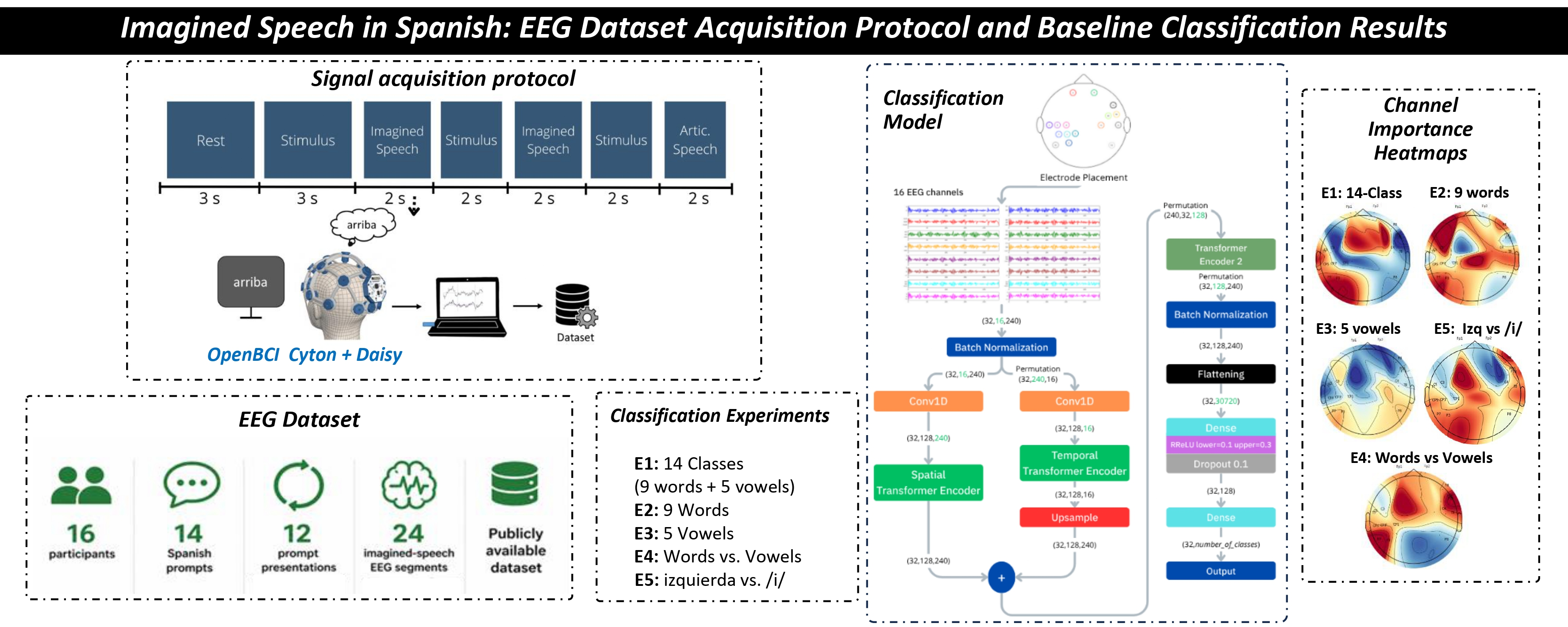
Imagined Speech in Spanish: EEG Dataset Acquisition Protocol and Baseline Classification Results
Keywords:
Imagined speech, EEG dataset, brain–computer interface (BCI), low-cost hardware, neural signal classificationAbstract
This work presents a new Spanish-language electroencephalography (EEG) dataset for imagined speech, designed to support research in brain–computer interface (BCI) applications for assistive communication. A structured experimental protocol was developed to guide the acquisition process, incorporating auditory comprehension, imagined speech, and articulated speech production stages to enhance cognitive engagement and enable signal validation. The dataset includes 16 participants (9 male and 7 female), each performing 14 linguistic prompts consisting of nine words and five vowels. EEG signals were recorded using an open-source, low-cost acquisition system (OpenBCI Cyton + Daisy) with 16 channels configured according to the international 10–20 system. The collected signals were preprocessed, segmented, and evaluated through a deep learning classification framework adapted from recent imagined speech decoding approaches. Five classification experiments were conducted to assess the discriminability of the imagined speech signals. The results showed accuracies above the chance level across all experiments, achieving 30.79% ± 4.76 for vowel classification, 20.81% ± 3.11 for word classification, and up to 74.61% ± 7.11 for binary word–vowel discrimination. Comparisons with public datasets demonstrated that the proposed dataset achieves competitive or superior performance despite using low-cost hardware. The code used in this work is available at https://github.com/GracielaRamirezA/Imagined-Speech-in-Spanish.git.
Downloads
References
J. L. Freeburn and J. Baker, “Functional speech and voice disorders: Approaches to diagnosis and treatment,” Neurologic Clinics, vol. 41, no. 4, pp. 635–646, 2023, https://doi.org/10.1016/j.ncl.2023.02.005
N. M. Sharma, V. Kumar, P. K. Mahapatra, and V. Gandhi, “Comparative analysis of various feature extraction techniques for classification of speech disfluencies,” Speech Communication, vol. 150, pp. 23–31, 2023, https://doi.org/10.1016/j.specom.2023.04.003
G. Hickok and D. Poeppel, “Dorsal and ventral streams: a framework for understanding aspects of the functional anatomy of language,” Cognition, vol. 92, no. 1, pp. 67–99, 2004, https://doi.org/10.1016/j.cognition.2003.10.011
W. A. Awuah, A. Ahluwalia, K. Darko, V. Sanker, J. K. Tan, P. O. Tenkorang, A. Ben-Jaafar, S. Ranganathan, N. Aderinto, A. Mehta, M. H. Shah, K. Lee Boon Chun, T. Abdul-Rahman, and O. Atallah, “Bridging minds and machines: The recent advances of brain-computer interfaces in neurological and neurosurgical applications,” World Neurosurgery, vol. 189, pp. 138–153, 2024, https://doi.org/10.1016/j.wneu.2024.05.104
S. T. Engelter, M. Gostynski, S. Papa, M. Frei, C. Born, V. Ajdacic-Gross, F. Gutzwiller, and P. A. Lyrer, “Epidemiology of aphasia attributable to first ischemic stroke,” Stroke, vol. 37, no. 6, pp. 1379–1384, 2006, https://doi.org/10.1161/01.STR.0000221815.64093.8c
G.-J. Rutten, “Chapter 2 - broca-wernicke theories: A historical perspective,” in Aphasia, ser. Handbook of Clinical Neurology, A. E. Hillis and J. Fridriksson, Eds. Elsevier, 2022, vol. 185, pp. 25–34, https://doi.org/10.1016/B978-0-12-823384-9.00001-3
A. B. Acharya and S. C. Dulebohn, “Broca aphasia,” StatPearls, 5 2022, https://www.ncbi.nlm.nih.gov/books/NBK436010/
F. Lui and M. Wroten, “Wernicke aphasia,” StatPearls, 11 2025, https://www.ncbi.nlm.nih.gov/books/NBK441951/
M. Purdy, “Aphasia, alexia, and agraphia,” in Encyclopedia of Mental Health (Second Edition), second edition ed., H. S. Friedman, Ed. Oxford: Academic Press, 2016, pp. 81–90, https://doi.org/10.1016/B978-0-12-397045-9.00056-2
J. S. Garcia-Salinas, A. A. Torres-Garcia, C. A. Reyes-Garcia, and L. Villaseñor-Pineda, “Intra-subject class-incremental deep learning approach for EEG-based imagined speech recognition,” Biomedical Signal Processing and Control, vol. 81, p. 104433, 2023, https://doi.org/10.1016/j.bspc.2022.104433
M. Nouri, F. Moradi, H. Ghaemi, and A. Motie Nasrabadi, “Towards real-world BCI: CCSPNet, a compact subject-independent motor imagery framework,” Digital Signal Processing, vol. 133, p. 103816, 2023, https://doi.org/10.1016/j.dsp.2022.103816
L. Farwell and E. Donchin, “Talking off the top of your head: toward a mental prosthesis utilizing event-related brain potentials,” Electroencephalography and Clinical Neurophysiology, vol. 70, no. 6, pp. 510–523, 1988, https://doi.org/10.1016/0013-4694(88)90149-6
S. Kumar, K. Mamun, and A. Sharma, “CSP-TSM: Optimizing the performance of riemannian tangent space mapping using common spatial pattern for MI-BCI,” Computers in Biology and Medicine, vol. 91, pp.231–242, 2017, https://doi.org/10.1016/j.compbiomed.2017.10.025
A. A. Torres-García, C. A. Reyes-García, and L. Villaseñor-Pineda, “Chapter 12 - a survey on EEG-based imagined speech classification,” in Biosignal Processing and Classification Using Computational Learning and Intelligence, A. A. Torres-García, C. A. Reyes-García, L. Villaseñor-Pineda, and O. Mendoza-Montoya, Eds. Academic Press, 2022, pp. 251–270, https://doi.org/10.1016/B978-0-12-820125-1.00025-7
B. Blankertz, K.-R. Muller, D. Krusienski, G. Schalk, J. Wolpaw, A. Schlogl, G. Pfurtscheller, J. Millan, M. Schroder, and N. Birbaumer, “The BCI competition III: validating alternative approaches to actual BCI problems,” IEEE Transactions on Neural Systems and Rehabilitation Engineering, vol. 14, no. 2, pp. 153–159, 2006, https://doi.org/10.1109/TNSRE.2006.875642
M. Tangermann, K.-R. Muller, A. Aertsen, N. Birbaumer, C. Braun, C. Brunner, R. Leeb, C. Mehring, K. Miller, G. Mueller-Putz, G. Nolte, G. Pfurtscheller, H. Preissl, G. Schalk, A. Schlogl, C. Vidaurre, S. Waldert, and B. Blankertz, “Review of the BCI competition IV,” Frontiers in Neuroscience, vol. 6, 2012, https://doi.org/10.3389/fnins.2012.00055
S. L. Metzger, K. T. Littlejohn, A. B. Silva, D. A. Moses, M. P. Seaton, R. Wang, M. E. Dougherty, J. R. Liu, P. Wu, M. A. Berger et al., “A high-performance neuroprosthesis for speech decoding and avatar control,” Nature, vol. 620, no. 7976, pp. 1037–1046, 2023, https://doi.org/10.1038/s41586-023-06443-4
C. S. DaSalla, H. Kambara, M. Sato, and Y. Koike, “Single-trial classification of vowel speech imagery using common spatial patterns,” Neural Networks, vol. 22, no. 9, pp. 1334–1339, 2009, https://doi.org/10.1016/j.neunet.2009.05.008
C. H. Nguyen, G. K. Karavas, and P. Artemiadis, “Inferring imagined speech using EEG signals: a new approach using Riemannian manifold features,” Journal of Neural Engineering, vol. 15, no. 1, p. 016002, 12 2017, https://doi.org/10.1088/1741-2552/AA8235
S. Deng, R. Srinivasan, T. Lappas, and M. D’Zmura, “EEG classification of imagined syllable rhythm using hilbert spectrum methods,” Journal of Neural Engineering, vol. 7, no. 4, p. 046006, jun 2010, https://doi.org/10.1088/1741-2560/7/4/046006
P. Suppes, Z. L. Lu, and B. Han, “Brain wave recognition of words,” Proceedings of the National Academy of Sciences, vol. 94, no. 26, pp. 14 965–14 969, 1997, https://doi.org/10.1073/PNAS.94.26.14965
S. Zhao and F. Rudzicz, “Classifying phonological categories in imagined and articulated speech,” in 2015 IEEE International Conference on Acoustics, Speech and Signal Processing (ICASSP), 2015, pp. 992–996, https://doi.org/10.1109/ICASSP.2015.7178118
B. Dekker, A. C. Schouten, and O. Scharenborg, “DAIS: The delft database of EEG recordings of dutch articulated and imagined speech,” in 2023 IEEE International Conference on Acoustics, Speech and Signal Processing (ICASSP), 2023, pp. 1–5, https://doi.org/10.1109/ICASSP49357.2023.10096145
N. Nieto, V. Peterson, H. L. Rufiner, J. E. Kamienkowski, and R. Spies, “Thinking out loud, an open-access EEG-based BCI dataset for inner speech recognition,” Scientific Data, vol. 9, no. 1, pp. 1–17, feb 2022, https://doi.org/10.1038/s41597-022-01147-2
G. A. P. Coretto, I. E. Gareis, and H. L. Rufiner, “Open access database of EEG signals recorded during imagined speech,” in 12th International Symposium on Medical Information Processing and Analysis, vol. 10160. SPIE, 2017, p. 1016002, https://doi.org/10.1117/12.2255697
J.-H. Jeong, J.-H. Cho, Y.-E. Lee, S.-H. Lee, G.-H. Shin, Y.-S. Kweon, J. d. R. Mill´an, K.-R. M¨uller, and S.-W. Lee, “2020 international brain–computer interface competition: A review,” Frontiers in Human Neuroscience, vol. 16, 2022, https://doi.org/10.3389/fnhum.2022.898300
Python Software Foundation, “Python 3.11 documentation,” https://docs.python.org/3.11/ , 2024, accessed: Jul. 2026.
Riverbank Computing, “PyQt5 Reference Guide,” https://pypi.org/project/PyQt5/ , 2024, accessed: Jul. 2026.
C. M. Kollod, A. Adolf, K. Iván, G. Márton, and I. Ulbert, “Deep comparisons of neural networks from the EEGNet family,” Electronics, vol. 12, no. 12, 2023, https://www.mdpi.com/2079-9292/12/12/2743
A. Hernandez-Galvan, G. Ramirez-Alonso, J. Camarillo-Cisneros, G. Samano-Lira, and J. Ramirez-Quintana, “Imagined Speech Recognition in a Subject Independent Approach Using a Prototypical Network,” in XLV Mexican Conference on Biomedical Engineering, C. J. Trujillo-Romero, R. Gonzalez-Landaeta, C. Chapa-González, G. Dorantes-Méndez, D.-L. Flores, J. J. A. F. Cuautle, M. R. Ortiz-Posadas, R. A. S. Ruiz, and E. Zuñiga-Aguilar, Eds. Cham: Springer International Publishing, 2023, pp. 37–45, https://doi.org/10.1007/978-3-031-18256-3_4
I. Gallo and S. Corchs, “Thinking is like processing a sequence of spatial and temporal words,” in 2024 International Joint Conference on Neural Networks (IJCNN), 2024, pp. 1–8, https://doi.org/10.1109/IJCNN60899.2024.10650922
M. T. Knierim, M. G. Bleichner, and P. Reali, “A systematic comparison of high-end and low-cost EEG amplifiers for concealed, around-the-ear EEG recordings,” Sensors, vol. 23, no. 9, 2023, https://doi.org/10.3390/s23094559
V. Peterson, C. Galv´an, H. Hern´andez, and R. Spies, “A feasibility study of a complete low-cost consumer-grade brain-computer interface system,” Heliyon, vol. 6, no. 3, 2020, https://doi.org/10.1016/j.heliyon.2020.e03425
Z. Jin, D. Li, and S. Huang, “A systematic review of EEG-basedImagined Speech decoding,” Applied Soft Computing, vol. 183, p. 113563, 2025, https://doi.org/10.1016/j.asoc.2025.113563