Optimized implementation methodology for HIL FPGA simulations for power converters
Keywords:
Power Converter, FPGA, HIL, LabView, SimulationAbstract
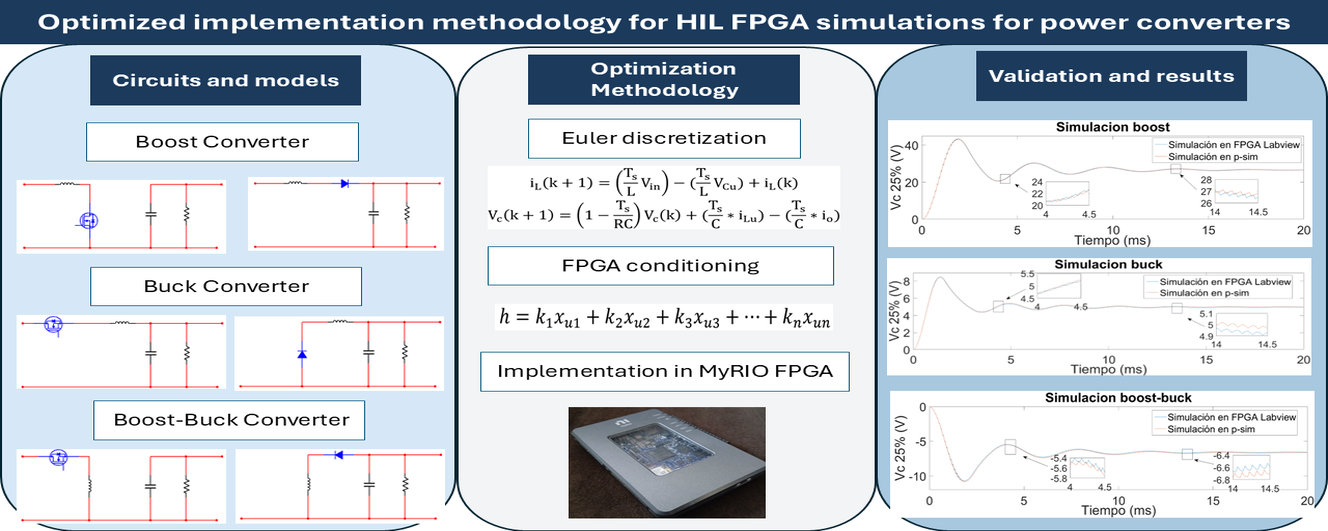
The growing complexity of power electronic systems demands simulation methods capable of high computational speed and accuracy. Traditional software‑based simulations exhibit long execution times and limited ability to reproduce critical operating conditions, while hardware experimentation may expose physical components to extreme scenarios that can compromise their integrity. This work presents an optimized methodology for modeling, discretizing, and implementing Boost, Buck, and Boost‑Buck converters on FPGA using LabVIEW. Mathematical models are derived from Kirchhoff’s laws and discretized through Euler’s method, followed by an algebraic conditioning stage that minimizes arithmetic operations and reduces clock‑cycle latency. Open‑loop tests comparing FPGA execution with PSIM simulations at 25% and 75% duty cycles demonstrate high fidelity in capacitor‑voltage and inductor‑current responses. Error growth at higher duty cycles is attributed to the UQ10.32 fixed‑point format. Overall, the proposed methodology offers an efficient and accurate alternative for real‑time‑oriented converter simulation, supporting safer and faster validation
Downloads
References
O. Bautista, FPGA implementation of a PV generator and a boost converter controller for a virtual laboratory environment. Iranian Journal of Science and Technology, Transactions of Electrical Engineering, vol. 48, no 2, pp. 533-551, 2024. https://doi.org/10.1007/s40998-024-00704-2
J. R. Camarillo-Penaranda, M. Aredes, G. Ramos, Hardware-in-the-loop testing of a distance protection relay. IEEE Transactions on Industry Applications, vol. 57, no 3, pp. 2326-2331, 2021. DOI: 10.1109/TIA.2021.3066328
L. Estrada, Real-time hardware in the loop simulation methodology for power converters using LabVIEW FPGA, Energies, vol. 13, no 2, pp. 373, 2020. https://doi.org/10.3390/en13020373
A. Frances, Modeling electronic power converters in smart DC microgrids an overview. IEEE Transactions on Smart Grid, vol. 9, no 6, pp. 6274-6287, 2017. DOI: 10.1109/TSG.2017.2707345
M. H. Cervantes, Real-time simulation of a Buck converter for educational purposes in a LabVIEW® programmed FPGA, En 2014 IEEE International Autumn Meeting on Power, Electronics and Computing (ROPEC). IEEE. pp. 1-6. 2014. DOI: 10.1109/ROPEC.2014.7036306
M. H. Cervantes, LabVIEW FPGA-programmed real-time simulation of a closed-loop DC-DC converter, En 2015 IEEE International Autumn Meeting on Power, Electronics and Computing (ROPEC). IEEE. pp. 1-6, 2015. DOI: 10.1109/ROPEC.2015.7395108
M. H. Cervantes, Real-time simulation of a Luenberger observer applied to DC-DC converters, IEEE Latin America Transactions, vol. 16, no 3, pp. 981-986, 2018. DOI: 10.1109/TLA.2018.8358682
M. H Cervantes, Design of a hardware in the loop scheme in DC-DC converters using LabVIEW FPGA, En 2020 IEEE International Autumn Meeting on Power, Electronics and Computing (ROPEC). IEEE, pp. 1-6, 2020. DOI: 10.1109/ROPEC50909.2020.9258691
O. Lucia, Real-time FPGA-based hardware-in-the-loop simulation test bench applied to multiple-output power converters. IEEE transactions on industry applications, vol. 47, no 2, pp. 853-860, 2010. doi: 10.1109/tia.2010.2102997
B. M. Hasaneen, Mohammed. Design and simulation of DC/DC boost converter. En 2008 12th International Middle East Power System Conference. IEEE, pp. 335-340. 2008. DOI: 10.1109/MEPCON.2008.4562340
F. F. Valderrama, H. Moreno, H. M. Vega, Analysis, simulation and control of a boost type DC-DC power converter. Ingenium, vol. 12, no 24, pp. 44-55. 2011. DOI: 10.21500/01247492.1295
R. Aliaga, Voltage source converter based statcom with predictive and fuzzy control. En 2016 IEEE International Conference on Automatica (ICA-ACCA). IEEE, pp. 1-7, 2016. DOI: 10.1109/ICA-ACCA.2016.7778469
R. O. Guerrero, Low cost and optimized FPGA-HIL real-time simulation of a Boost converter powered by a photovoltaic panel, IEEE Latin America Transactions, vol. 22, no 11, pp. 962-970, 2024. DOI: 10.1109/TLA.2024.10738270