A Decentralized Learning Architecture for Medical Prescription Anomaly Detection via Hybrid Federated-Swarm Learning
Keywords:
Blockchains, Decentralized applications, Federated learning, InterPlanetary File System (IPFS), Medical information systems, Smart contractsAbstract
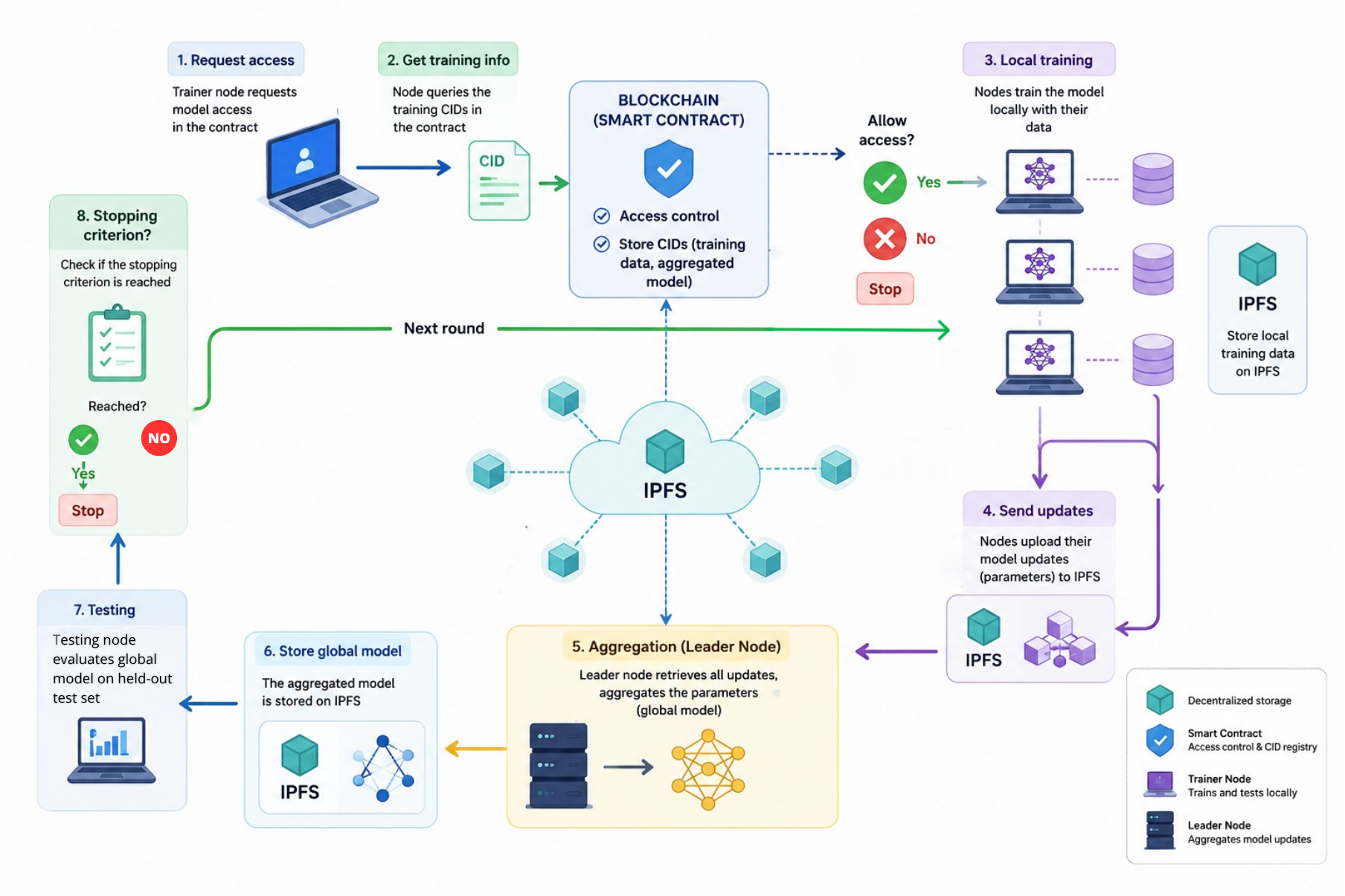
The increasing use of electronic medical records (EMRs) has improved efficiency, accuracy, and accessibility of patient data. However, conventional centralized architectures suffer from single points of failure and data privacy issues. To address these challenges, this study proposes a decentralized machine learning architecture that combines concepts from Federated Learning (FL) and Swarm Learning (SL) for anomaly detection in medical prescriptions. The proposed architecture leverages blockchain and the InterPlanetary File System (IPFS) to enable secure model sharing and decentralized storage, thereby reducing communication complexity and establishing a transparent, decentralized parameter repository. Experimental evaluations were conducted using logistic regression (LR), a multi-layer perceptron (MLP), and a decision tree (DT) model. Compared with the FL baseline, the proposed system achieved superior efficiency, lower resource consumption, and improved latency, along with smaller block sizes. It, however, exhibited slightly lower transaction throughput and longer training rounds, reflecting the added complexity of decentralization. In predictive performance on the anomaly classification task, DT achieved the highest precision and recall under the evaluated dataset (F1-score=0.9912), followed by MLP (0.5504) and LR (0.2442). The decentralized training approach led to negligible performance loss relative to centralized models, less than 4% for LR and below 1% for both MLP and DT. Overall, the proposed system demonstrates a robust and efficient alternative for decentralized learning in healthcare applications, maintaining strong predictive performance while enhancing architectural transparency.
Downloads
References
E. T. V. de Castro, G. R. Silva, and E. D. Canedo, “Ensuring privacy in the application of the brazilian general data protection law (lgpd),” in Proceedings of the 37th ACM/SIGAPP Symposium on Applied Computing, 2022, pp. 1228–1235. doi: 10.1145/3477314.3507023.
M. V. P. Prestes, D. M. S. Bonini, F. C. d. Melo, M. Bastos, J. S. Bonini, and W. C. F. N. d. Silva, “General data protection law nº 13.709/2018: notes on its context as a legal framework in brazil,” Research, Society and Development, vol. 10, no. 12, p. e568101220906, 2021. doi: 10.33448/rsd-v10i12.20906.
C. G. Granmar, “Global applicability of the gdpr in context,” International Data Privacy Law, vol. 11, no. 3, pp. 225–244, 06 2021. doi: 10.1093/idpl/ipab012.
E. Ates Bulut and A. T. ISIK, “Abuse/misuse of prescription medications in older adults,” Clinics in Geriatric Medicine, vol. 38, no. 1, pp. 85–97, 2022. doi: 10.1016/j.cger.2021.07.004.
S. Chatterjee and A. Biswas, “An assessment of legibility and rationality of prescriptions through prescription audit,” QAI Journal for Healthcare Quality and Patient Safety, vol. 5, no. 2, pp. 30–35, 2024. doi: 10.4103/QAIJ.QAIJ 14 24.
K. B. Johnson, W.-Q. Wei, D. Weeraratne, M. E. Frisse, K. Misulis, K. Rhee, J. Zhao, and J. L. Snowdon, “Precision medicine, ai, and the future of personalized health care,” Clinical and Translational Science, vol. 14, no. 1, pp. 86–93, 2021. doi: 10.1111/cts.12884.
P. Ocan, “Enhancing prescription fraud and error detection in nhs prescriptions through anomaly detection,” Reflective Professional, vol. 4, 2024. doi: 10.48525/rp-2024-id156.
A. Rashidian, H. Joudaki, and T. Vian, “No evidence of the effect of the interventions to combat health care fraud and abuse: a systematic review of literature,” PLOS ONE, vol. 7, no. 8, pp. 1–8, 08 2012. doi: 10.1371/journal.pone.0041988.
J. D. E. Caro and C. Fajardo, “Predicting shock in pediatric patients through thermal gradients and machine learning: A multi-model approach,” IEEE Latin America Transactions, vol. 24, no. 2, pp. 144–152, 2026. doi: 10.1109/TLA.2026.11369471.
A. Vidales-Esquivel, F. Ornelas-Tellez, and J. Ortiz-Bejar, “Harmonic analysis and pattern classification of electrocardiograms for heart disease diagnosis,” IEEE Latin America Transactions, vol. 24, no. 2, pp. 164–173, 2026. doi: 10.1109/TLA.2026.11369468.
J. M. Johnson and T. M. Khoshgoftaar, “Medicare fraud detection using neural networks,” Journal of Big Data, vol. 6, no. 1, pp. 1–35, 2019. doi: 10.1186/s40537-019-0225-0.
J. G. Almaraz-Rivera, “An anomaly-based detection system for monitoring kubernetes infrastructures,” IEEE Latin America Transactions, vol. 21, no. 3, pp. 457–465, 2023. doi: 10.1109/TLA.2023.10068850.
C. Zhang, X. Xiao, and C. Wu, “Medical fraud and abuse detection system based on machine learning,” International Journal of Environmental Research and Public Health, vol. 17, no. 19, p. 7265, 2020. doi: 10.3390/ijerph17197265.
S. Tanwar, K. Parekh, and R. Evans, “Blockchain-based electronic healthcare record system for healthcare 4.0 applications,” Journal of Information Security and Applications, vol. 50, p. 102407, 2020. doi: 10.1016/j.jisa.2019.102407.
R. Y. Gupta, S. S. Mudigonda, and P. K. Baruah, “A comparative study of using various machine learning and deep learning-based fraud detection models for universal health coverage schemes,” International Journal of Engineering Trends and Technology, vol. 69, no. 3, pp. 96–102, 2021. doi: 10.14445/22315381/IJETT-V69I3P216.
E. Moore, A. Imteaj, S. Rezapour, and M. H. Amini, “A survey on secure and private federated learning using blockchain: Theory and application in resource-constrained computing,” IEEE Internet of Things Journal, vol. 10, no. 24, pp. 21942–21958, 2023. doi: 10.1109/JIOT.2023.3313055.
Y. Li, C. Chen, N. Liu, H. Huang, Z. Zheng, and Q. Yan, “A blockchain-based decentralized federated learning framework with committee consensus,” IEEE Network, vol. 35, no. 1, pp. 234–241, 2020. doi: 10.1109/MNET.011.2000263.
Y. Qu, M. P. Uddin, C. Gan, Y. Xiang, L. Gao, and J. Yearwood, “Blockchain-enabled federated learning: A survey,” ACM Computing Surveys, vol. 55, no. 4, pp. 1–35, 2022. doi: 10.1145/3524104.
J. Han, Y. Han, Y. Zhang, X. Jing, and Y. Ma, “Demystifying swarm learning: An emerging decentralized federated learning system,” in 2024 IEEE 24th International Symposium on Cluster, Cloud and Internet Computing (CCGrid). IEEE, 2024, pp. 367–373. doi: 10.1109/CCGrid59990.2024.00045.
S. Warnat-Herresthal et al., “Swarm learning for decentralized and confidential clinical machine learning,” Nature, vol. 594, no. 7862, pp. 265–270, 2021. doi: 10.1038/s41586-021-03583-3.
H. A. Madni, R. M. Umer, and G. L. Foresti, “Blockchain-based swarm learning for the mitigation of gradient leakage in federated learning,” IEEE Access, vol. 11, pp. 16549–16556, 2023. doi: 10.1109/ACCESS.2023.3246126.
E. Hallaji, R. Razavi-Far, M. Saif, B. Wang, and Q. Yang, “Decentralized federated learning: A survey on security and privacy,” IEEE Transactions on Big Data, vol. 10, no. 2, pp. 194–213, 2024. doi: 10.1109/TBDATA.2024.3362191.
H. D. Dos Santos, A. H. D. Ulbrich, V. Woloszyn, and R. Vieira, “Ddc-outlier: preventing medication errors using unsupervised learning,” IEEE Journal of Biomedical and Health Informatics, vol. 23, no. 2, pp. 874–881, 2018. doi: 10.1109/JBHI.2018.2828028.
R. Kumar et al., “Blockchain-federated-learning and deep learning models for covid-19 detection using ct imaging,” IEEE Sensors Journal, vol. 21, no. 14, pp. 16301–16314, 2021. doi: 10.1109/JSEN.2021.3076767.
L. Settipalli and G. Gangadharan, “Qfbn: Quorum based federated blockchain network for healthcare system to avoid multiple benefits and data breaches,” IEEE Consumer Electronics Magazine, 2022. doi: 10.1109/MCE.2022.3188880.
M. J. Baucas, P. Spachos, and K. N. Plataniotis, “Federated learning and blockchain-enabled fog-iot platform for wearables in predictive healthcare,” IEEE Transactions on Computational Social Systems, 2023. doi: 10.1109/TCSS.2023.3235950.
G. A. Zutião, “Detecção de anomalias em prescrições médicas com aprendizagem federada e gerenciamento de armazenamento em blockchain,” Master’s Thesis in Computer Science and Computational Mathematics, Instituto de Ciências Matemáticas e de Computação, Universidade de São Paulo, São Carlos, 2023. doi: 10.11606/D.55.2023.tde-19122023-122357.
O. L. Saldanha et al., “Direct prediction of genetic aberrations from pathology images in gastric cancer with swarm learning,” Gastric Cancer, vol. 26, no. 2, pp. 264–274, 2023. doi: 10.1007/s10120-022-01347-0.
J. Jayabalan and N. Jeyanthi, “Scalable blockchain model using off-chain ipfs storage for healthcare data security and privacy,” Journal of Parallel and Distributed Computing, vol. 164, pp. 152–167, 2022. doi: 10.1016/j.jpdc.2022.03.009.
C. Fan, C. Lin, H. Khazaei, and P. Musilek, “Performance analysis of hyperledger besu in private blockchain,” in 2022 IEEE International Conference on Decentralized Applications and Infrastructures (DAPPS), 2022, pp. 64–73. doi: 10.1109/DAPPS55202.2022.00016.
T. Akiba, S. Sano, T. Yanase, T. Ohta, and M. Koyama, “Optuna: A next-generation hyperparameter optimization framework,” in Proceedings of the 25th ACM SIGKDD International Conference on Knowledge Discovery & Data Mining, 2019, pp. 2623–2631. doi: 10.1145/3292500.3330701.
H. Luo, X. Pan, Q. Wang, S. Ye, and Y. Qian, “Logistic regression and random forest for effective imbalanced classification,” in 2019 IEEE 43rd Annual Computer Software and Applications Conference (COMPSAC), vol. 1. IEEE, 2019, pp. 916–917. doi: 10.1109/COMPSAC.2019.00139.