Denoising of EEG Signals in Brain–Computer Interfaces Using Extended Kalman-Filtered Recurrent High-Order Neural Networks
Denoising of EEG Signals in Brain–Computer Interfaces
Keywords:
Electroencephalography, brain–computer interface, Recurrent High Order Neural Network, EKF, real-time signal processing, noise reductionAbstract
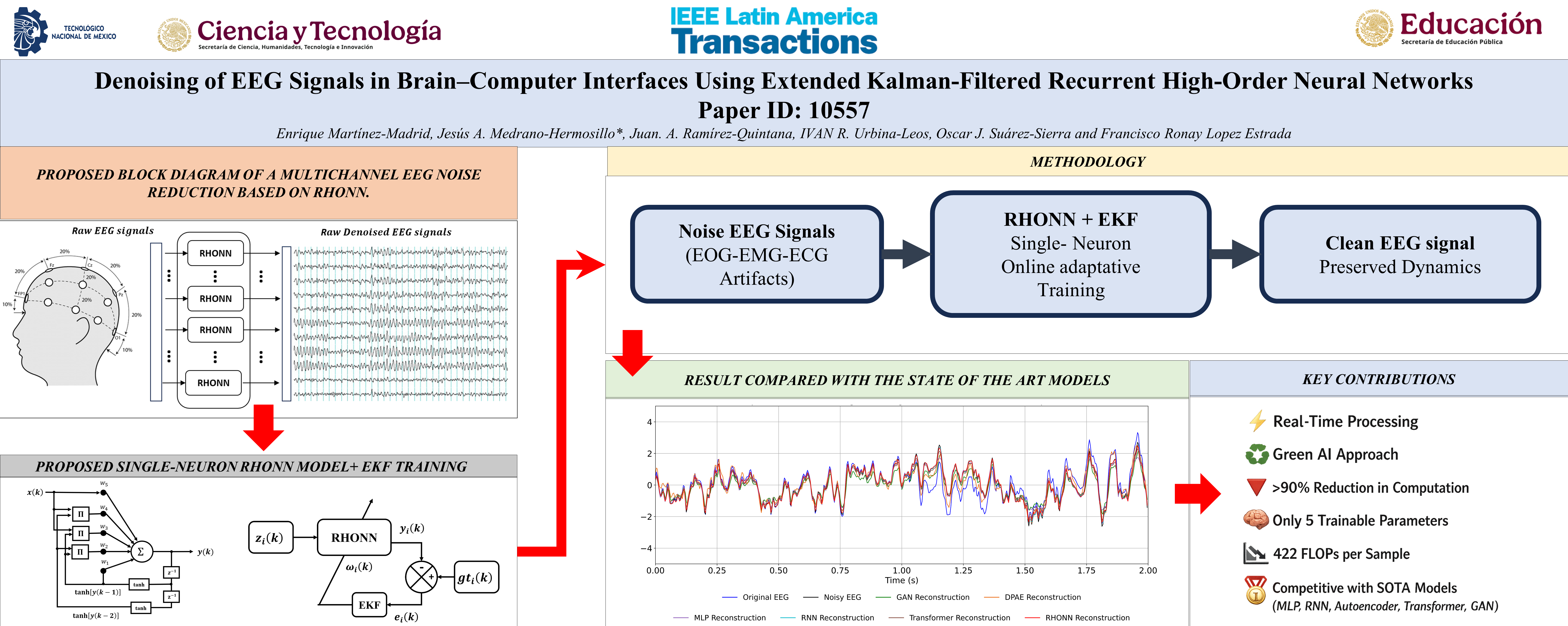
This paper presents a Recurrent High-Order Neural Network (RHONN) for EEG denoising in brain–computer interface (BCI) applications. Trained online using the Extended Kalman Filter (EKF), the proposed approach effectively suppresses EOG, EMG, and ECG artifacts under non-stationary conditions while preserving EEG temporal structure. Experimental results show that RHONN achieves performance comparable to or better than conventional filters and deep learning models, including MLPs, RNNs, GANs, and autoencoders. A key advantage of the RHONN--EKF framework is its very low computational cost. By modeling each EEG channel with a single high-order neuron, the method reduces computational load by more than 90% compared to state-of-the-art models, making it suitable for real-time, resource-constrained BCI systems and consistent with Green AI principles.
Downloads
References
• Niedermeyer, E., & da Silva, F. H. Lopes. (2005). Electroencephalography: Basic principles, clinical applications, and related fields. Lippincott Williams & Wilkins. ISBN: 0781751268.
• Wolpaw, J. R. (2013). Brain–computer interfaces. En Handbook of Clinical Neurology (Vol. 110, pp. 67–74). Elsevier. ISBN: 0199921482.
• Hyvärinen, A., & Oja, E. (2000). Independent component analysis: algorithms and applications. Neural Networks, 13(4–5), 411–430. https://doi.org/10.1016/S0893-6080(00)00026-5
• Addison, P. S. (2005). Wavelet transforms and the ECG: a review. Physiological Measurement, 26(5), R155. https://doi.org/10.1088/0967-3334/26/5/R01
• Roy, Y., Banville, H., Albuquerque, I., Gramfort, A., Falk, T. H., & Faubert, J. (2019). Deep learning-based electroencephalography analysis: a systematic review. Journal of Neural Engineering, 16(5), 051001. https://doi.org/10.1088/1741-2552/ab260c
• Alanís García, A. Y. (2004). Entrenamiento de redes neuronales con el filtro de Kalman (Tesis de maestría). Centro de Investigación y de Estudios Avanzados del IPN (CINVESTAV).
• Sánchez, E. N., Alanís, A. Y., & Loukianov, A. G. (2008). Discrete-Time Block Control. Springer. ISBN: 9783540782889.
• Zhang, H., Zhao, M., Wei, C., Mantini, D., Li, Z., & Liu, Q. (2021). EEGdenoiseNet: a benchmark dataset for deep learning solutions of EEG denoising. Journal of Neural Engineering, 18(5), 056057. https://doi.org/10.1088/1741-2552/ac2bf8
• Gordienko, Y., Gordienko, N., Taran, V., Rojbi, A., Telenyk, S., & Stirenko, S. (2025). Effect of natural and synthetic noise data augmentation on physical action classification by brain–computer interface and deep learning. Frontiers in Neuroinformatics, 19, 1521805. https://doi.org/10.3389/fninf.2025.1521805
• Dryden, I. L., & Mardia, K. V. (2016). Statistical shape analysis: with applications in R. John Wiley & Sons. ISBN: 9780470699621.
• An, Y., Lam, H. K., & Ling, S. H. (2022). Auto-denoising for EEG signals using generative adversarial network. Sensors, 22(5), 1750. https://doi.org/10.3390/s22051750
• Xiong, W., Ma, L., & Li, H. (2024). A general dual-pathway network for EEG denoising. Frontiers in Neuroscience, 17, 1258024. https://doi.org/10.3389/fnins.2023.1258024
• Chaddad, A., Wu, Y., Kateb, R., & Bouridane, A. (2023). Electroencephalography signal processing: A comprehensive review and analysis of methods and techniques. Sensors, 23(14), 6434.
• Khosla, A., Khandnor, P., & Chand, T. (2020). A comparative analysis of signal processing and classification methods for different applications based on EEG signals. Biocybernetics and Biomedical Engineering, 40(2), 649–690.
• Saber, M. (2022). Removing powerline interference from EEG signal using optimized FIR filters. Journal of Artificial Intelligence and Metaheuristics, 1(1), 8–19. https://doi.org/10.54216/JAIM.010101
• Felja, M., Bencheqroune, A., Karim, M., & Bennis, G. (2020). Removing artifacts from EEG signal using wavelet transform and conventional filters. WSEAS Transactions on Information Science and Applications, 17, 177–183. https://doi.org/10.37394/23209.2020.17.22
• Kaur, C., Bisht, A., Singh, P., & Joshi, G. (2021). EEG Signal denoising using hybrid approach of Variational Mode Decomposition and wavelets for depression. Biomedical Signal Processing and Control, 65, 102337.
• Yan, W., & Wu, Y. (2022). A time-frequency denoising method for single-channel event-related EEG. Frontiers in Neuroscience, 16, 991136.
• Gajbhiye, P., Tripathy, R. K., Bhattacharyya, A., & Pachori, R. B. (2019). Novel approaches for the removal of motion artifact from EEG recordings. IEEE Sensors Journal, 19(22), 10600–10608. https://doi.org/10.1109/JSEN.2019.2931727
• Noorbasha, S. K., & Sudha, G. F. (2020). Removal of EOG artifacts from single channel EEG—an efficient model combining overlap segmented ASSA and ANC. Biomedical Signal Processing and Control, 60, 101987. https://doi.org/10.1016/j.bspc.2020.101987
• Wang, X., Zhang, H., Tan, J., Xu, Y., Sun, P. Z., Ji, J., Lu, J., Zhu, M., Tong, M. C. F., Mukhopadhyay, S. C., et al. (2023). High-Quality Auditory Brainstem Response Acquisition in Motion via Adaptive Kalman Filtering. IEEE Transactions on Cognitive and Developmental Systems, 16(3), 877–887. https://doi.org/10.1109/TCDS.2023.3308561
• Abutaleb, A., Abdelaleem, H., & Hewedy, K. (2021). Stochastic models for the EEG frequencies. International Journal of Signal Processing, 6.
• Alturki, F. A., AlSharabi, K., Abdurraqeeb, A. M., & Aljalal, M. (2020). EEG signal analysis for diagnosing neurological disorders using discrete wavelet transform and intelligent techniques. Sensors, 20(9), 2505. https://doi.org/10.3390/s20092505
• Nayak, A. B., Shah, A., Maheshwari, S., Anand, V., Chakraborty, S., & Kumar, T. S. (2024). An empirical wavelet transform-based approach for motion artifact removal in electroencephalogram signals. Decision Analytics Journal, 10, 100420. https://doi.org/10.1016/j.dajour.2024.100420
• Luján, M. Á., Jimeno, M. V., Mateo Sotos, J., Ricarte, J. J., & Borja, A. L. (2021). A survey on EEG signal processing techniques and machine learning: Applications to the neurofeedback of autobiographical memory deficits in schizophrenia. Electronics, 10(23), 3037. https://doi.org/10.3390/electronics10233037
• Stalin, S., Roy, V., Shukla, P. K., Zaguia, A., Khan, M. M., Shukla, P. K., & Jain, A. (2021). A Machine Learning-Based Big EEG Data Artifact Detection and Wavelet-Based Removal: An Empirical Approach. Mathematical Problems in Engineering, 2021(1), 2942808. https://doi.org/10.1155/2021/2942808
• Sun, W., Su, Y., Wu, X., & Wu, X. (2020). A novel end-to-end 1D-ResCNN model to remove artifact from EEG signals. Neurocomputing, 404, 108–121. https://doi.org/10.1016/j.neucom.2020.04.029
• Hossain, M. S., Mahmud, S., Khandakar, A., Al-Emadi, N., Chowdhury, F. A., Mahbub, Z. B., Reaz, M. B. I., & Chowdhury, M. E. H. (2023). MultiResUNet3+: A full-scale connected multi-residual UNet model to denoise EOG and EMG artifacts from corrupted EEG signals. Bioengineering, 10(5), 579. https://doi.org/10.3390/bioengineering10050579
• Cai, Y., Meng, Z., & Huang, D. (2025). DHCT-GAN: Improving EEG Signal Quality with a Dual-Branch Hybrid CNN–Transformer Network. Sensors, 25(1), 231. https://doi.org/10.3390/s25010231
• Moody, G. B., & Mark, R. G. (1992). MIT-BIH arrhythmia database. PhysioNet. https://doi.org/10.13026/C2F305
• Pion-Tonachini, L., Kreutz-Delgado, K., & Makeig, S. (2019). ICLabel: An automated EEG independent component classifier, dataset, and website. NeuroImage, 198, 181–197. https://doi.org/10.1016/j.neuroimage.2019.05.026
• Goldberger, A. L., Amaral, L. A. N., Glass, L., Hausdorff, J. M., Ivanov, P. C., Mark, R. G., Mietus, J. E., Moody, G. B., Peng, C.-K., & Stanley, H. E. (2000). PhysioBank, PhysioToolkit, and PhysioNet: components of a new research resource for complex physiologic signals. Circulation, 101(23), e215–e220. https://doi.org/10.1161/01.CIR.101.23.e215
• Cisotto, G., & Chicco, D. (2024). Ten quick tips for clinical EEG data acquisition and signal processing. PeerJ Computer Science, 10, e2256. https://doi.org/10.7717/peerj-cs.2256
• Li, Y., Zeng, W., Dong, W., Han, D., Chen, L., Chen, H., Kang, Z., Gong, S., Yan, H., Siok, W. T., & Wang, N. (2025). A Tale of Single-Channel EEG: Devices, Datasets, Signal Processing, Applications, and Future Directions. IEEE Transactions on Instrumentation and Measurement, 74, 1–20. https://doi.org/10.1109/TIM.2025.3556900
• Xue, Z., Zhang, Y., Li, H., Chen, H., Shen, S., & Du, H. (2024). Instrumentation, Measurement, and Signal Processing in EEG-Based Brain–Computer Interfaces: Situations and Prospects. IEEE Transactions on Instrumentation and Measurement, 73, 1–28. https://doi.org/10.1109/TIM.2024.3417598
• Weng, W., Gu, Y., Guo, S., Ma, Y., Yang, Z., Liu, Y., & Chen, Y. (2025). Self-supervised Learning for Electroencephalogram: A Systematic Survey. ACM Computing Surveys, 57(12), 1–38. https://doi.org/10.1145/3736574
• Li, G., Yuan, Y., Ouyang, D., Zhang, L., Yuan, B., Chang, X., Guo, Z., & Guo, G. (2024). Driver Distraction From the EEG Perspective: A Review. IEEE Sensors Journal, 24(3), 2329–2349. https://doi.org/10.1109/JSEN.2023.3339727
• Sabio, J., Williams, N. S., McArthur, G. M., & Badcock, N. A. (2024). A scoping review on the use of consumer-grade EEG devices for research. PLOS ONE, 19(3), e0291186. https://doi.org/10.1371/journal.pone.0291186
• Sun, Y., Chen, X., Liu, B., Liang, L., Wang, Y., Gao, S., & Gao, X. (2025). Signal acquisition of brain–computer interfaces: A medical-engineering crossover perspective review. Fundamental Research, 5(1), 3–16. https://doi.org/10.1016/j.fmre.2024.04.011
• Erat, K., Şahin, E. B., Doğan, F., Merdanoğlu, N., Akcakaya, A., & Durdu, P. O. (2024). Emotion recognition with EEG-based brain-computer interfaces: a systematic literature review. Multimedia Tools and Applications, 83(33), 79647–79694. https://doi.org/10.1007/s11042-024-18259-z
• Schmierer, T., Li, T., & Li, Y. (2024). Harnessing machine learning for EEG signal analysis: Innovations in depth of anaesthesia assessment. Artificial Intelligence in Medicine, 151, 102869. https://doi.org/10.1016/j.artmed.2024.102869
• Chen, J., Pi, D., Jiang, X., Xu, Y., Chen, Y., & Wang, X. (2024). Denosieformer: A Transformer-Based Approach for Single-Channel EEG Artifact Removal. IEEE Transactions on Instrumentation and Measurement, 73, 1–16. https://doi.org/10.1109/TIM.2023.3341114
• Xing, L., & Casson, A. J. (2024). Deep Autoencoder for Real-Time Single-Channel EEG Cleaning and Its Smartphone Implementation Using TensorFlow Lite With Hardware/Software Acceleration. IEEE Transactions on Biomedical Engineering, 71(11), 3111–3122. https://doi.org/10.1109/TBME.2024.3408331
• Zhao, S., Gao, H., Li, X., Li, H., Wang, Y., Hu, R., Zhang, J., Yao, W., & Li, G. (2024). An outlier detection based two-stage EEG artifact removal method using empirical wavelet transform and canonical correlation analysis. Biomedical Signal Processing and Control, 92, 106022. https://doi.org/10.1016/j.bspc.2024.106022
• Coelli, S., Calcagno, A., Cassani, C. M., Temporiti, F., Reali, P., Gatti, R., Galli, M., & Bianchi, A. M. (2024). Selecting methods for a modular EEG pre-processing pipeline: An objective comparison. Biomedical Signal Processing and Control, 90, 105830. https://doi.org/10.1016/j.bspc.2023.105830
• Cui, H., Li, C., Liu, A., Qian, R., & Chen, X. (2024). A Dual-Branch Interactive Fusion Network to Remove Artifacts From Single-Channel EEG. IEEE Transactions on Instrumentation and Measurement, 73, 1–12. https://doi.org/10.1109/TIM.2023.3342863
• Wang, B., Deng, F., & Jiang, P. (2024). EEGDiR: Electroencephalogram denoising network for temporal information storage and global modeling through Retentive Network. Computers in Biology and Medicine, 177, 108626. https://doi.org/10.1016/j.compbiomed.2024.108626
• Ch Vidyasagar, K. E., Revanth Kumar, K., Anantha Sai, G. N. K., Ruchita, M., & Saikia, M. J. (2024). Signal to Image Conversion and Convolutional Neural Networks for Physiological Signal Processing: A Review. IEEE Access, 12, 66726–66764. https://doi.org/10.1109/ACCESS.2024.3399114
• Caldas, A. S. L., Pereira, E. T., Leite, N. M. N., Oliveira, A. D. B., & Lucena, E. R. (2020). Towards automatic EEG signal denoising by quality metric optimization. En 2020 International Joint Conference on Neural Networks (IJCNN) (pp. 1–7). IEEE. https://doi.org/10.1109/IJCNN48605.2020.9207504
• Zhang, X. (2024). Deep Learning-Based Techniques for Electroencephalogram (EEG) Signal Denoising. Transactions on Computer Science and Intelligent Systems Research, 5, 922–927. https://doi.org/10.62051/rrve8560
• Versaci, M., & La Foresta, F. (2024). EEG Data Analysis Techniques for Precision Removal and Enhanced Alzheimer’s Diagnosis. Signals, 5(2), 343–381. https://doi.org/10.3390/signals5020018
• Chuang, C.-H., Chang, K.-Y., Huang, C.-S., & Bessas, A.-M. (2024). ART: Artifact Removal Transformer for Reconstructing Noise-Free Multichannel EEG Signals. arXiv. https://doi.org/10.48550/ARXIV.2409.07326
• Agarwal, N., Chintha, V. R., Kolli, R. K., Goel, O., & Agarwal, R. (2022). Deep Learning for real time EEG artifact detection in wearables. International Journal for Research Publication and Seminar, 13(5), 402–433. https://doi.org/10.36676/jrps.v13.i5.1510
• Hwaidi, J. F., & Chen, T. M. (2021). A Noise Removal Approach from EEG Recordings Based on Variational Autoencoders. En 2021 13th International Conference on Computer and Automation Engineering (ICCAE) (pp. 19–23). IEEE. https://doi.org/10.1109/ICCAE51876.2021.9426150
• Gabardi, M., Saibene, A., Gasparini, F., Rizzo, D., & Stella, F. A. (2023). A multi-artifact EEG denoising by frequency-based deep learning. arXiv. https://arxiv.org/abs/2310.17335
• Maitin, A. M., Romero Muñoz, J. P., & García-Tejedor, Á. J. (2022). Survey of Machine Learning Techniques in the Analysis of EEG Signals for Parkinson’s Disease. Applied Sciences, 12(14), 6967. https://doi.org/10.3390/app12146967
• Shafiezadeh, S., Duma, G. M., Mento, G., Danieli, A., Antoniazzi, L., Del Popolo Cristaldi, F., Bonanni, P., & Testolin, A. (2023). Methodological issues in evaluating machine learning models for EEG seizure prediction. Applied Sciences, 13(7), 4262. https://doi.org/10.3390/app13074262
• Brophy, E., Redmond, P., Fleury, A., De Vos, M., Boylan, G., & Ward, T. (2022). Denoising EEG signals for real-world BCI applications using GANs. Frontiers in Neuroergonomics, 2, 805573. https://doi.org/10.3389/fnrgo.2021.805573
• Yakoubi, M., Hamdi, R., & Bousbia Salah, M. (2024). Removal noise from EEG signal using unscented Kalman filter to train multi layer perceptron (MLP).
• Lu, W. (2024). A review of EEG noise reduction technology based on DCCRN-LSTM. Theoretical and Natural Science, 58, 182–187. https://doi.org/10.54254/2753-8818/58/20241381
• World Medical Association. (2013). World Medical Association Declaration of Helsinki: Ethical Principles for Medical Research Involving Human Subjects. Adopted at the 64th WMA General Assembly, Fortaleza, Brazil. https://jamanetwork.com/journals/jama/fullarticle/1760318