Porting a Virtual Reality Kayak Application Across Two Head-Mounted Displays: Presence, Usability, and Attitudes Toward Tourism
Keywords:
Virtual Reality, tourism, presence, inmersion, attitudes, attitudes towards tourismAbstract
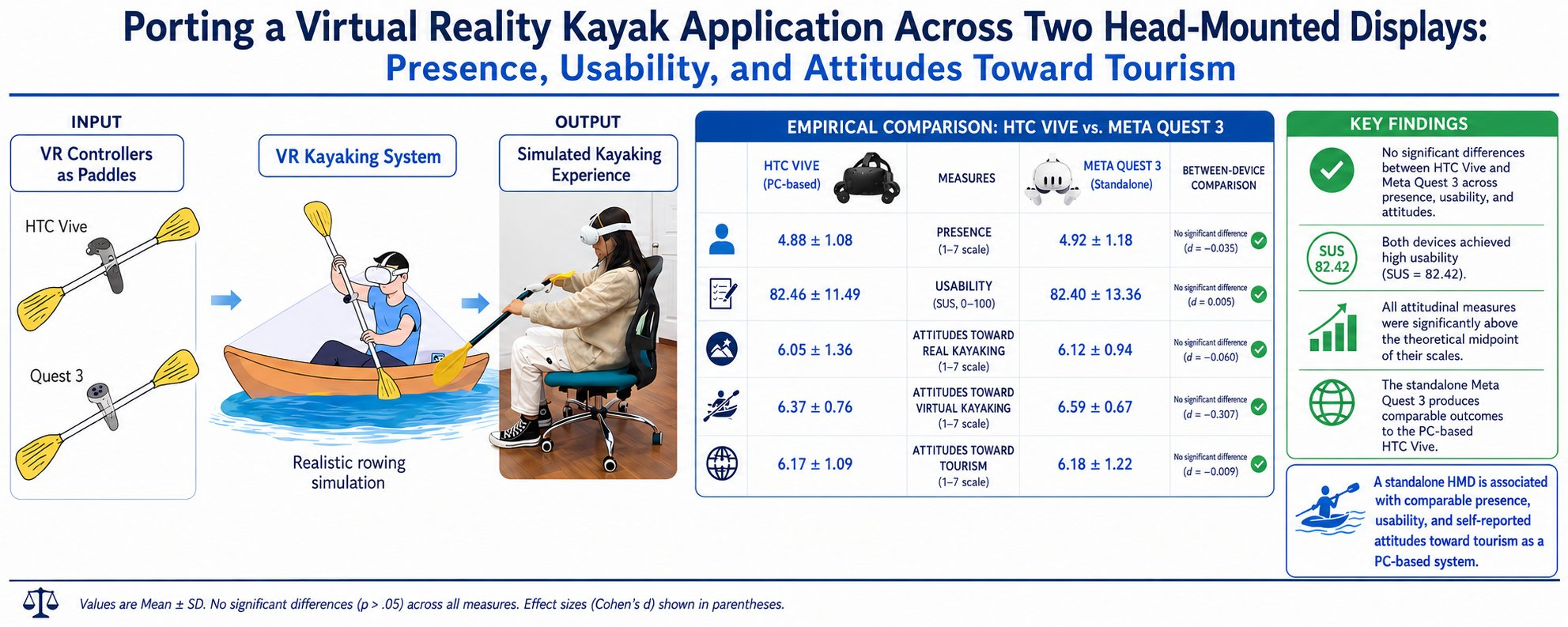
Tourism is an important economic activity for Chile. The use of Virtual Reality (VR) technologies have a positive impact on the reception of messages towards points of interest in tourism, influencing peoples' attitudes towards tourism and intention to visit. Building on previous research on tourism, virtual reality, and attitudes, we present a porting of a VR activity of Kayaking on a lake in Chile, to two VR devices (HTC Vive and Meta Quest 3) using the Unity Editor. Differences in perceived presence and usability of the developed software are analyzed, along with attitudes towards kayaking and tourism. Results indicate that there are no significant differences in presence, usability or attitudes between participants that used the HTC Vive or the Meta Quest 3 device. Meanwhile, the scores of presence, usability, and attitudes toward kayaking and tourism are statistically higher than the theoretical midpoint of the scales, suggesting that the virtual reality experience is associated with positive evaluations of the simulated activity. The results are analyzed and discussed in relation to the characteristics of both VR devices, as well as the methodological utility of the results.
Downloads
References
S. F. Schubert, J. G. Brida, and W. A. Risso, “The impacts of
international tourism demand on economic growth of small economies
dependent on tourism,” Tourism Management, vol. 32, no. 2, pp.
–385, 2011. [Online]. Available: https://doi.org/10.1016/j.tourman.
03.007
World Travel & Tourism Council. (2025) Wttc report shows
travel & tourism set to support 91mn new jobs by 2035.
Accessed: Jan. 2026. [Online]. Available: https://wttc.org/news/
wttc-report-shows-travel-and-tourism-set-to-support-91mn-new-jobs-by-2035
“Travel and tourism: contribution to global gdp
” [Online]. Available: https://www.statista.com/statistics/233223/
travel-and-tourism-total-economic-contribution-worldwide/
W. Bank, “Prosperity data360 tourism country snapshots : Chile,”
[Online]. Available: http://documents.worldbank.org/curated/en/
Subsecretar´ıa de Turismo de Chile and SERNATUR, “Bar´ometro de
turismo – diciembre 2024,” Gobierno de Chile, Tech. Rep., Dec. 2024.
[Online]. Available: https://www.subturismo.gob.cl/wp-content/uploads/
/01/barometro-de-turismo-diciembre-2024.pdf
A. Marasco, P. Buonincontri, M. v. Niekerk, M. Orlowski, and
F. Okumus¸, “Exploring the role of next-generation virtual technologies
in destination marketing,” Journal of Destination Marketing &
Management, vol. 9, p. 138, Jan. 2018. [Online]. Available:
https://doi.org/10.1016/j.jdmm.2017.12.002
N. Sousa, E. Al´en, N. Losada, and M. Melo, “Virtual reality
in tourism promotion: A research agenda based on a bibliometric
approach,” Journal of Quality Assurance in Hospitality & Tourism,
vol. 25, no. 2, pp. 313–342, 2024. [Online]. Available: https:
//doi.org/10.1080/1528008X.2022.2112807
J. Beck, M. Rainoldi, and R. Egger, “Virtual reality in tourism: a stateof-
the-art review,” Tourism Review, vol. 74, 05 2019.
M. de Lurdes Calisto and S. Sarkar, “A systematic review of virtual
reality in tourism and hospitality: The known and the paths to
follow,” International Journal of Hospitality Management, vol. 116,
p. 103623, 2024. [Online]. Available: https://www.sciencedirect.com/
science/article/pii/S0278431923001974
I. P. Tussyadiah, D. Wang, T. H. Jung, and M. C. Tom Dieck, “Virtual
reality, presence, and attitude change: Empirical evidence from tourism,”
Tourism management, vol. 66, pp. 140–154, 2018.
F. Besoain, J. Gonz´alez-Ortega, and I. Gallardo, “An evaluation of
the effects of a virtual museum on users’ attitudes towards cultural
heritage,” Applied Sciences, vol. 12, no. 3, 2022. [Online]. Available:
https://doi.org/10.3390/app12031341
M. Buji´c, M. Salminen, and J. Hamari, “More immersed but
less present: Unpacking factors of presence across devices,” in
Proceedings of the 2023 ACM International Conference on Interactive
Media Experiences, 2023, pp. 140–149. [Online]. Available: https:
//doi.org/10.1145/3573381.3596152
L. Jego, I. Gallardo, and F. Besoain, “Developing a virtual reality
experience with game elements for tourism: Kayak simulator,” in 2019
IEEE CHILEAN Conference on Electrical, Electronics Engineering,
Information and Communication Technologies (CHILECON), 2019,
pp. 1–6. [Online]. Available: https://doi.org/10.1109/CHILECON47746.
8988058
HTC, “”htc vive site”.” [Online]. Available: ”https://www.vive.com/us/”
Meta, “”meta quest 3”.” [Online]. Available: https://www.meta.com/
quest/quest-3/
M. Sharples, Human-Computer Interaction. Academic Press, 12 1996,
pp. 293–323.
F. Karray, M. Alemzadeh, J. Saleh, and M. N. Arab, “Human-computer
interaction: Overview on state of the art,” International Journal on
Smart Sensing and Intelligent Systems, vol. 1, pp. 137–159, 01 2008.
[Online]. Available: https://doi.org/10.21307/ijssis-2017-283
M. Wadhwa and U. Shrivastava, “Ubiquitous computing: A
comprehensive review,” in International Conference on Electrical
and Electronics Engineering. Springer, 2023, pp. 591–600. [Online].
Available: https://doi.org/10.1007/978-981-99-8661-3 42
M. Espinilla, V. Villarreal, and I. McChesney, “Ubiquitous computing
and ambient intelligence—ucami,” p. 4034, 2019. [Online]. Available:
https://doi.org/10.3390/s19184034
H. Ardiny and E. Khanmirza, “The role of ar and vr technologies
in education developments: opportunities and challenges,” in 2018
th rsi international conference on robotics and mechatronics
(icrom). IEEE, 2018, pp. 482–487. [Online]. Available: https:
//doi.org/10.1109/ICRoM.2018.8657615
C. Anthes, R. J. Garc´ıa-Hern´andez, M. Wiedemann, and
D. Kranzlm¨uller, “State of the art of virtual reality technology,”
in 2016 IEEE aerospace conference. IEEE, 2016, pp. 1–19. [Online].
Available: https://doi.org/10.1109/AERO.2016.7500674
J. M¨utterlein, “The three pillars of virtual reality? investigating the
roles of immersion, presence, and interactivity,” in 51st Hawaii
International Conference on System Sciences, 01 2018. [Online].
Available: https://doi.org/10.24251/HICSS.2018.174
M. Maravilla, A. Cisneros, A. Stoddard, D. Scretching, B. Murray,
and E. Redmiles, “Defining virtual reality: Insights from research
and practice,” in iConference 2019, 01 2019. [Online]. Available:
https://doi.org/10.21900/iconf.2019.103338
C. Anthes, R. Garc´ıa Hernandez, M. Wiedemann, and D. Kranzlm¨uller,
“State of the art of virtual reality technologies,” in 2016 IEEE
Aerospace Conference, 03 2016. [Online]. Available: https://doi.org/10.
/AERO.2016.7500674
I. P. Tussyadiah, D. Wang, and C. Jia, “Virtual reality
and attitudes toward tourism destinations,” in Information and
Communication Technologies in Tourism 2017: Proceedings of
the International Conference in Rome, Italy, January 24-
, 2017. Springer, 2017, pp. 229–239. [Online]. Available:
https://doi.org/10.1007/978-3-319-51168-9 17
B. Standen, J. Anderson, A. Sumich, and N. Heym, “Effects of systemand
media-driven immersive capabilities on presence and affective
experience,” Virtual Reality, pp. 1–14, 2023. [Online]. Available:
https://doi.org/10.1007/s10055-021-00579-2
V. De Luca, G. Pellegrino, and L. T. De Paolis, “The impact of usability
and learnability on presence factors in a vr human body navigator,” in
International conference on extended reality. Springer, 2023, pp. 378–
[Online]. Available: https://doi.org/10.1007/978-3-031-43401-3 25
B. G. Witmer and M. J. Singer, “Measuring presence in virtual environments:
A presence questionnaire,” Presence, vol. 7, no. 3, pp. 225–240,
K. M. Lee, “Presence, explicated,” Communication Theory, vol. 14,
no. 1, pp. 27–50, 2004. [Online]. Available: https://doi.org/10.1111/j.
-2885.2004.tb00302.x
M. V. Sanchez-Vives and M. Slater, “From presence to consciousness
through virtual reality,” Nature Reviews Neuroscience, vol. 6, no. 4, pp.
–339, 2005. [Online]. Available: https://doi.org/10.1038/nrn1651
A. Wiepke and B. Heinemann, “A systematic literature review on user
factors to support the sense of presence in virtual reality learning
environments,” Computers & Education: X Reality, vol. 4, p. 100064,
[Online]. Available: https://doi.org/10.1016/j.cexr.2024.100064
A. Voinescu, K. Petrini, and D. Stanton Fraser, “Presence and simulator
sickness predict the usability of a virtual reality attention task,” Virtual
Reality, vol. 27, no. 3, pp. 1967–1983, 2023. [Online]. Available:
https://doi.org/10.1007/s10055-023-00782-3
J. Lewis and J. Sauro, Usability and User Experience: Design and
Evaluation. John Wiley & Sons, 08 2021, pp. 972–1015.
J. Nielsen, “Usability 101: Introduction to usability,”
2024. [Online]. Available: https://www.nngroup.com/articles/
usability-101-introduction-to-usability/
T. Lupo and E. Bellomo, “A methodological framework based on
a danp model for evaluating the software quality in terms of
usability: a preliminary investigation on mobile operating systems,”
Decision Science Letters, pp. 521–536, 01 2020. [Online]. Available:
https://doi.org/10.5267/j.dsl.2020.8.005
X. Ferre, N. Juristo, H. Windl, and L. Constantine, “Usability basics
for software developers,” IEEE Software, vol. 18, no. 1, pp. 22–29,
[Online]. Available: https://doi.org/10.1109/52.903160
L. Schwarzbach and R. Schmitt, “Heuristic methods,” in Operations
Research and Management: Quantitative Methods for Planning
and Decision-Making in Business and Economics, ser. Springer
Texts in Business and Economics, F. W. Peren and T. Neifer,
Eds. Springer, Cham, 2024, pp. 131–154. [Online]. Available:
https://doi.org/10.1007/978-3-031-47206-0 7
R. da Silva de Queiroz Pierre, “Heuristics in design: A literature
review,” Procedia Manufacturing, vol. 3, pp. 6571–6578, 2015.
[Online]. Available: https://doi.org/10.1016/j.promfg.2015.07.961
R. Murtza, S. Monroe, and R. J. Youmans, “Heuristic evaluation for
virtual reality systems,” in Proceedings of the Human Factors and
Ergonomics Society Annual Meeting, vol. 61, 2017, pp. 2067–2071.
[Online]. Available: https://doi.org/10.1177/1541931213602000
J. R. Lewis, “The system usability scale: Past, present, and
future,” International Journal of Human-Computer Interaction, vol. 34,
no. 7, pp. 577–590, 2018. [Online]. Available: https://doi.org/10.1080/
2018.1455307
J. Brooke, “Sus: A quick and dirty usability scale,” in Usability Evaluation
in Industry, P. W. Jordan, B. Thomas, B. A. Weerdmeester, and
I. L. McClelland, Eds. Taylor & Francis, 1996, pp. 189–194.
L. R. Fabringar, T. K. MacDonald, and D. T. Wegener, “The origins and
structure of attitudes,” in The Handbook of Attitudes, Volume 1: Basic
Principles. Routledge, 2018, pp. 109–157.
P. Bri˜nol, R. E. Petty, and M. Stavraki, “Structure and function
of attitudes,” in Oxford Research Encyclopedia of Psychology, 2019.
[Online]. Available: https://doi.org/10.1093/acrefore/9780190236557.
320
F. Besoain and I. Gallardo, “The mediation effect of attitudes for the
association between thoughts and the use of condoms in a mobile-app
environment: From thought to intention,” International Journal of
Environmental Research and Public Health, vol. 19, no. 20, p. 13631,
[Online]. Available: https://doi.org/10.3390/ijerph192013631
S. J. Kraus, “Attitudes and the prediction of behavior: A metaanalysis
of the empirical literature,” Personality and Social Psychology
Bulletin, vol. 21, no. 1, pp. 58–75, 1995. [Online]. Available:
https://doi.org/10.1177/0146167295211007
L. R. Glasman and D. Albarrac´ın, “Forming attitudes that predict
future behavior: A meta-analysis of the attitude-behavior relation,”
Psychological Bulletin, vol. 132, no. 5, pp. 778–822, 2006. [Online].
Available: https://doi.org/10.1037/0033-2909.132.5.778
E. Ervina and V. Octaviany, “The role of tourist attitude toward
destination awareness, destination personality and future visit intention,”
Asia Pacific Management and Business Application, vol. 11, no. 1,
pp. 1–18, 2022. [Online]. Available: https://doi.org/10.21776/ub.apmba.
011.01.1
D. Pinelle, N. Wong, and T. Stach, “Heuristic evaluation for
games: Usability principles for video game design,” in Proceedings
of the SIGCHI Conference on Human Factors in Computing
Systems (CHI ’08), 2008, pp. 1453–1462. [Online]. Available:
https://doi.org/10.1145/1357054.1357282
G. Makransky, L. Lilleholt, and A. Aaby, “Development and validation
of the multimodal presence scale for virtual reality environments:
A confirmatory factor analysis and item response theory approach,”
Computers in Human Behavior, vol. 72, pp. 276–285, 2017. [Online].
Available: https://doi.org/10.1016/j.chb.2017.02.066
J. A. Krosnick, C. M. Judd, and B. Wittenbrink, “The measurement
of attitudes,” in The Handbook of Attitudes, D. Albarrac´ın and B. T.
Johnson, Eds. Taylor & Francis Group, 2018. [Online]. Available:
https://doi.org/10.4324/9781315178103
G. McLean and J. B. Barhorst, “Living the experience before you go. . .
but did it meet expectations? the role of virtual reality during hotel
bookings,” Journal of Travel Research, vol. 61, no. 6, pp. 1233–1251,
[Online]. Available: https://doi.org/10.1177/00472875211028313
S. D. Hoang, S. K. Dey, Z. Tuˇckov´a, and T. P. Pham, “Harnessing
the power of virtual reality: Enhancing telepresence and inspiring
sustainable travel intentions in the tourism industry,” Technology
in Society, vol. 75, p. 102378, Sep. 2023. [Online]. Available:
https://doi.org/10.1016/j.techsoc.2023.102378
J. J. Cummings and J. N. Bailenson, “How immersive is enough? a
meta-analysis of the effect of immersive technology on user presence,”
Media Psychology, vol. 19, no. 2, pp. 272–309, 2016. [Online].
Available: https://doi.org/10.1080/15213269.2015.1015740
L. Bergkvist and J. R. Rossiter, “The predictive validity of multipleitem
versus single-item measures of the same constructs,” Journal
of Marketing Research, vol. 44, no. 2, pp. 175–184, 2007. [Online].
Available: https://doi.org/10.1509/jmkr.44.2.175