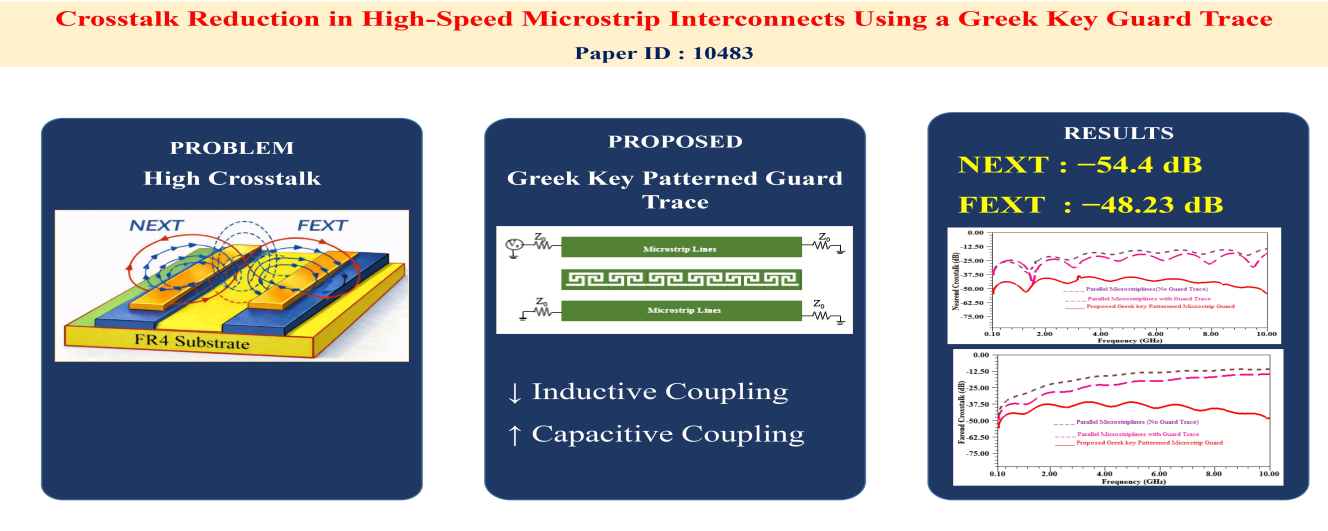
Crosstalk Reduction in High-Speed Microstrip Interconnects Using a Greek Key Guard Trace
Keywords:
crosstalk reduction, Greek key guard trace, High-speed PCB, Microstrip interconnects, Near-end crosstalk, Far-end crosstalk, Signal integrityAbstract
This work presents a method for suppressing near-end crosstalk (NEXT) and far-end crosstalk (FEXT) in high-speed microstrip interconnects using a Greek key patterned defective microstrip guard trace. The structure increases effective capacitance and modifies the inductive path between coupled lines, improving electromagnetic isolation without increasing line spacing. A full parametric study is carried out in HFSS to evaluate the effect of defect width and unit-cell spacing on crosstalk behavior. The results show that a defect width of 0.01 mm with a spacing of 1.0 mm provides the strongest suppression, achieving NEXT of −57.53 dB and FEXT of −51.70 dB at 10 GHz. When compared with conventional guard traces, the proposed design delivers more than 60% improvement in NEXT and over 80% improvement in FEXT. Analysis shows saturation after 0.025 mm defect width, beyond which no significant improvement can be achieved. The proposed structure provides an optimal and compact method to reduce coupling effects in high-speed PCB designs with high density.
Downloads
References
Y. Wang, C. Li, and X. Li, “Reducing crosstalk between microstrip lines using CSR structures,” Engineering Reports, vol. 5, no. 7, Art. no. e12728, 2023, doi: 10.1002/eng2.12728.
C. Li, Y. Wang, and X. Li, “Crosstalk reduction between microstrip lines using TL-shaped defected microstrip structures,” Engineering Reports, vol. 5, no. 1, pp. 1–9, 2022.
W. Dai, W. Feng, and W. Che, “Reduction of UWB far-end crosstalk in microwave and millimeter-wave bands using periodically loaded transmission lines with discontinuous structured guard lines,” IEEE Trans. Plasma Sci., vol. 48, no. 7, pp. 2372–2383, Jul. 2020, doi: 10.1109/TPS.2020.3001201.
G. Arumugam, S.-K. Natarajan, P. Rajeswari, and M.-S. Karoui, “Near-end and far-end crosstalk reduction in high-speed signaling channels using periodical spiral resonator defected microstrip lines in high-performance printed circuit boards,” IEICE Electron. Express, vol. 22, no. 1, Art. no. 20240268, Jan. 2025, doi: 10.1587/elex.22.20240268.
Gobinath, et al., “Reduction of near-end and far-end crosstalk in microwave and millimeter-wave bands using meander-shaped defected microstrip structures,” J. Phys.: Conf. Ser., vol. 2466, Art. no. 012016, 2023, doi: 10.1088/1742-6596/2466/1/012016.
A Gobinath, et al., “Reduction of electromagnetic coupling between parallel high-speed interconnects using defected microstrip structures,” Mater. Today Proc., 2023, doi: 10.1016/j.matpr.2023.08.201.
R. Packianathan and G. Arumugam, “Performance analysis of microstrip line interconnect structures with novel guard traces as parallel links for high-speed DRAM interfaces,” Wireless Pers. Commun., vol. 112, no. 1, pp. 261–271, 2020, doi: 10.1007/s11277-020-07025-7.
J. Lim, S. Lee, Y. Jeong, and J. Lee, “A novel method using a rectangular groove to reduce far-end crosstalk in microstrip lines covered with a dielectric layer,” IEEE Access, vol. 7, pp. 93643–93652, 2019.
X.-B. Yu, Q.-M. Cai, Y. Ren, X. Ye, and J. Fan, “Study of thickening solder mask coated microstrip lines on high-speed PCBs for crosstalk reduction in DDR5,” in Proc. IEEE Int. Symp. Electromagn. Compat. Signal/Power Integrity, Jul./Aug. 2020, pp. 575–577.
X. Gao, H. Zhang, P. He, et al., “Crosstalk suppression based on mode mismatch between spoof SPP transmission line and microstrip,” IEEE Trans. Compon., Packag. Manuf. Technol., vol. 9, pp. 2267–2275, 2019, doi: 10.1109/TCPMT.2019.2931373.
S. Yong, V. Khilkevich, X. Cai, et al., “Comprehensive and practical way to look at far-end crosstalk for transmission lines with lossy conductor and dielectric,” IEEE Trans. Electromagn. Compat., vol. 62, no. 2, pp. 510–520, Apr. 2020, doi: 10.1109/TEMC.2019.2902070.
Y. Liu, S. Yong, Y. Guo, et al., “An empirical modeling of far-end crosstalk and insertion loss in microstrip lines,” IEEE Trans. Signal Power Integr., vol. 1, no. 2, pp. 130–139, Jun. 2022, doi: 10.1109/TSIPI.2022.3214172.
S. S. Sharma, A. K. Pandey, and T. Mishra, “Electromagnetic field study of partially coupled microstrip line at different frequency,” in Proc. 2nd Int. Conf. Micro-Electronics Telecommun. Eng. (ICMETE), Ghaziabad, India, 2018, pp. 36–38, doi: 10.1109/ICMETE.2018.00021.
R. Balakrishnan, S. A. Thomas, and S. Sharan, “Crosstalk and EMI reduction using enhanced guard trace technique,” in Proc. IEEE Elect. Design Adv. Packag. Syst. Symp. (EDAPS), Honolulu, HI, USA, 2018, pp. 1–3, doi: 10.1109/EDAPS.2018.8680903.
J. Lim, S. Lee, and J. Lee, “A novel layer shaping method to reduce far-end crosstalk noise in microstrip lines using a 3D printer,” in Proc. 4th Aust. Microw. Symp. (AMS), Sydney, NSW, Australia, 2020, pp. 1–2, doi: 10.1109/AMS48904.2020.9059422.
F. D. Mbairi, W. P. Siebert, and H. Hesselbom, “High-frequency transmission line crosstalk reduction using spacing rules,” IEEE Trans. Compon. Packag. Technol., vol. 31, no. 3, pp. 601–610, Sep. 2008, doi: 10.1109/TCAPT.2008.2001163.
L. Zhang, Q. Cai, X. Yu, et al., “Far-end crosstalk mitigation for microstrip lines in high-speed PCBs,” in Proc. Cross Strait Quad-Regional Radio Sci. Wireless Technol. Conf., Fuzhou, China, 2019, pp. 1–3, doi: 10.1109/CSQRWC.2019.8799209.
W. Jiang, X.-D. Cai, B. Sen, and G. Wang, “Equation-based solutions to coupled, asymmetrical, lossy, and nonuniform microstrip lines for tab routing applications,” IEEE Trans. Electromagn. Compat., vol. 61, no. 2, pp. 548–557, Apr. 2019.
L. K. Baghel, S. Kumar, S. A. Sis, and J. Kim, “Crosstalk reduction in coupled microstrip lines using TT-shaped defected microstrip structures,” in Proc. Joint Asia-Pac. Int. Symp. Electromagn. Compat. Int. Conf. Electromagn. Interference Compat., May 2023, pp. 1–4.
J. Ge, R. Floyd, A. Khan, and G. Wang, “High-performance interconnects with reduced far-end crosstalk for high-speed ICs and communication systems,” IEEE Trans. Compon., Packag. Manuf. Technol., vol. 13, no. 7, pp. 1013–1020, Jul. 2023.
X. Liu, et al., “Equivalent circuit model of crosstalk reduction in parallel transmission lines with defected microstrip structures,” in Proc. Cross Strait Quad-Regional Radio Sci. Wireless Technol. Conf., Jul. 2018, pp. 1–2.
Li, Y. Wang, and X. Li, “Crosstalk reduction between microstrip lines using TL-shaped defected microstrip structures,” Engineering Reports, vol. 5, no. 1, Art. no. e12559, 2023.
R. Li, Y. Wang, W. Yang, and X. Li, “G-shaped defected microstrip structure-based method of reducing crosstalk of coupled microstrip lines,” Prog. Electromagn. Res. M, vol. 105, pp. 99–109, 2021.
Y. V., G. N. Alsath, and M. Kanagasabai, “Defected microstrip structure-based near-end and far-end crosstalk mitigation in high-speed PCBs for mixed signals,” Microelectronics Int., vol. 41, no. 1, pp. 16–25, 2024.