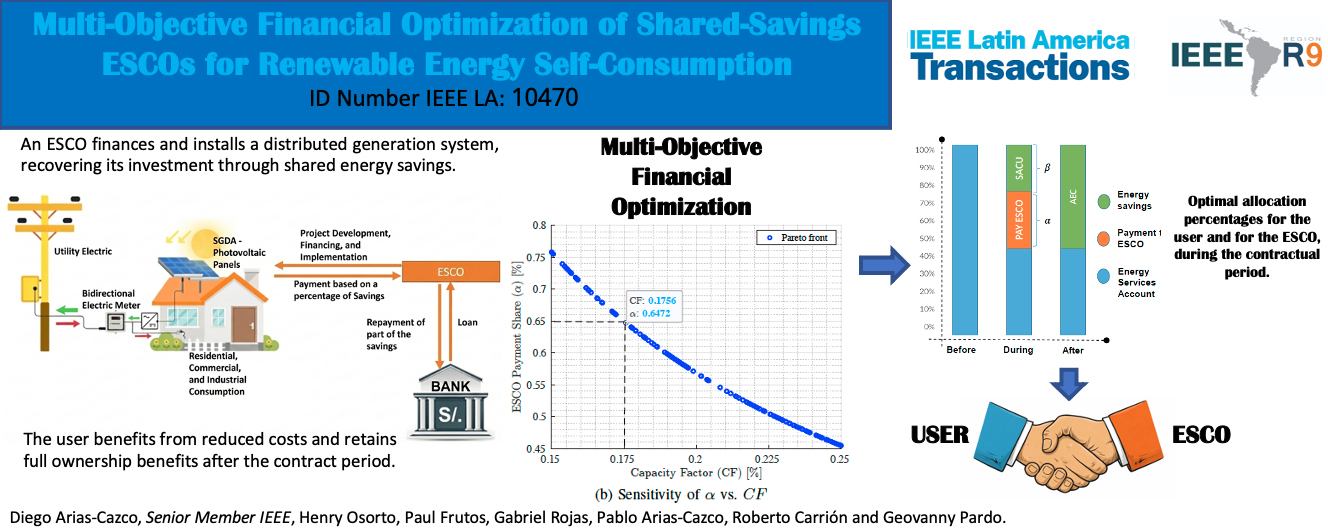
Multi-Objective Financial Optimization of Shared-Savings ESCOs for Renewable Energy Self-Consumption
Keywords:
ESCO, ESPC, Multi-objective Optimization, Pareto Front, Renewable Energy Financing, Levelized Cost, Self- Consumption, Distributed Energy Resources, Project FinancingAbstract
This paper presents a multi-objective optimization model for structuring financially viable contracts in self-supply energy projects based on Energy Service Companies (ESCO). The proposed methodology uses Pareto frontier analysis to evaluate the trade-off between user benefits (through savings allocation, β) and ESCO revenues (through the cost-sharing factor, α), incorporating a levelized cost approach to ensure financial balance under a project finance framework.
Key variables, including the optimal ESCO contract duration and the sensitivity to electricity tariffs, discount rates, and system capacity factor, are analyzed using Pareto frontiers and contour maps to identify regions of optimal financial performance.
The methodology is validated through a case study, demonstrating its applicability for structuring optimal Energy Savings Performance Contracts (ESPC). Additionally, debt coverage indicators (DSCR, LLCR, and PLCR) are incorporated to assess financial feasibility.
The proposed approach provides a robust decision-making tool for users, investors, and regulators seeking sustainable distributed generation business models supported by project financing structures.
Downloads
References
A. Allouhi, “Solar PV integration in commercial buildings for self-consumption based on life-cycle economic/environmental multiobjective optimization,” Journal of Cleaner Production, vol. 270, p. 122375, 2020. DOI: https://doi.org/10.1016/j.jclepro.2020.122375.
E. L. Vine, “Energy services industry,” in Encyclopedia of Energy (C. J. Cleveland, ed.), pp. 437–446, New York: Elsevier, 2004. DOI: https://doi.org/10.1016/B0-12-176480-X/00166-2.
A. V. de Carvalho, L. R. Sanchez, S. Nour, A. Gal, V. Dufresne, P. Langlois, M. Couture-Roy, and S. Flamand, “Guia F: El modelo de negocio ESCO y los contratos de servicios energéticos por desempeño,” tech. rep., Inter-American Development Bank, 2017. DOI: https://doi.org/10.18235/0000788.
A. Piterou and A.-M. Coles, “A review of business models for decentralised energy provision,” Business Strategy and the Environment, 2020. DOI: https://doi.org/10.1002/bse.2709.
A. González, “12 - case study: Integrated design and deployment of a grassroots-based citizen energy community project based on an ESCO business model,” in Energy Communities (C. Cruz, P. Arévalo-Cordero, M. Tostado-Véliz, and F. Jurado, eds.), pp. 219–229, Elsevier, 2026. DOI: https://doi.org/10.1016/B978-0-443-36459-4.00012-9.
P. Bertoldi and B. Boza-Kiss, “Analysis of barriers and drivers for the development of the esco markets in europe,” Energy Policy, vol. 107, pp. 345–355, 2017. DOI: https://doi.org/10.1016/j.enpol.2017.04.023.
A. Febranzah and D. A. Krisprimandoyo, “A risk-adjusted financial feasibility model for ESCOs: Introducing payment from savings (PFS) concept,” Energy Conversion and Management: X, vol. 26, p. 100945, 2025. DOI: https://doi.org/10.1016/j.ecmx.2025.100945.
J. Natividade, C. O. Cruz, and C. M. Silva, “Improving the efficiency of energy consumption in buildings: Simulation of alternative ENPC models,” Sustainability, vol. 14, no. 7, 2022. DOI: https://doi.org/10.3390/su14074228.
A. Allouhi, “Solar pv integration in commercial buildings for self-consumption based on life-cycle economic/environmental multiobjective optimization,” Journal of Cleaner Production, vol. 270,
p. 122375, 2020. DOI: https://doi.org/10.1016/j.jclepro.2020.122375.
J. Kurowska-Pysz and G. Kunikowski, “The esco formula as support for public and commercial energy projects in poland,” Energies, vol. 14, no. 23, 2021. DOI: https://doi.org/10.3390/en14238098.
R. Magalhães, F. Narracci, and J. Lowitzsch, “Crowdfunding and energy efficiency contracting: Exploring new pathways for private investment in building renovations,” FinTech, vol. 4, no. 1, 2025. DOI:
https://doi.org/10.3390/fintech4010006.
H. Guo, S. Jia, M. Wang, and Y. Zhang, “Construction and empirical analysis of esco risk early warning model for energy-saving retrofit project of existing buildings based on cloud matter element theory in china,” Energies, vol. 18, no. 6, 2025. DOI: https://doi.org/10.3390/en18061390.
S. Scarpellini, J. Gimeno, P. Portillo-Tarragona, and E. Llera-Sastresa, “Financial resources for the investments in renewable self-consumption in a circular economy framework,” Sustainability, vol. 13, no. 12, 2021. DOI: https://doi.org/10.3390/su13126838.
N. Okay and U. Akman, “Analysis of ESCO activities using country indicators,” Renewable and Sustainable Energy Reviews, vol. 14, no. 9, pp. 2760–2771, 2010. DOI: https://doi.org/10.1016/j.rser.2010.07.013.
D. Arias-Cazco, P. Gavela, L. Cruz-Panchi, and P. Izquierdo, “Sensitivity analysis for Levelized Cost of Electricity (LCOE) with multiobjective optimization,” IEEE Latin America Transactions, vol. 20, no. 8, pp. 2071–2078, 2022. DOI: https://doi.org/10.1109/TLA.2022.9853227.
D. Arias-Cazco, P. Masache, G. Pardo-Salazar, and L. Cruz-Panchi, “A multi-method sensitivity framework for lcoe under uncertainty: Combining monte carlo, pareto frontier, and contour maps,” in 2025 IEEE Ninth Ecuador Technical Chapters Meeting (ETCM), pp. 1–6, 2025. DOI: https://doi.org/ETCM67548.2025.11304340.
K. Deb, A. Pratap, S. Agarwal, and T. Meyarivan, “A fast and elitist multiobjective genetic algorithm: NSGA-ii,” IEEE Transactions on Evolutionary Computation, vol. 6, no. 2, pp. 182–197, 2002. DOI: https://doi.org/10.1109/4235.996017.
K. Deb, “Multi-objective optimisation using evolutionary algorithms: an introduction,” in Multi objective evolutionary optimisation for product design and manufacturing, pp. 3–34, Springer, 2011. DOI: https://doi.org/10.1007/978-0-85729-652-8_1.