Modeling and Analysis of a Liquid-Cooled Heat Sink for Inverters Used in Hybrid Electric Vehicles
Keywords:
eletric vehicles, liquid cooling, traction inverters, thermal modelingAbstract
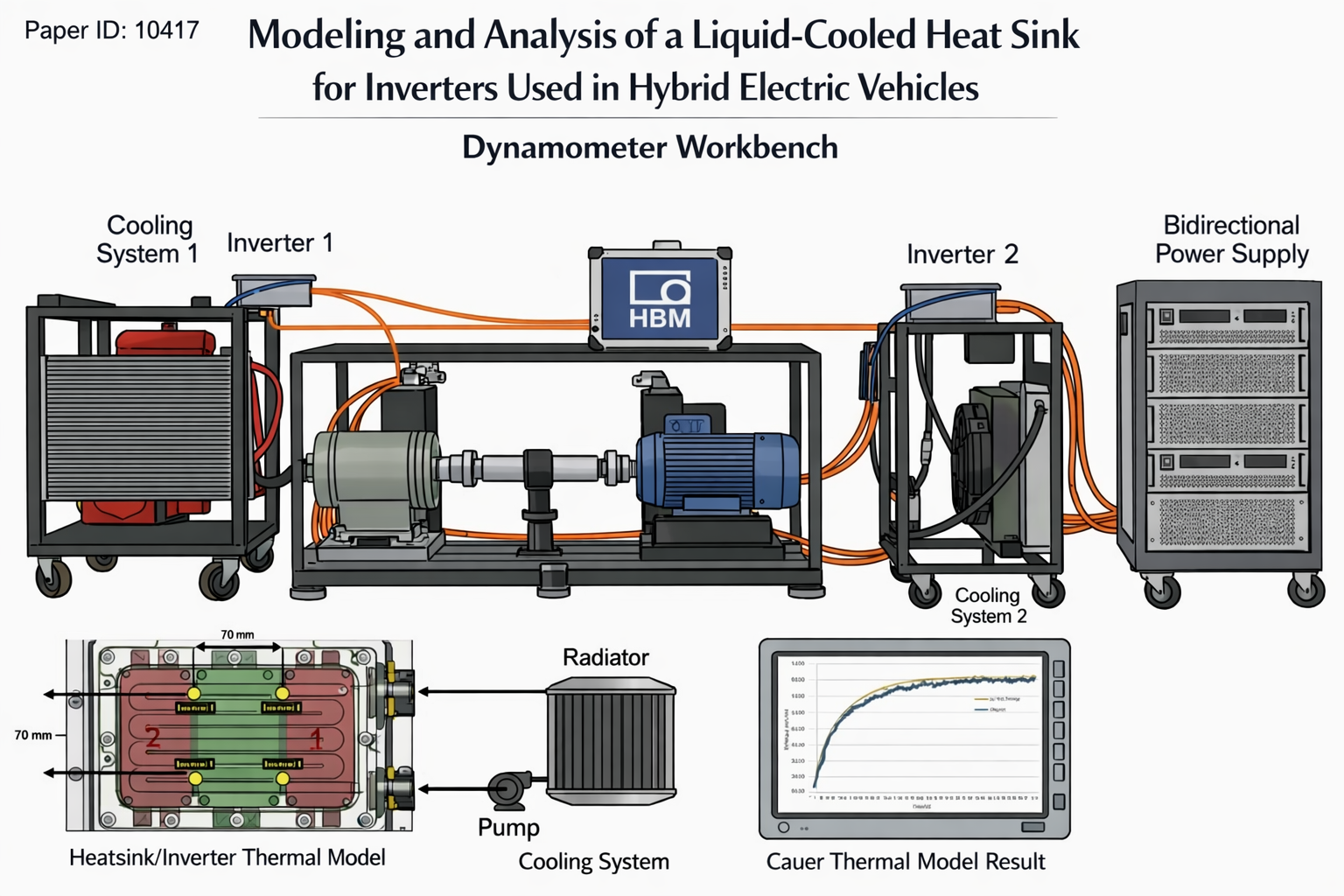
This study presents the experimental characterization and dynamic thermal modeling of a liquid-cooled inverter heatsink for electric vehicle traction applications. The proposed approach considers the entire inverter housing as the heatsink and experimentally validates its thermal behavior under realistic operating conditions. Specifically, the heat transfer system was modeled using a Cauer equivalent circuit. The characterization yielded a thermal resistance of 16.75 m°C/W and a thermal capacitance of 6444.3 J/°C. The model validation was performed on a dynamometer bench with the inverter operating at an input power of 65.86 kW. Under these conditions, the system dissipated 2.34 kW of total power losses, resulting in average IGBT case temperatures of approximately 77 °C. The comparison between the experimental measurements and the model estimates, which predicted a case temperature of 80.48 °C, demonstrates the accuracy and reliability of the developed thermal model for this inverter-heatsink configuration.
Downloads
References
S. M. S. H. Rafin, R. Islam and O. A. Mohammed, "Overview of Power Electronic Converters in Electric Vehicle Applications," 2023 Fourth International Symposium on 3D Power Electronics Integration and Manufacturing (3D-PEIM), Miami, FL, USA, 2023, pp. 1-7. DOI: 10.1109/3D-PEIM55914.2023.10052532
C. Sachs e M. Neuburger, "A Data-Based Review of Battery Electric Vehicle and Traction Inverter Trends," na IECON 2025 - 51st Annual Conference of the IEEE Industrial Electronics Society, 2025. DOI: 10.48550/arXiv.2508.14224
F. Aguilera, P. M. de la Barrera and C. H. De Angelo, “Selection of Induction Machine Models for Efficiency Evaluation in Electric Vehicles,” IEEE Latin America Transactions, vol. 11, no. 1, pp. 334–340, Feb. 2013. DOI: 10.1109/TLA.2013.6502826
P. H. A. S. e. Silva, L. A. B. Viera, R. Camponogara, H. Pinheiro and R. P. Vieira, "Analysis of the Impact of Semiconductor Losses in High-Density Power Inverters," IEEE 8th Southern Power Electronics Conference and 17th Brazilian Power Electronics Conference, 2023, pp. 1-6. DOI: 10.1109/SPEC59248.2023.10355877
T. E. Salem, S. B. Bayne, D. Porschet and Y. Chen, "Thermal performance of water-cooled heat sinks," Twentieth Annual IEEE Applied Power Electronics Conference and Exposition, 2005, pp. 129-133, v.1. DOI: 10.1109/APEC.2005.1452902
P. H. A. S. e. Silva, E. C. Silva, L. R. Rocha, L. A. B. Viera and R. P. Vieira, "Study and Evaluation of Liquid Cooling Heat Sinks for High Power Density Inverters," IEEE 8th Southern Power Electronics Conference and 17th Brazilian Power Electronics Conference, 2023, pp. 1-6. DOI: 10.1109/SPEC59248.2023.10355878
R. Aqeel, M. Aashquin, A. Raza, H. Ali, and S. Ahmed, “Effect of Heat Sink Configuration on the Performance of Thermoelectric Refrigeration,” in Proc. IEEE Latin America Electron Devices Conf. (LAEDC), Apr. 2021, pp. 1-4. DOI: 10.1109/LAEDC51812.2021.9437978.
B. Li, X. Yang, K. Wang, H. Zhu, L. Wang and W. Chen, A compact double-sided cooling 650V/30A GaN power module with low parasitic parameters, IEEE Transactions on Power Electronics, vol. 37, no. 1, pp. 426-439, 2022. DOI: 10.1109/TPEL.2021.3092367
R. Šprlák, D. Kalvar, J. Opluštil and P. Chlebiš, "Design of experimental liquid heat sink for high power electronic," 2014 14th International Conference on Environment and Electrical Engineering, Poland, 2014, pp. 392-396. DOI: 10.1109/EEEIC.2014.6835873
D. DeVoto and P. McCluskey, "Reliability modeling of a single phase liquid cooling system for power electronics applications," 2010 12th IEEE Intersociety Conference on Thermal and Thermomechanical Phenomena in Electronic Systems, Las Vegas, USA, 2010, pp. 1-5. DOI: 10.1109/ITHERM.2010.5501363
P. H. A. S. e Silva, E. C. da Silva, L. R. Rocha, P. R. Eckert and R. P. Vieira, "Analysis and Modeling of a Liquid Cooled Heat Sink for EV Traction Inverter Systems," 2022 IEEE Transportation Electrification Conference & Expo (ITEC), 2022, pp. 825-830. DOI: 10.1109/ITEC53557.2022.9813808
G. R. Bruzinga, A. J. Sguarezi Filho and A. Pelizari, “Analysis and Design of 3 kW Axial Flux Permanent Magnet Synchronous Motor for Electric Car,” IEEE Latin America Transactions, vol. 20, no. 5, pp. 855–863, May 2022. DOI: 10.1109/TLA.2022.9693571
A. Chatterjee, M. Anwar, R. Shivshankar, V. Bhaskar, V. Nukala and N. Bajoria, "Thermal Modelling of EV Inverters: Physical Models to Thermal Networks for Advanced Power Modules," 2025 IEEE Energy Conversion Conference Congress and Exposition (ECCE), Philadelphia, PA, USA, 2025, pp. 1-6. DOI: 10.1109/ECCE58356.2025.11259658.
X. Chen, X. Xu, M. Li, Y. Li and H. Ling, "Prediction of SiC MOSFET Power Modules Junction Temperature for Electric Vehicle Based on Electro-Thermal Coupled Model," 2024 IEEE 22nd International Conference on Industrial Informatics (INDIN), Beijing, China, 2024, pp. 1-6. DOI: 10.1109/INDIN58382.2024.10774495.
A. Kempitiya and W. Chou, "Electro-thermal analysis for automotive high power MOSFETs," 2017 33rd Thermal Measurement, Modeling & Management Symposium (SEMI-THERM), San Jose, CA, USA, 2017, pp. 302-305. DOI: 10.1109/SEMI-THERM.2017.7896945.
V. Ravindra, P. Elango and P. Prasad, "Experimental Investigation of Flow and Thermal Characteristics of Traction Inverter cold plate," 2025 IEEE Energy Conversion Congress & Exposition Asia (ECCE-Asia), Bengaluru, India, 2025, pp. 1-6. DOI: 10.1109/ECCE-Asia63110.2025.11112026.
G. Moreno et al., "Evaluation of Heat Spreading Technologies Within Double-Side-Cooled Power Modules," 2025 Fifth International Symposium on 3D Power Electronics Integration and Manufacturing (3D-PEIM), Denver, CO, USA, 2025, pp. 1-8. DOI: 10.1109/3D-PEIM64703.2025.11180271.
V. Ravindra, P. Elango and P. Prasad, "Experimental Investigation of Flow and Thermal Characteristics of Traction Inverter cold plate," 2025 IEEE Energy Conversion Congress & Exposition Asia (ECCE-Asia), Bengaluru, India, 2025, pp. 1-6. DOI: 10.1109/ECCE-Asia63110.2025.11112026.
L. Zhou et al., "Reliability Study of Die Attachments in SiC Power Modules with Thermal Balancing Control," 2025 IEEE/AIAA Transportation Electrification Conference and Electric Aircraft Technologies Symposium (ITEC+EATS), Anaheim, CA, USA, 2025, pp. 1-5. DOI: 10.1109/ITEC63604.2025.11097929.
C. Zhang and R. Negri, "Analysis of Coolant Transients Impact on SiC Power Module in Traction Inverter," PCIM Conference 2025; International Exhibition and Conference for Power Electronics, Intelligent Motion, Renewable Energy and Energy Management, Nürnberg, Germany, 2025, pp. 2790-2795. DOI: 10.30420/566541374.
D. A. B. Zambra, L. M. Abdalla, P. H. Conrado, A. R. Rauber, and L. R. Colpo, “Evaluating a Liquid Cooled Heatsink for Drive Systems used in Hybrid Electric Vehicles,” in INDUSCON 2025 - IEEE International Conference on Industry Applications, 2025, pp. 1–6. DOI: 10.1109/INDUSCON66435.2025.11241641.
Siemens AG, “PT100 Resistance Thermometer, Technical Data,” Document No. CA1N1714E, Nov. 1998. Available: https://sid.siemens.com/v/u/20052
Datasheet: EconoDUAL™3 module with Trench/Fieldstop IGBT4 and emitter controlled HE diode and PressFIT / NTC - FF225R12ME4_B11, Infineon Technologies AG, Munich, DE, 2024, p. 14. Available: https://www.infineon.com/
FLIR Systems, “FLIR E4 Infrared Camera Datasheet,” Publ. No. 63901-0101, Dec. 2014. Available: https://www.flir.com/pt-br/products/e4/
Technical Information: Transient thermal measurements and thermal equivalent circuit models – AN2015-10, Infineon Technologies AG, Munich, DE, p. 11. Available: https://www.infineon.com/
K. Murthy and R. Bedford, "Transformation between Foster and Cauer equivalent networks," in IEEE Transactions on Circuits and Systems, vol. 25, no. 4, pp. 238-239, April 1978. DOI: 10.1109/TCS.1978.1084459.