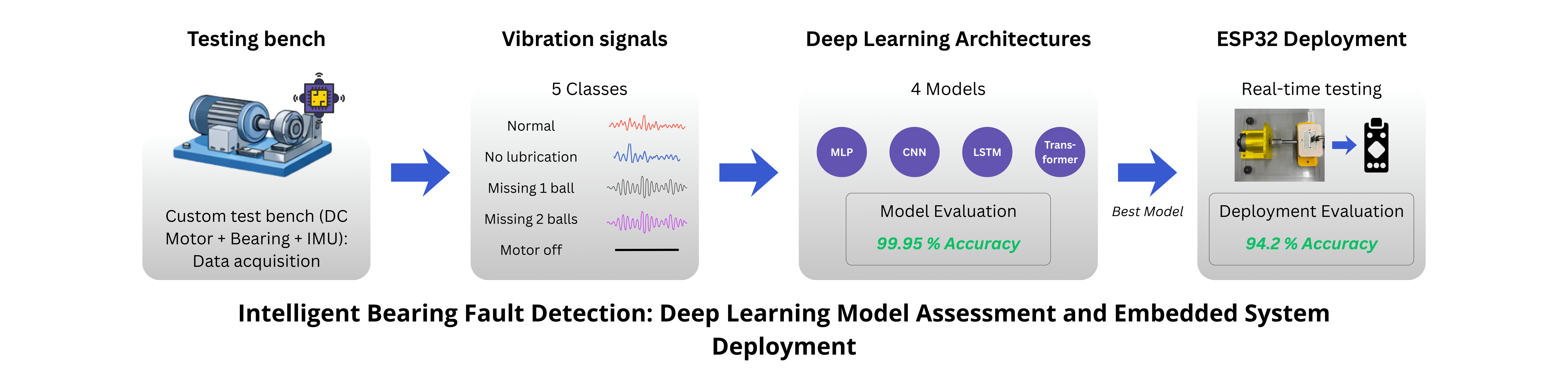
Intelligent Bearing Fault Detection: Deep Learning Model Assessment and Embedded System Deployment
Keywords:
Artificial Intelligence, Ball bearings, Data acquisition, Data analysis, Deep Learning, Spectral Analysis, TinyML, Vibration measurementAbstract
Bearings are vital parts used in many industrial settings; however, their failures can greatly reduce system efficiency and operational reliability. In this context, AI-driven predictive maintenance is an effective approach for identifying and classifying bearing faults via vibration analysis. This study creates a custom dataset by recording vibration signals from a DC motor operating under various fault conditions (bearing without lubrication, bearing with one missing ball, and bearing with two missing balls), as well as under normal operation (bearing without failure), using an accelerometer and a controlled test bench. Furthermore, four neural network models — Multilayer Perceptron (MLP), Convolutional Neural Network (CNN), Long Short-Term Memory (LSTM), and Transformer — were trained and evaluated based on accuracy, recall, and F1-score. The CNN model performed best, achieving a 99.95% accuracy on the validation dataset. This model was then implemented on an ESP32, reaching 94.2% accuracy during real-time testing. These results demonstrate that AI-based fault detection systems can be effectively deployed on resource-limited platforms, providing a promising solution for predictive maintenance and educational efforts to boost STEM skills.
Downloads
References
F. Xu, N. Ding, N. Li, L. Liu, N. Hou, N. Xu, W. Guo, L. Tian, H. Xu, C. L. Wu, X. Wu, and X. Chen, “A review of bearing failure modes, mechanisms, and causes,” Eng. Fail. Anal., vol. 152, Art. no. 107518, Oct. 2023, doi: 10.1016/j.engfailanal.2023.107518.
L. S. Sawaqed and A. M. Alrayes, “Bearing fault diagnostic using machine learning algorithms,” Prog. Artif. Intell., vol. 9, no. 4, pp. 341–350, Oct. 2020, doi: 10.1007/s13748-020-00217-z.
S. Nandi, H.A. Toliyat, and X. Li, “Condition Monitoring and Fault Diagnosis of Electrical Motors—A Review,” IEEE Trans. Energy Convers., vol. 20, no. 4, pp. 719–729, Dec. 2005, doi: 10.1109/TEC.2005.847955.
J. Vargas-Machuca, F. García, and A. M. Coronado, “Detailed Comparison of Methods for Classifying Bearing Failures Using Noisy Measurements,” J. Failure Anal. Prev., vol. 20, no. 3, pp. 744–754, May 2020, doi: 10.1007/s11668-020-00872-3.
S. Zhang, S. Zhang, B. Wang, and T. G. Habetler, “Deep Learning Algorithms for Bearing Fault Diagnostics—A Comprehensive Review,” IEEE Access, vol. 8, pp. 29857–29881, 2020, doi: 10.1109/access.2020.2972859.
W. Olarte, M. Botero, and B. A. Cañon, “ANÁLISIS DE VIBRACIONES: UNA HERRAMIENTA CLAVE EN EL MANTENIMIENTO PREDICTIVO,” Scientia Et Technica, vol. 16, no. 45, pp. 219–222, 2010. [Online]. Available: https://www.redalyc.org/articulo.oa?id=84917249040.
W. Qian, S. Li, and X. Jiang, “Deep transfer network for rotating machine fault analysis,” Pattern Recognit., vol. 96, Art. no. 106993, Dec. 2019, doi: 10.1016/j.patcog.2019.106993.
M. H. M. Ghazali, and W. Rahiman, “Vibration Analysis for Machine Monitoring and Diagnosis: A Systematic Review,” Shock Vib., vol. 2021, no. 1, Art. no. 9469318, 2021, doi: 10.1155/2021/9469318.
D.-T. Hoang and H.-J. Kang, “Rolling element bearing fault diagnosis using convolutional neural network and vibration image,” Cogn. Syst. Res., vol. 53, pp. 42–50, Mar. 2018, doi: 10.1016/j.cogsys.2018.03.002.
D. H. Carvalho, D. P. Viana, A. A. Lima, M. F. Pinto, L. Tarrataca, F. L. Silva, R. H. Ramirez, T. Moura, U. A. Barbosa, and D. Barreto, “Diagnostic and severity analysis of combined failures composed by imbalance and misalignment in rotating machines,” Int. J. Adv. Manuf. Technol., vol. 114, pp. 3077–3092, Apr. 2021, doi: 10.1007/s00170-021-06873-2.
A. Khorram, M. Khalooei, and M. Rezghi, “End-to-end CNN + LSTM deep learning approach for bearing fault diagnosis,” Appl. Intell., vol. 51, pp. 736–751, Aug. 2020, doi: 10.1007/s10489-020-01859-1.
V. K, A. Rajakannu, M. Kamarudden, R. KP, and S. R. A V, “Intelligent Fault Diagnosis of Rotating Machinery Using Deep Learning Algorithms: A Comparative Analysis of MLP, CNN, RNN, and LSTM,” Int. J. Electr. Electron. Eng., vol. 11, no. 9, pp. 294–315, Sep. 2024, doi: 10.14445/23488379/ijeee-v11i9p127.
S. Gao, L. Xu, Y. Zhang, and Z. Pei, “Rolling bearing fault diagnosis based on SSA optimized self-adaptive DBN,” ISA Trans., vol. 128, pp. 485–502, Sep. 2022, doi: 10.1016/j.isatra.2021.11.024.
M. A. Jamil and S. Khanam, “Fault Classification of Rolling Element Bearing in Machine Learning Domain,” Int. J. Acoust. Vib., vol. 27, no. 2, pp. 77–90, Jun. 2022, doi: 10.20855/ijav.2022.27.21829.
A. F. Cotrino, J. A. López, J. C. Blandón, and A. Toro Lazo, “Low-cost prototype for bearing failure detection using Tiny ML through vibration analysis,” HardwareX, vol. 22, pp. e00658–e00658, May 2025, doi: 10.1016/j.ohx.2025.e00658.
C. G. Northcutt, A. Athalye, and J. Mueller, “Pervasive label errors in test sets destabilize machine learning benchmarks,” in Proc. 35th Conf. Neural Inf. Process. Syst. (NeurIPS), Virtual Conf., Dec. 2021, pp. 1–15.
S. Mohammed, L. Budach, M. Feuerpfeil, N. Ihde, A. Nathansen, N. Noack, H. Patzlaff, F. Naumann, and H. Harmouch, “The effects of data quality on machine learning performance on tabular data,” Inf. Syst., vol. 132, Art. no. 102549, Mar. 2025, doi: 10.1016/j.is.2025.102549.
R. Liu, B. Yang, E. Zio, and X. Chen, “Artificial intelligence for fault diagnosis of rotating machinery: A review,” Mech. Syst. Signal Process., vol. 108, pp. 33–47, Aug. 2018, doi: 10.1016/j.ymssp.2018.02.016.
Y. Chen, B. Zheng, Z. Zhang, Q. Wang, C. Shen, and Q. Zhang, “Deep Learning on Mobile and Embedded Devices,” ACM Comput. Surv., vol. 53, no. 4, pp. 1–37, Aug. 2020, doi: 10.1145/3398209.
Edge Impulse, “Edge Impulse,” [Online]. Available: https://edgeimpulse.com.
N. M. Foumani, L. Miller, C. W. Tan, G. I. Webb, G. Forestier, and M. Salehi, “Deep Learning for Time Series Classification and Extrinsic Regression: A Current Survey,” ACM Comput. Surv., vol. 56, no. 9, Art. no. 217, pp. 1–45, Apr. 2024, doi: 10.1145/3649448.
J. Chen and X. Ran, “Deep Learning with Edge Computing: A Review,” Proc. IEEE, vol. 107, no. 8, pp. 1655–1674, Jul. 2019, doi: 10.1109/jproc.2019.2921977.
W. Roth, G. Schindler, B. Klein, R. Peharz, S. Tschiatschek, H. Fröning, F. Pernkopf, and Z. Ghahramani, “Resource-Efficient Neural Networks for Embedded Systems,” J. Mach. Learn. Res., vol. 25, no. 1, Art. no. 50, pp. 2506-2556, Jan. 2024, doi: 10.5555/3722577.3722627.
A. A. Lakis, “Rotating machinery fault diagnosis using time-frequency methods,” in Proc. 7th WSEAS Int. Conf. Elect. Pow. Syst., High Volt., Elect. Mach., Venice, Italy, Nov. 2007, pp. 139–144.
Dynamox, “Análisis espectral: cómo aplicarlo para analizar las vibraciones en activos industriales,” 2024. [Online]. Available: https://dynamox.net/es/blog/analisis-espectral-como-aplicarlo-para-analizar-las-vibraciones-en-activos-industriales.
Edge Impulse (s.f) “Using the Edge Impulse Python SDK with TensorFlow and Keras,” [Online]. Available: https://docs.edgeimpulse.com/docs/tutorials/ml-and-data-engineering/ei-python-sdk/python-sdk-with-tf-keras.