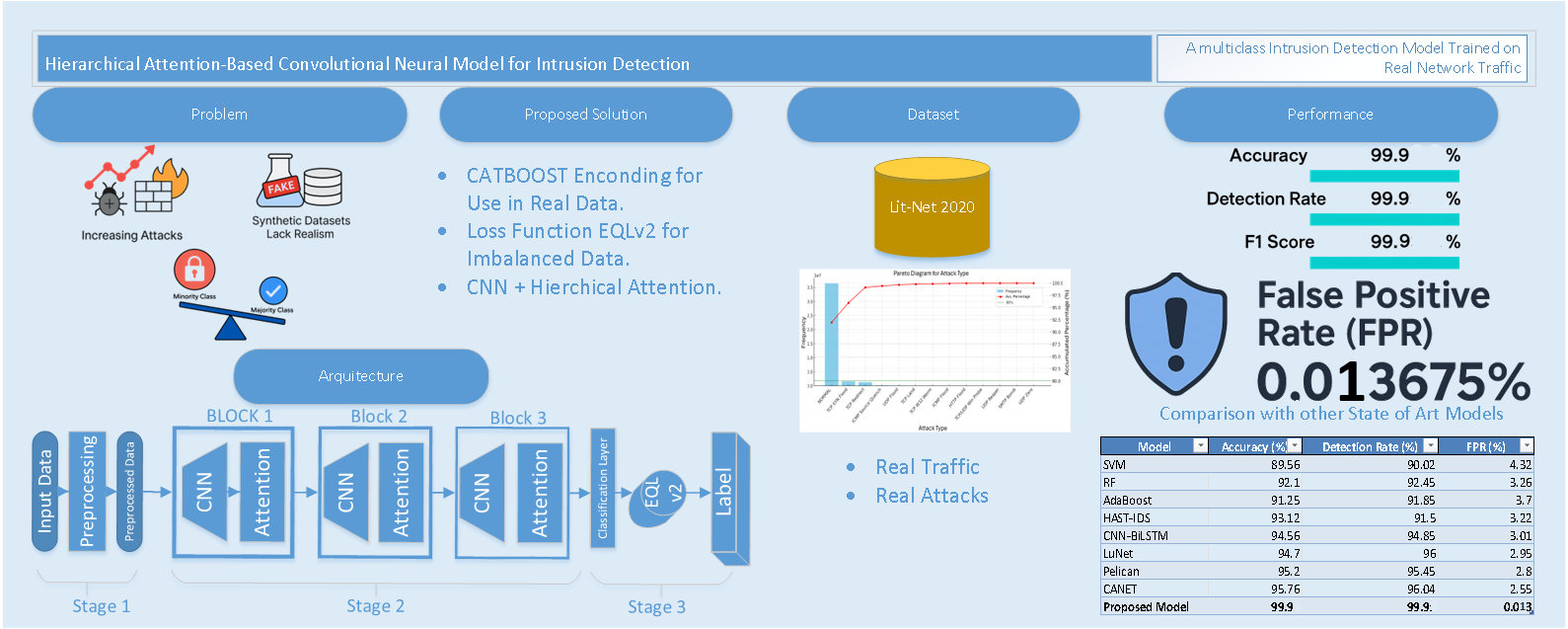
Hierarchical Attention-Based Convolutional Neural Network Model for Intrusion Detection
Keywords:
Intrusion detection, convolutional neural networks, real data, cybersecurity, deep learningAbstract
The increasing scale and complexity of internet-connected systems demand robust intrusion detection under realistic traffic conditions. This study presents H.A.L.C.CO.N (Hierarchical Attention-based Loss Equalization with CatBoost-enhanced Convolutional Neural Network), a multiclass intrusion detection model evaluated on the real-world LITNET-2020 dataset. The model integrates convolutional feature extraction, hierarchical attention, CatBoost-based encoding for high-cardinality categorical features, and Equalization Loss V2 (EQLv2) to address severe class imbalance. Experimental results show strong performance, achieving a detection rate of 99.997%, an F1-score of 99.997%, an accuracy of 99.996%, and a false positive rate of 0.0135%. These findings indicate that H.A.L.C.CO.N is an effective and practical solution for real-world multiclass intrusion detection.
Downloads
References
L. Wenchao, Y. Ping, W. Yue, P. Li, and L. Jianhua, “A new intrusion detection system based on knn classification algorithm in wireless sensor network,” Journal of Electrical and Computer Engineering, vol. 78, 2014. [Online]. Available: https://doi.org/10.1155/2014/240217
S. Wagh, V. K. Pachghare, and S. R. Kolhe, “Survey on intrusion detection system using machine learning techniques,” International Journal of Computer Applications, vol. 78, 2013. [Online]. Available: https://doi.org/10.5120/13608-1412
R. Vinayakumar, M. Alazab, K. P. Soman, P. Poornachandran, A. Al-Nemrat, and S. Venkatraman, “Deep learning approach for intelligent intrusion detection system,” IEEE Access, vol. 7, pp. 41525–41550, 2019. [Online]. Available: https://doi.org/10.1109/ACCESS.2019.2895334
J. Yan, D. Jin, C. W. Lee, and P. Liu, “A comparative study of off-line deep learning based network intrusion detection,” 2018 Tenth International Conference on Ubiquitous and Future Networks (ICUFN), pp. 299–304, 2018. [Online]. Available: https://doi.org/10.1109/ICUFN.2018.8436774
K. Ren, S. Yuan, C. Zhang, Y. Shi, and Z. Huang, “CANET: A hierarchical CNN-attention model for network intrusion detection,” Computer Communications, vol. 205, pp. 170–181, 2023. [Online]. Available: https://doi.org/10.1016/j.comcom.2023.04.018
J. Tan, X. Lu, G. Zhang, C. Yin, and Q. Li, “Equalization loss v2: A new gradient balance approach for long-tailed object detection,” 2021 IEEE/CVF Conference on Computer Vision and Pattern Recognition (CVPR), pp. 1685–1694, 2021. [Online]. Available: https://doi.org/10.1109/CVPR46437.2021.00173
N. Moustafa and J. Slay, “UNSW-NB15: A comprehensive data set for network intrusion detection systems (UNSW-NB15 network data set),” in 2015 Military Communications and Information Systems Conference (MilCIS), 2015, pp. 1–6. [Online]. Available: https://doi.org/10.1109/MilCIS.2015.7348942
R. Damasevicius, A. Venckauskas, S. Grigaliunas, J. Toldinas, N. Morkevicius, T. Aleliunas, and P. Smuikys, “LITNET-2020: An annotated real-world network flow dataset for network intrusion detection,” Electronics, vol. 9, no. 5, p. 800, 2020. [Online]. Available: https://doi.org/10.3390/electronics9050800
A. Khraisat, I. Gondal, P. Vamplew, and J. Kamruzzaman, “Survey of intrusion detection systems: techniques, datasets and challenges,” Cybersecurity, vol. 2, no. 1, p. 20, Jul. 2019. [Online]. Available: https://doi.org/10.1186/s42400-019-0038-7
I. Ahmad, M. Basheri, M. J. Iqbal, and A. Rahim, “Performance comparison of support vector machine, random forest, and extreme learning machine for intrusion detection,” IEEE Access, vol. 6, pp. 33789–33795, 2018. [Online]. Available: https://doi.org/10.1109/ACCESS.2018.2841987
W. Hu, J. Gao, Y. Wang, O. Wu, and S. Maybank, “Online Adaboost-based parameterized methods for dynamic distributed network intrusion detection,” IEEE Transactions on Cybernetics, vol. 44, no. 1, pp. 66–82, 2014. [Online]. Available: https://doi.org/10.1109/TCYB.2013.2247592
W. Wang, Y. Sheng, J. Wang, X. Zeng, X. Ye, Y. Huang, and M. Zhu, “HAST-IDS: Learning hierarchical spatial-temporal features using deep neural networks to improve intrusion detection,” IEEE Access, vol. 6, pp. 1792–1806, 2018. [Online]. Available: https://doi.org/10.1109/ACCESS.2017.2780250
J. Sinha and M. Manollas, “Efficient deep CNN-BiLSTM model for network intrusion detection,” in Proceedings of the 2020 3rd International Conference on Artificial Intelligence and Pattern Recognition, 2020, pp. 223–231. [Online]. Available: https://doi.org/10.1145/3430199.3430224
P. Wu, H. Guo, and N. Moustafa, “Pelican: A deep residual network for network intrusion detection,” in 2020 50th Annual IEEE/IFIP International Conference on Dependable Systems and Networks Workshops (DSN-W), 2020, pp. 55–62. [Online]. Available: https://doi.org/10.1109/DSN-W50199.2020.00018
S. Chaudhari, G. Polatkan, R. Ramanath, and V. Mithal, “A comprehensive review of attention mechanisms in deep learning,” arXiv preprint arXiv:1904.02874, 2020. [Online]. Available: https://doi.org/10.48550/arXiv.1904.02874
J. Kim, J. Kim, and H. K. Kim, “Attention-based recurrent neural network for network intrusion detection,” 2018 International Conference on Big Data and Smart Computing (BigComp), pp. 313–316, 2018. [Online]. Available: https://doi.org/10.1109/BIGCOMP.2018.00055
R. Sommer and V. Paxson, “Outside the closed world: On using machine learning for network intrusion detection,” 2010 IEEE Symposium on Security and Privacy, pp. 305–316, 2010. [Online]. Available: https://doi.org/10.1109/SP.2010.25
I. Sharafaldin, A. H. Lashkari, S. Hakak, and A. A. Ghorbani, “Developing realistic distributed denial of service (DDoS) attack dataset and taxonomy,” in 2019 International Carnahan Conference on Security Technology (ICCST), 2019, pp. 1–8. [Online]. Available: https://doi.org/10.1109/CCST.2019.8888419
L. Prokhorenkova, G. Gusev, A. Vorobev, A. V. Dorogush, and A. Gulin, “CatBoost: unbiased boosting with categorical features,” Advances in Neural Information Processing Systems, vol. 31, 2018. [Online]. Available: https://doi.org/10.48550/arXiv.1810.11363
P. Wu and H. Guo, “LuNet: A deep neural network for network intrusion detection,” in 2019 IEEE Symposium Series on Computational Intelligence (SSCI), 2019, pp. 617–624. [Online]. Available: https://doi.org/10.1109/SSCI44817.2019.9003126