Synthetic Dataset Generation for Tomato Ripening Stage Detection in Different Scenes
Keywords:
Synthetic data, YOLO, Tomato ripening stages, Genetic algorithm, OptimizationAbstract
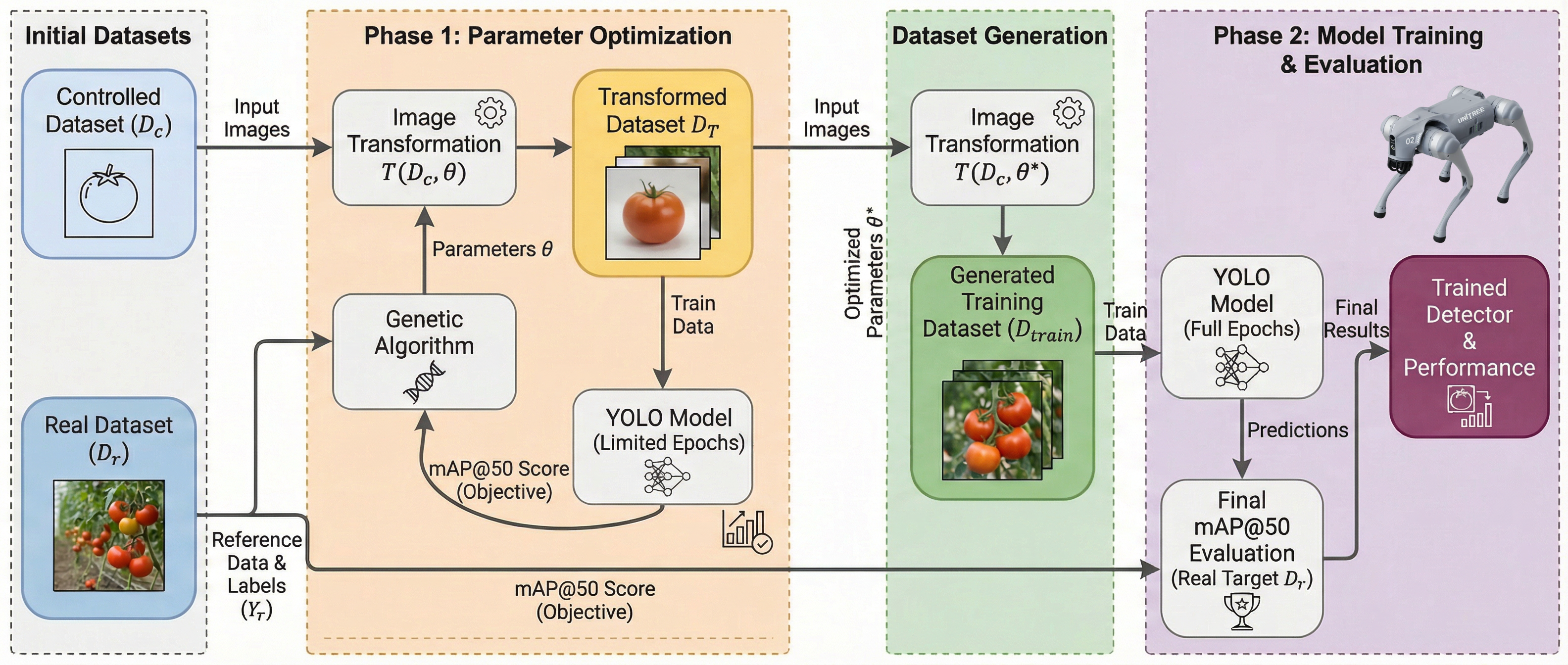
The development of intelligent robotic systems for agriculture depends on large and representative datasets, which are essential for training computer vision models. However, the availability of public datasets in this area is limited, hindering the implementation and improvement of these technologies. To address this problem, we propose a methodology for synthetic dataset generation. This methodology includes the automated creation of datasets optimized through evolutionary algorithms, thereby improving the quality and diversity of the generated data. To validate the method, we tested it in a case study: the detection of tomato ripening stages in greenhouses. The experiments showed that training a detector (YOLOv5m model) with this synthetic data significantly improves its performance in real scenarios, increasing detection from null to acceptable performance. These results validate the effectiveness of synthetic data generation as a viable and affordable alternative to compensate for the shortage of agricultural datasets.
Downloads
References
H. Nie, X. Yang, S. Zheng, and L. Hou, “Gene-based developments in improving quality of tomato: Focus on firmness, shelf life, and pre-and post-harvest stress adaptations,” Horticulturae, vol. 10, no. 6, p. 641, 2024, DOI: https://doi.org/10.3390/horticulturae10060641.
T. A. Teka, “Analysis of the effect of maturity stage on the postharvest biochemical quality characteristics of tomato (lycopersicon esculentum mill.) fruit,” International Research Journal of Pharmaceutical and Applied Sciences, vol. 3, no. 5, pp. 180–186, 2013, ISSN: 2277-4149.
Y. Edan, G. Adamides, and R. Oberti, “Agriculture automation,” Springer handbook of automation, pp. 1055–1078, 2023, DOI:
https://doi.org/10.1007/978-3-030-96729-1 49.
K. H. Coble, A. K. Mishra, S. Ferrell, and T. Griffin, “Big data in agriculture: A challenge for the future,” Applied Economic
Perspectives and Policy, vol. 40, no. 1, pp. 79–96, 2018, DOI: https://doi.org/10.1093/aepp/ppx056.
N. Giakoumoglou, E. M. Pechlivani, and D. Tzovaras, “Generate-paste-blend-detect: Synthetic dataset for object detection in the agriculture domain,” Smart Agricultural Technology, vol. 5, p. 100258, 2023, DOI: https://doi.org/10.1016/j.atech.2023.100258.
M. Afonso and V. Giufrida, “Synthetic data for computer vision in agriculture,” Frontiers in Plant Science, vol. 14, p. 1277073, 2023, DOI:
https://doi.org/10.3389/fpls.2023.1277073.
S. Wimmer and R. Finger, “A note on synthetic data for replication purposes in agricultural economics,” Journal of Agricultural Economics, vol. 74, no. 1, pp. 316–323, 2023, DOI: https://doi.org/10.1111/1477-9552.12505.
D. Wu, S. Jiang, E. Zhao, Y. Liu, H. Zhu, W. Wang, and R. Wang, “Detection of camellia oleifera fruit in complex scenes by using yolov7
and data augmentation,” Applied sciences, vol. 12, no. 22, p. 11318, 2022, DOI: https://doi.org/10.3390/app122211318.
P. Enkvetchakul and O. Surinta, “Effective data augmentation and training techniques for improving deep learning in plant leaf disease recognition,” Applied Science and Engineering Progress, vol. 15, no. 3, pp. 3810–3810, 2022, DOI: https://doi.org/10.14416/j.asep.2021.01.003.
R. Nithya, B. Santhi, R. Manikandan, M. Rahimi, and A. H. Gandomi, “Computer vision system for mango fruit defect detection using deep convolutional neural network,” foods, vol. 11, no. 21, p. 3483, 2022, DOI: https://doi.org/10.3390/foods11213483.
J. J. Bird, C. M. Barnes, L. J. Manso, A. Ek´art, and D. R. Faria, “Fruit quality and defect image classification with conditional gan data
augmentation,” Scientia Horticulturae, vol. 293, p. 110684, 2022, DOI: https://doi.org/10.1016/j.scienta.2021.110684.
L. Divyanth, D. Guru, P. Soni, R. Machavaram, M. Nadimi, and J. Paliwal, “Image-to-image translation-based data augmentation for
improving crop/weed classification models for precision agriculture applications,” Algorithms, vol. 15, no. 11, p. 401, 2022, DOI: https://doi.org/10.3390/a15110401.
B. Min, T. Kim, D. Shin, and D. Shin, “Data augmentation method for plant leaf disease recognition,” Applied Sciences, vol. 13, no. 3, p. 1465, 2023, DOI: https://doi.org/10.3390/app13031465.
H. Tan, Y. Hu, B. Ma, G. Yu, and Y. Li, “An improved dcgan model: Data augmentation of hyperspectral image for identification pesticide residues of hami melon,” Food Control, vol. 157, p. 110168, 2024, DOI: https://doi.org/10.1016/j.foodcont.2023.110168.
M. Momeny, A. Jahanbakhshi, A. A. Neshat, R. Hadipour-Rokni, Y.-D. Zhang, and Y. Ampatzidis, “Detection of citrus black spot disease and ripeness level in orange fruit using learning-to-augment incorporated deep networks,” Ecological Informatics, vol. 71, p. 101829, 2022, DOI: https://doi.org/10.1016/j.ecoinf.2022.101829.
G. Dai, J. Fan, Z. Tian, and C. Wang, “Pplc-net: Neural network-based plant disease identification model supported by weather data
augmentation and multi-level attention mechanism,” Journal of King Saud University-Computer and Information Sciences, vol. 35, no. 5, p.101555, 2023, DOI: https://doi.org/10.1016/j.jksuci.2023.101555.
A. Rahman, Y. Lu, and H. Wang, “Performance evaluation of deep learning object detectors for weed detection for cotton,”
Smart Agricultural Technology, vol. 3, p. 100126, 2023, DOI: https://doi.org/10.1016/j.atech.2022.100126.
H. Li, W. Guo, G. Lu, and Y. Shi, “Augmentation method for high intra-class variation data in apple detection,” Sensors, vol. 22, no. 17, p. 6325,2022, DOI: https://doi.org/10.3390/s22176325.
X. Fu, S. Zhao, C. Wang, X. Tang, D. Tao, G. Li, L. Jiao, and D. Dong, “Green fruit detection with a small dataset under a similar
color background based on the improved yolov5-at,” Foods, vol. 13, no. 7, p. 1060, 2024, DOI: https://doi.org/10.3390/foods13071060.
J. Gao, J. Zhang, F. Zhang, and J. Gao, “Lacta: A lightweight and accurate algorithm for cherry tomato detection in unstructured environments,” Expert systems with applications, vol. 238, p. 122073, 2024, DOI: https://doi.org/10.1016/j.eswa.2023.122073.
A. Martinez Guevara, “Desarrollo e implementaci´on de un sistema inteligente para clasificaci´on de tomates (solanum lycopersicum),” Ph.D. dissertation, Universidad Aut´onoma de Chapingo, 2021.
T. et al., “Labelimg.” [Online]. Available: https://github.com/heartexlabs/labelImg
I. Goodfellow, Y. Bengio, and A. Courville, Deep Learning. MIT Press, 2016, http://www.deeplearningbook.org.
A. E. Eiben and J. E. Smith, “Introduction to evolutionary computing,” 2015,” DOI: https://doi.org/10.1007/978-3-662-44874-8.