Hybrid IRS–NOMA Framework for Turbulence Resilient Underwater Visible Light Communication
Keywords:
Underwater Visible Light Communication, Non-Orthogonal Multiple Access, Intelligent Reflecting Surface, EGG DistributionAbstract
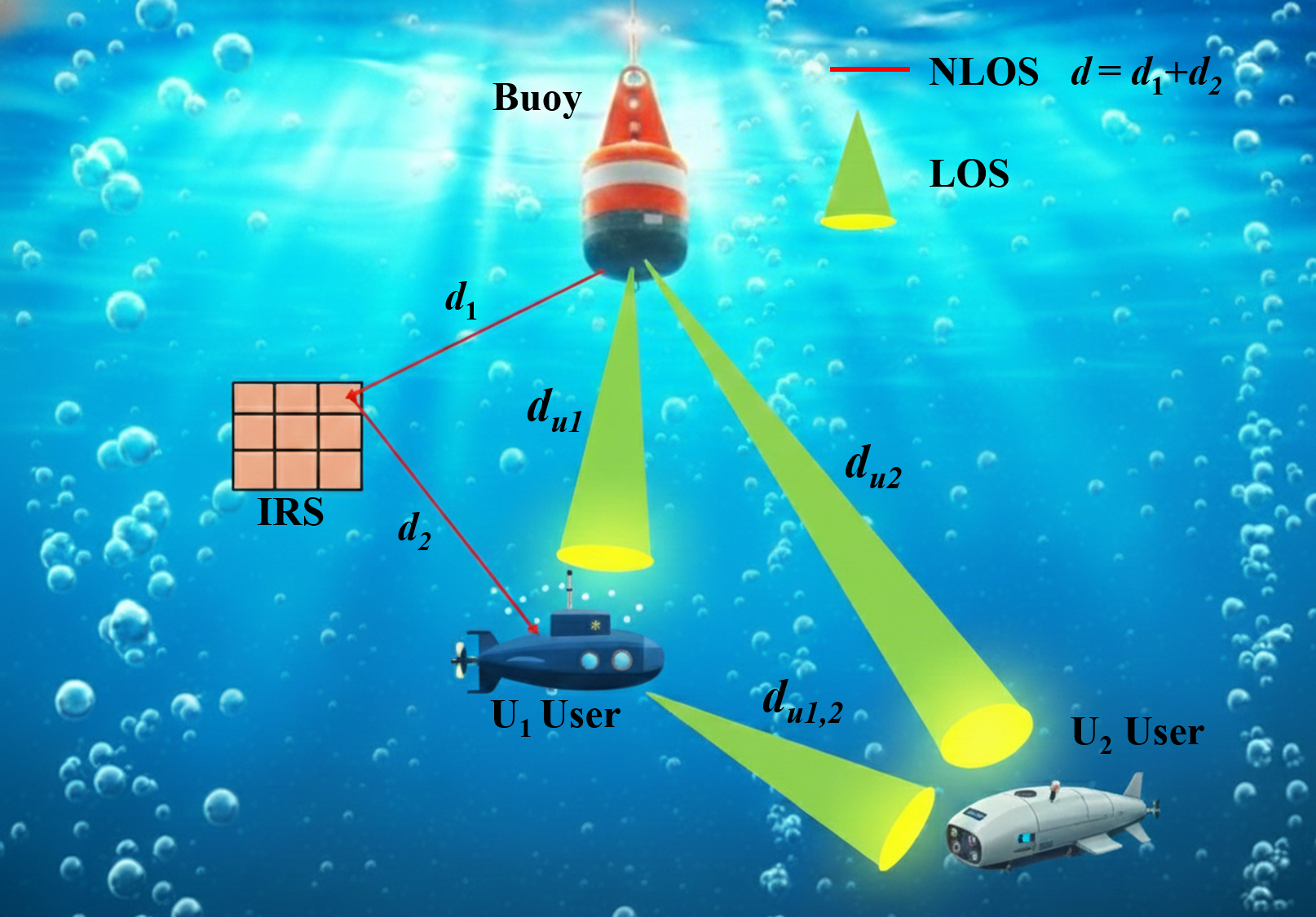
Underwater Visible Light Communication (UVLC) offers high data rates, low latency, and strong physical-layer security, making it as an alternative to acoustic and RF systems for real-time underwater applications. However, its performance is severely degraded by absorption, scattering, and turbulence-induced fading. To enhance link reliability, recent advances in Non-Orthogonal Multiple Access (NOMA) and Intelligent Reflecting Surfaces (IRS) are being integrated into UVLC systems. NOMA enables simultaneous multiuser access through power-domain multiplexing, improving spectral efficiency and connectivity, while IRS enhances signal strength and coverage by intelligently reflecting and directing optical beams. Motivated by these benefits, we propose a hybrid IRS–NOMA framework for UVLC to improve link reliability and mitigate turbulence effects. A composite channel model is formulated by combining direct and IRS-reflected paths under absorption, scattering, and turbulence modeled using the Exponential Generalized Gamma (EGG) distribution with pointing errors. Closed-form expressions for the outage probability and average bit error rate (ABER) are derived in terms of the Meijer-$G$ function. System performance is evaluated under various configurations, and Monte Carlo simulations validate the analytical results, demonstrating excellent match and highlighting the effectiveness of the proposed IRS–NOMA-assisted UVLC design.
Downloads
References
Z. Zeng, S. Fu, H. Zhang, Y. Dong, and J. Cheng, “A survey
of underwater optical wireless communications,” IEEE Communica-
JOURNAL OF LATEX CLASS FILES, VOL. 14, NO. 8, AUGUST 2021 9
tions Surveys & Tutorials, vol. 19, no. 1, pp. 204–238, 2017, doi:
1109/COMST.2016.2618841.
V. L. Jayaweera, C. Peiris, D. Darshani, S. Edirisinghe, N. Dharmaweera,
and U. Wijewardhana, “Visible light communication for underwater
applications: Principles, challenges, and future prospects,” Photonics,
vol. 12, no. 6, 2025, doi: 10.3390/photonics12060593.
A. S. Abrar and M. Rani, “Underwater visible light communication:
recent advancements and channel modeling,” Journal of Optics, pp. 1–
, 2025, doi: https://doi.org/10.1007/s12596-025-02839-9.
J. Merin Joshiba, D. Judson, and V. Bhaskar, “A comprehensive review
on noma assisted emerging techniques in 5g and beyond 5g wireless
systems,” Wireless Personal Communications, vol. 130, no. 4, pp. 2385–
, 2023, doi: https://doi.org/10.1007/s11277-023-10384-6.
L. Dai, B. Wang, Y. Yuan, S. Han, I. Chih-lin, and Z. Wang, “Nonorthogonal multiple access for 5g: solutions, challenges, opportunities,
and future research trends,” IEEE Communications Magazine, vol. 53,
no. 9, pp. 74–81, 2015, doi: 10.1109/MCOM.2015.7263349.
M. Jain, N. Sharma, A. Gupta, D. Rawal, and P. Garg, “Performance
analysis of noma assisted underwater visible light communication system,” IEEE Wireless Communications Letters, vol. 9, no. 8, pp. 1291–
, 2020, doi: 10.1109/LWC.2020.2988887.
M. Elamassie, L. Bariah, M. Uysal, S. Muhaidat, and P. C. Sofotasios, “Capacity analysis of noma-enabled underwater vlc networks,”
IEEE Access, vol. 9, pp. 153 305–153 315, 2021, doi: 10.1109/ACCESS.2021.3122399.
K. W. S. Palitharathna, H. Suraweera, G. M. R. Godaliyadda, V. Herath,
and J. Thompson, “Average rate analysis of cooperative noma aided
underwater optical wireless systems,” IEEE Open Journal of the Communications Society, vol. 2, pp. 2292 – 2310, 09 2021, doi: 10.1109/OJCOMS.2021.3116146.
A. Kumar, S. Al-Kuwari, D. N. K. Jayakody, and R. Alkanhel, “Security
performance analysis of a noma-assisted underwater vlc system under
imprecise channel estimations,” IEEE Access, vol. 10, pp. 117 021–
032, 2022, doi: 10.1109/ACCESS.2022.3218049.
Q. Wu, S. Zhang, B. Zheng, C. You, and R. Zhang, “Intelligent
reflecting surface-aided wireless communications: A tutorial,” IEEE
Transactions on Communications, vol. 69, no. 5, pp. 3313–3351, 2021,
doi: 10.1109/TCOMM.2021.3051897.
K. Dolas and M. R. Bhatnagar, “On performance of irs-assisted hybrid
satellite–terrestrial cooperative communication,” IEEE Transactions on
Aerospace and Electronic Systems, vol. 59, no. 2, pp. 2020–2028, 2023,
doi: 10.1109/TAES.2022.3200930.
Y. Ata, H. Abumarshoud, L. Bariah, S. Muhaidat, and M. A. Imran,
“Intelligent reflecting surfaces for underwater visible light communications,” IEEE Photonics Journal, vol. 15, no. 1, pp. 1–10, 2023, doi:
1109/JPHOT.2023.3235916.
Y. Ata, X. Yi, Y. Li, X. Tao, and A. M. Vegni, “A unified channel
model for irs-aided underwater owc with combined attenuation losses,”
IEEE Journal on Selected Areas in Communications, vol. 43, no. 5, pp.
–1567, 2025, doi: 10.1109/JSAC.2025.3543523.
R. Salam, V. A. Bohara, and A. Srivastava, “Smart element allocation
strategies for dynamic optical irs in underwater wireless communication,” IEEE Transactions on Vehicular Technology, vol. 74, no. 3, pp.
–4361, 2025, doi: 10.1109/TVT.2024.3492284.
M. Jain, N. Sharma, A. Gupta, D. Rawal, and P. Garg, “Noma assisted
underwater visible light communication system with full-duplex cooperative relaying,” Vehicular Communications, vol. 31, p. 100359, 2021,
doi: https://doi.org/10.1016/j.vehcom.2021.100359.
M. F. Ali, D. N. K. Jayakody, S. Garg, G. Kaddoum, and M. S.
Hossain, “Dual-hop mixed fso-vlc underwater wireless communication
link,” IEEE Transactions on Network and Service Management, vol. 19,
no. 3, pp. 3105–3120, 2022, doi: 10.1109/TNSM.2022.3181169.
E. Zedini, H. M. Oubei, A. Kammoun, M. Hamdi, B. S. Ooi, and M.-
S. Alouini, “Unified statistical channel model for turbulence-induced
fading in underwater wireless optical communication systems,” IEEE
Transactions on Communications, vol. 67, no. 4, pp. 2893–2907, 2019,
doi: 10.1109/TCOMM.2019.2891542.
I. Gradshteyn and I. Ryzhik, Table of Integrals, Series, and Products,
th ed. San Diego: Academic Press, 2007.
Wolfram Research, Meijer G-Function Properties, Wolfram Functions
Site, 2024, available at: http://functions.wolfram.com/07.34.02.0001.01.