CEEMDAN-based Single-Channel Blind Source Extraction for Bearing Fault Detection and Diagnosis
Keywords:
Bearing fault diagnosis, blind source extraction, Hilbert envelope spectrum analysis, singular value entropy.Abstract
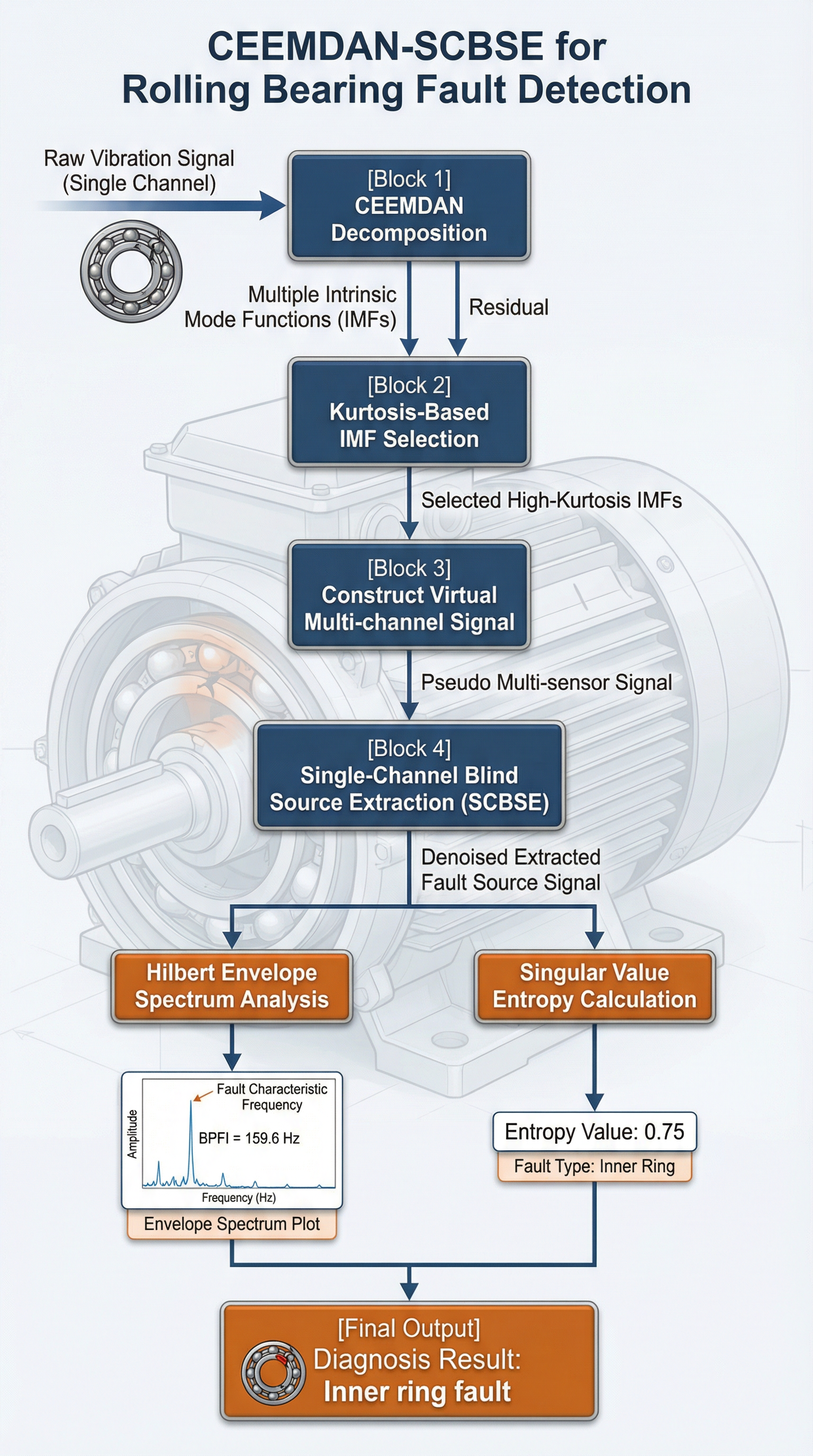
Bearings are key components for power transmission in industrial applications. However, how to accurately detect bearing status and perform fault diagnosis in intense background noise remains a challenging task. This paper presents a single-channel blind extraction algorithm for bearing fault detection and diagnosis. First, the vibration signal is decomposed into several intrinsic model functions (IMFs) and a residual. Using a kurtosis index technique to filter the decomposed IMF components, thereby building a multi-channel feature set and overcoming the problem of mode mixing. Then, a blind extraction technology is used to extract fault features from the virtual multi-channel mixed signals. Furthermore, the maximum energy amplitude at the fault feature frequency is obtained to identify fault features by using envelope spectrum analysis. Finally, determining the type of fault in the bearing through the magnitude of singular value entropy to achieve fault diagnosis. Experimental results based on the public bearing fault signal datasets verify the feasibility and superiority. It can make the pulse component in the measurement signal more prominent and suppress the
noise component entirely, achieving a powerful de-noising ability. The signal-to-noise ratio has been increased by a maximum of
53.35%, and the root mean square error has been decreased by a maximum of 10.86%
Downloads
References
X. Q. Wu, H. Wang, J. Meng, L. Zhang, C. Chen, and W. Fan. Collaboration transfer enabled standard rank control chart for crossdomain incipient fault detection of bearings with limited historical data. IEEE Transactions on Instrumentation and Measurement, 74:3546812, 2025. https://doi.org/10.1109/TIM.2025.3582306.
A. Menendez, L. Magadan, J. C. Granda Candas, and F. J. Suarez Alonso. Fault detection system for bearings in electric motors using variational auto encoders. IEEE Latin America Transactions, 23(5):371–379, 2025. https://doi.org/10.1109/TLA.2025.10974368.
Y. K. Deng, S. H. Tang, S. Chang, H. Zhang, D. C. Liu, and W. Wang. A novel scheme for range ambiguity suppression of spaceborne sar based on underdetermined blind source separation. IEEE Transactions on Geoscience and Remote Sensing, 63:5207915, 2025. https://doi.org/10.1109/TGRS.2025.3556296.
Y. Xie, T. Zou, J. J. Yang, W. J. Sun, and S. L. Xie. SAUCBSS: Sparsity-based adaptive underdetermined convolutive blind source separation. Knowledge-Based Systems, 300:112224, 2024. https://doi.org/10.1016/j.knosys.2024.112224.
H. X. Ruan, S. Zhao, Z. B. Lin, and J. Lu. Computationally-efficient blind source extraction under extremely low SNR conditions based on principal component analysis. Applied Acoustics, 236:110709, 2025. https://doi.org/10.1016/j.apacoust.2025.110709.
Z. Koldovsky, J. Cmejla, and S. O’Regan. Blind capon beamformer based on independent component extraction: Single-parameter algorithm. IEEE Signal Processing Letters, 32:801–805, 2025. https://doi.org/10.1109/LSP.2025.3538261.
X. Zhao, Y. Qin, C. He, and L. Jia. Underdetermined blind source extraction of early vehicle bearing faults based on EMD and kernelized correlation maximization. Journal of Intelligent Manufacturing, 33:185–201, 2020. https://doi.org/10.1007/s10845-020-01655-1.
K. W. Wang, Q. S. Hao, X. Zhang, Z. Y. Tang, and Y. Shen. Blind source extraction of acoustic emission signals for rail cracks
based on ensemble empirical mode decomposition and constrained independent component analysis. Measurement, 157:107653, 2020. https://doi.org/10.1016/j.measurement.2020.107653.
T. Thelaidjia, N. Chetih, A. Moussaoui, and S. Chenikher. Successive variational mode decomposition and blind source separation based on salp swarm optimization for bearing fault diagnosis. The International Journal of Advanced Manufacturing Technology, 125:5541–5556, 2023. https://doi.org/10.1007/s00170-023-10968-3.
R. K. Mandal, H. Devarajan, S. Nandi, T. B. Shanker, and M. Ghassemi. An underdetermined single-channel blind-source-separation for multisource acoustic-emission-based partial discharge signals in power transformers. IEEE Transactions on Plasma Science, 53(4):788–797, 2025. https://doi.org/10.1109/TPS.2025.3538746.
X. Y. Jia, M. Zhang, Y. Z. Gao, and Y. N. Guo. Transition-PDualGAN: An enhanced framework for single-channel blind source separation with transition domain. Digital Signal Processing, 160:105037, 2025. https://doi.org/10.1016/j.dsp.2025.105037.
N. E. Huang. The empirical mode decomposition and the hilbert spectrum for nonlinear and non-stationary time series analysis. Proceedings of Royal Society of London, 545(1971):903–995, 1998. https://doi.org/10.1098/rspa.1998.0193.
D. G. Li, X. Y. Luo, J. M. Zhao, F. M. Wu, H. R. Jiang, and D. Y. Shi. GNSS signal-to-noise snow depth inversion based on robust empirical mode decomposition. Intelligent and Converged Networks, 6(2):115–128, 2025. https://doi.org/10.23919/ICN.2025.0007.
Y. P. Wang, Q. S. Zhang, R. F. Cao, S. Zhang, S. S. Li, and D. Xu. The single-channel blind source separation based on VMD
and Tukey M estimation for rolling bearing composite fault diagnosis. Measurement and Control, 56(9/10):1599–1612, 2023. https://doi.org/10.1177/00202940231174405.
J. R. Yeh, J. S. Shieh, and N. E. Huang. Complementary ensemble empirical mode decomposition: a novel noise enhanced data analysis method. Advances in Adaptive Data Analysis, 2(2):135–156, 2010. https://doi.org/10.1142/S1793536910000422.
A. Humeau-Heurtier, G. Mahe, and P. Abraham. Multi-dimensional complete ensemble empirical mode decomposition with adaptive noise applied to laser speckle contrast images. IEEE Transactions on Medical Imaging, 34(10):2103–2117, 2015. https://doi.org/10.1109/TMI.2015.2419711.
M. A. Colominas, G. Schlotthauer, and M. E. Torres. Improved complete ensemble EMD: A suitable tool for biomedical signal processing. Biomedical Signal Processing and Control, 14:19–29, 2014. https://doi.org/10.1016/j.bspc.2014.06.009.
Q. W. Li, X. Xiao, L. Wang, H. Song, H. Kono, P. F. Liu, H. Lu, and T. Kikkawa. Direct extraction of tumor response based
on ensemble empirical mode decomposition for image reconstruction of early breast cancer detection by UWB. IEEE Transactions on Biomedical Circuits and Systems, 9(5):710–724, 2015. https://doi.org/10.1109/TBCAS.2015.2481940.
Z. W. Zhuang, H. Y. Chen, J. X. Tang, M. S. Chen, and X. J. Hezhou. A new denoising method for ship-radiated noise based on complete ensemble empirical mode decomposition. 2025 IEEE 8th Information Technology and Mechatronics Engineering Conference (ITOEC), 8:1638–1642, 2025. https://doi.org/10.1109/ITOEC63606.2025.10967791.
Z. Pan, B. Xu, W. J. Chen, D. Fan, X. H. Meng, M. F. Peng, and C. Zhou. Improved complete ensemble empirical mode decomposition with adaptive noise and its application in noise reduction for fiber optic sensing. Journal of Lightwave Technology, 43(5):2466–2474, 2025. https://doi.org/10.1109/JLT.2024.3489953.
R. Abdelkader, A. Kaddour, A. Bendiabdellah, and Z. Derouiche. Rolling bearing fault diagnosis based on an improved denoising method using the complete ensemble empirical mode decomposition and the optimized thresholding operation. IEEE Sensors Journal, 18(17):7166–7172, 2018. https://doi.org/10.1109/JSEN.2018.2853136.
Y. Li, J. W. Zhou, H. G. Li, G. Meng, and J. Bian. A fast and adaptive empirical mode decomposition method and its application in rolling bearing fault diagnosis. IEEE Sensors Journal, 23(1):567–576, 2023. https://doi.org/10.1109/JSEN.2022.3223980.
S. Misra R. D. De Roo and C. S. Ruf. Sensitivity of the kurtosis statistic as a detector of pulsed sinusoidal RFI. IEEE Transactions
on Geoscience and Remote Sensing, 45(7):1938–1946, 2007. https://doi.org/10.1109/TGRS.2006.888101.
L. He, X. L. Li, Q. Y. Zhou, C. Yi, and Y. F. Li. Neural network integrated with classical signal processing techniques for generating optimized square envelope spectrum and its application in machine condition monitoring. IEEE Transactions on Instrumentation and Measurement, 74:3548311, 2025. https://doi.org/10.1109/TIM.2025.3584118.
S. Chen, Y. Lin, Y. Yuan, X. X. Li, L. S. Hou, and S. N. Zhang. Suppressive interference suppression for airborne sar using bss for singular value and eigenvalue decomposition based on information entropy. IEEE Transactions on Geoscience and Remote Sensing, 61:5205611, 2023. https://doi.org/10.1109/TGRS.2023.3263218.
The bearing date center website of Case Western Reserve University. [Online]. Available: http://csegroups.case.edu/bearingdatacenter/pages/download-data-file.
The rotor-rolling bearing dataset of Shenyang Aero-Engine Design and Research Institute. [Online]. Available: http://ides.nuaa.edu.cn.
S. Y. Shao, S. McAleer, R. Q. Yan, and P. Baldi. Highly accurate machine fault diagnosis using deep transfer learning. IEEE
Transactions on Industrial Informatics, 15(4):2446–2455, 2019. https://doi.org/10.1109/TII.2018.2864759.
X. L. Liu, M. Z. Jiang, Z. Q. Liu, and H. Wang. A morphology filterassisted extreme-point symmetric mode decomposition (MF-ESMD) denoising method for bridge dynamic deflection based on ground-based microwave interferometry. Shock and Vibration, 2020(11):1–13, 2020. https://doi.org/10.1155/2020/8430986.
X. L. Liu, H. Wang, and Y. M. Huang. SCBSS signal de-noising method of integrating EEMD and ESMD for dynamic deflection of
bridges using GBSAR. IEEE Journal of Selected Topics in Applied Earth Observations and Remote Sensing, 14:2845–2856, 2021. https://doi.org/10.1109/JSTARS.2021.3061543.