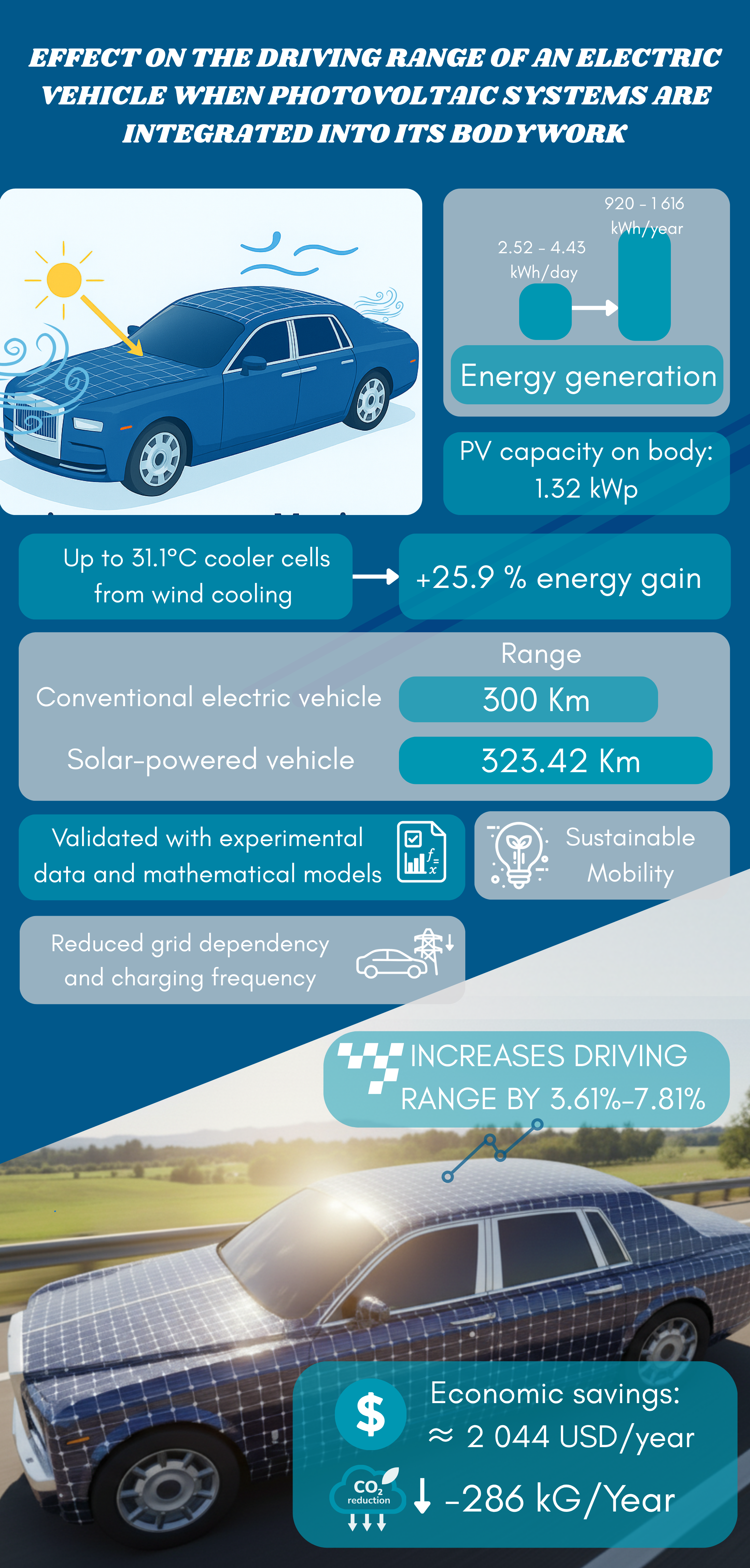
Effect on the driving range of an electric vehicle when photovoltaic systems are integrated into its bodywork
Keywords:
Electric vehicle, Driving range, Electric energy, Photovoltaic systemAbstract
Maintaining a sufficient driving range in electric vehicles (EVs) typically requires large battery capacities, which increases weight, cost, and reduces efficiency. This study evaluates the impact of integrating photovoltaic (PV) systems into the vehicle body through a comprehensive approach that jointly considers energy generation, thermal effects due to forced convection, aerodynamic losses, and annual energy performance. A mixed quasi-experimental methodology was implemented, combining experimental I–V characterization under real operating conditions with simulations based on a 3D vehicle model. Results show that the PV system can generate between 2.52 and 4.43 kWh/day, leading to a driving range increase between 3.61% and 7.81% (up to 23.42 km/day). Additionally, annual energy generation ranges from 1021 to 1616 kWh, with potential savings of up to 2044 USD/year. These results demonstrate that PV integration can enhance energy efficiency and reduce reliance on grid charging under real operating conditions.
Downloads
References
IEA, “Global EV Outlook 2024,” IEA, Paris, Apr. 2024. [Online]. Available: https://www.iea.org/reports/global-ev-outlook-2024.
G. García and Espona García, “La transición al vehículo eléctrico: Evolución y problemas,” Boletín Económico de ICE, no. 3172, Jul. 2024. doi: 10.32796/bice.2024.3172.7813.
D. Duque Sarmiento and J. Rocano, “Determinación de la autonomía del vehículo eléctrico mediante ciclos controlados,” Undergraduate thesis, Universidad Politécnica Salesiana, Cuenca, Ecuador, Jan. 2018. [Online]. Available: https://dspace.ups.edu.ec/bitstream/123456789/15067/1/UPS-CT007435.pdf.
IEA, “Global EV Outlook 2021,” IEA, Paris, Apr. 2021. [Online]. Available: https://www.iea.org/reports/global-ev-outlook-2021.
Z. Rezvani, J. Jansson, and J. Bodin, “Advances in consumer electric vehicle adoption research: A review and research agenda,” Transp. Res. Part D Transp. Environ., vol. 34, pp. 122–136, 2015, doi: 10.1016/j.trd.2014.10.010.
G. Rizzo and M. Sorrentino, “Introducing Sunshine Forecast to improve On-Board energy management of hybrid solar vehicles,” IFAC Proceedings Volumes, vol. 43, no. 7, pp. 276–281, Jul. 2010, doi: 10.3182/20100712-3-DE-2013.00082.
M. K. Yoong et al., "Studies of regenerative braking in electric vehicle," 2010 IEEE Conference on Sustainable Utilization and Development in Engineering and Technology, Kuala Lumpur, Malaysia, 2010, pp. 40-45, doi: 10.1109/STUDENT.2010.5686984.
K. Araki, Y. Ota, and M. Yamaguchi, “Measurement and Modeling of 3D Solar Irradiance for Vehicle-Integrated Photovoltaic,” Appl. Sci., vol. 10, no. 3, p. 872, Jan. 2020. doi: 10.3390/app10030872.
J. A. Duffie and W. A. Beckman, “Solar Engineering of Thermal Processes”, 4th ed., Hoboken, NJ, USA: John Wiley & Sons, 2013, pp.3-42. doi: 10.1002/9781118671603.
M. R. Battioni, G. A. Risso, M. Cutrera, and J. A. Schmidt, “Evaluación de distintos métodos para estimar la temperatura de operación de módulos fotovoltaicos y estimación de las pérdidas de energía por efecto de la temperatura,” Avances en Energías Renovables y Medio Ambiente, vol. 4, no. 1, Nov. 2016. [Online]. Available: http://hdl.handle.net/11336/30135.
S. Dubey, J. N. Sarvaiya, B. Seshadri, and T. D. Photovoltaic, “(PV) Efficiency and Its Effect on PV Production in the World – A Review,” Energy Procedia, vol. 33, pp. 311–321, Jan. 2013, doi: 10.1016/j.egypro.2013.05.072.
A. Goetzberger and V. U. Hoffmann, “Photovoltaic Solar Energy Generation”, Springer, 2005.
O. Izquierdo, A. Velasco, M. Lafuente, P. Peña, and Á. Hernández, “Performance and energy consumption of electric vehicles used in microgrid management: Analysis of the real impact of ambient temperature”, Journal of Power Sources, vol. 635, p. 236511, Feb. 2025, doi: 10.1016/j.jpowsour.2025.236511.
F. A. Tiano, G. Rizzo, M. Marino, and A. Monetti, “Evaluation of the potential of solar photovoltaic panels installed on vehicle body including temperature effect on efficiency,” eTransportation, vol. 5, p. 100067, Jun. 2020, https://doi.org/10.1016/j.etran.2020.100088.
D. P. Birnie, “Analysis of energy capture by vehicle solar roofs in conjunction with workplace plug-in charging,” Solar Energy, vol. 125, pp. 219–226, Jan. 2016, doi: 10.1016/j.solener.2015.12.014.
M. A. Rahmawijaya, M. A. Zidan, M. A. Yaqin, M. Z. Aprilyansyah, R. R. Alif Wianto, and S. D. Prasetyo, “Optimizing Aerodynamics in Solar Car Design: A Comprehensive CFD Study”, Pena Jour. of Flow. Dyn., vol. 2, no. 1, pp. 13–23, Sep. 2025, https://doi.org/10.37934/pjfd.2.1.1323.
R. Kanmani, M. K. Kamalinee, S. M. Thoufic, R. Suganya and S. Muthulakshmi, "Development and Proposal System for the Formulation of Solar paint," 2021 7th International Conference on Advanced Computing and Communication Systems (ICACCS), Coimbatore, India, 2021, pp. 623-627, doi: 10.1109/ICACCS51430.2021.9442003.
A. Padgaonkar, “The Potential of Solar Paint to Harvest Solar Energy,” J. High School Sci., vol. 7, no. 1, Mar. 2023. [Online]. Available: https://jhss.scholasticahq.com/article/73368-the-potential-of-solar-paint-to-harvest-solar-energy.
Patel, N., Bittkau, K., Ding, K., van Sark, W., & Reinders, A. H. M. E. (2024). Vehicle Integrated Photovoltaics. 491–506, https://doi.org/10.1002/9781119578826.ch30.
J. Pastuszak and P. Węgierek, “Photovoltaic Cell Generations and Current Research Directions for Their Development,” Materials (Basel), vol. 15, no. 16, p. 5542, Aug. 2022, doi:10.3390/ma15165542.
Patel, N., Bittkau, K., Pieters, B. E., Sovetkin, E., Ding, K., & Reinders, A. (2024). Impact of Additional PV Weight on the Energy Consumption of Electric Vehicles With Onboard PV. IEEE Journal of Photovoltaics, 14(2), 319329. https://doi.org/10.1109/JPHOTOV.2024.3359446.
A. D. Jones and C. P. Underwood, “A thermal model for photovoltaic systems,” Solar Energy, vol. 70, no. 4, pp. 349–359, Jan. 2001, doi: 10.1016/S0038-092X(00)00149-3.
W. Li, Y. Shi, K. Chen, L. Zhu, and S. Fan, “A comprehensive photonic approach for solar cell cooling,” ACS Photonics, vol. 4, no. 4, pp. 774–782, Mar. 2017, doi: 10.1021/acsphotonics.7b00089.
S. Kumar and S. Mullick, “Wind heat transfer coefficient in solar collectors in outdoor conditions,” Sol. Energy, vol. 84, no. 6, pp. 956–963, 2010. https://doi.org/10.1016/j.solener.2010.03.003.
R. Hassanian, N. Yeganeh, and M. Riedel, “Wind Velocity and Forced Heat Transfer Model for Photovoltaic Module,” Fluids (Basel), vol. 9, no. 1, p. 17, 2024. https://doi.org/10.3390/fluids9010017.
K. Mallon, F. Assadian, y B. Fu, “Analysis of On-Board Photovoltaics for a Battery Electric Bus and Their Impact on Battery Lifespan”, Energies, vol. 10, no. 7, p. 943, Jul. 2017, doi: 10.3390/en10070943.
I. Diahovchenko, L. Petrichenko, I. Borzenkov, y M. Kolcun, “Application of photovoltaic panels in electric vehicles to enhance the range”, Heliyon, vol. 8, no. 12, p. e12425, Dic. 2022, doi: 10.1016/j.heliyon.2022.e12425.
N. R. Pochont, Y. R. Sekhar, M. C. Brito, and V. T. Rao, “Assessing the scope of vehicle integrated photovoltaics in urban driving conditions – Case study of a Tier-II city in southern India,” Sustain. Energy Technol. Assess., vol. 72, p. 104040, Nov. 2024., doi: 10.1016/j.seta.2024.104040.
Y. Hayakawa, D. Sato, y N. Yamada, “Measurement of the Convective Heat Transfer Coefficient and Temperature of Vehicle-Integrated Photovoltaic Modules”, Energies, vol. 15, no. 13, p. 4818, Jun. 2022, doi: 10.3390/en15134818.
M. Jankovec, K. Brecl, M. Bokalič, M. Pirc, y M. Topič, «Monitoring solar irradiance and PV module performance in mobile applications», Solar Energy Materials And Solar Cells, vol. 277, p. 113101, ago. 2024, doi: 10.1016/j.solmat.2024.113101.
F. Karoui, B. Chambion, F. Claudon, y B. Commault, “Integrated Photovoltaics Potential for Passenger Cars: A Focus on the Sensitivity to Electrical Architecture Losses”, Applied Sciences, vol. 13, no. 14, p. 8373, Jul. 2023, doi: 10.3390/app13148373.
S. Sagaria, G. Duarte, D. Neves, and P. Baptista, “Photovoltaic integrated electric vehicles: Assessment of synergies between solar energy, vehicle types and usage patterns,” J. Clean. Prod., vol. 348, p. 131402, Mar. 2022., doi: 10.1016/j.jclepro.2022.131402.
P. Balakrishnan, T. Lakshmanan, R. Ravi, and M. Faqir, “Optimization of Solar Energy Utilization for Electric Vehicles (EVs)”, en Advances in computational intelligence and robotics book series, 2025, pp. 343-374. doi: 10.4018/979-8-3373-1434-1.ch012.
J. Heeraman, R. Kalyani, and B. Amala, “Towards a sustainable future: Design and fabrication of a Solar-Powered Electric Vehicle,” IOP Conference Series Earth and Environmental Science, vol. 1285, no. 1, p. 012035, Jan. 2024, doi: 10.1088/1755-1315/1285/1/012035.
R. Hernández, C. Fernández, and P. Baptista, Metodología de la investigación, 6th ed., McGraw-Hill, 2014. [Online]. Available: https://apiperiodico.jalisco.gob.mx/api/sites/periodicooficial.jalisco.gob.mx/files/metodologia_de_la_investigacion__roberto_hernandez_sampieri.pdf.
B. Kretchmer, R. Monahan, A. Garcia, E. Garner, B. Sims, N. Njoku, M. Lahey, and N. Monteiro, “Solar powered electric vehicle,” Purdue University Northwest,” Int. Res. J. Mod. Eng. Technol. Sci., Apr, 2017. [Online]. Available: https://www.pnw.edu/wp-content/uploads/2020/03/Solar_Vehicle_ME439_Final_Paper_v2.pdf.
A. K. Tripathi, G. Sree Lakshmi, H. Mishra, S. Chapala, M. Alwetaishi, F. Atamurotov, N. E. Benti, S. Sura and C. Ahamed Saleel, “Integration of Solar PV Panels in Electric Vehicle Charging Infrastructure: Benefits, Challenges, and Environmental Implications,” Energy Science & Engineering, vol. 13, no. 4, pp. 2135-2152, Apr. 2025. doi: 10.1002/ese3.70014.
M. W. Davis, A. H. Fanney, and B. P. Dougherty, “Prediction of building integrated photovoltaic cell temperatures,” Journal of Solar Energy Engineering, vol. 123, no. 3, pp. 200–210, Mar. 2001, doi: 10.1115/1.1385825.
B. Amiot, H. Pabiou, R. L. Berre, and S. Giroux–Julien, “An innovative method for measuring the convective cooling of photovoltaic modules,” Sol. Energy, vol. 274, p. 112531, 2024. https://doi.org/10.1016/j.solener.2024.112531.
R. Van Greunen and C. Oosthuizen, “Data Driven Methods for Finding Coefficients of Aerodynamic Drag and Rolling Resistance of Electric Vehicles,” World Electric Vehicle Journal, vol. 14, no. 6, p. 134, 2023b. https://doi.org/10.3390/wevj14060134.
M. Weiss, T. Winbush, A. Newman, and E. Helmers, “Energy Consumption of Electric Vehicles in Europe,” Sustainability (Basel), vol. 16, no. 17, p. 7529, 2024., doi: 10.3390/su16177529.
K. S. Dasari, S. R. Mopidevi, and S. R. Basappa, “Research on factors influencing the performance of electric vehicles and its impacts,” Science And Technology For Energy Transition, vol. 80, p. 38, 2025., doi: 10.2516/stet/2025018.
Resolución 000705 de 2024, por la cual se modifica la Resolución 000762 de 2023, mediante la cual se actualizó el factor de emisión del Sistema Interconectado Nacional, Unidad de Planeación Minero-Energética (UPME), Colombia, Aug, 2024. [Online]. Available: https://www1.upme.gov.co/Normatividad/705_2024.pdf.