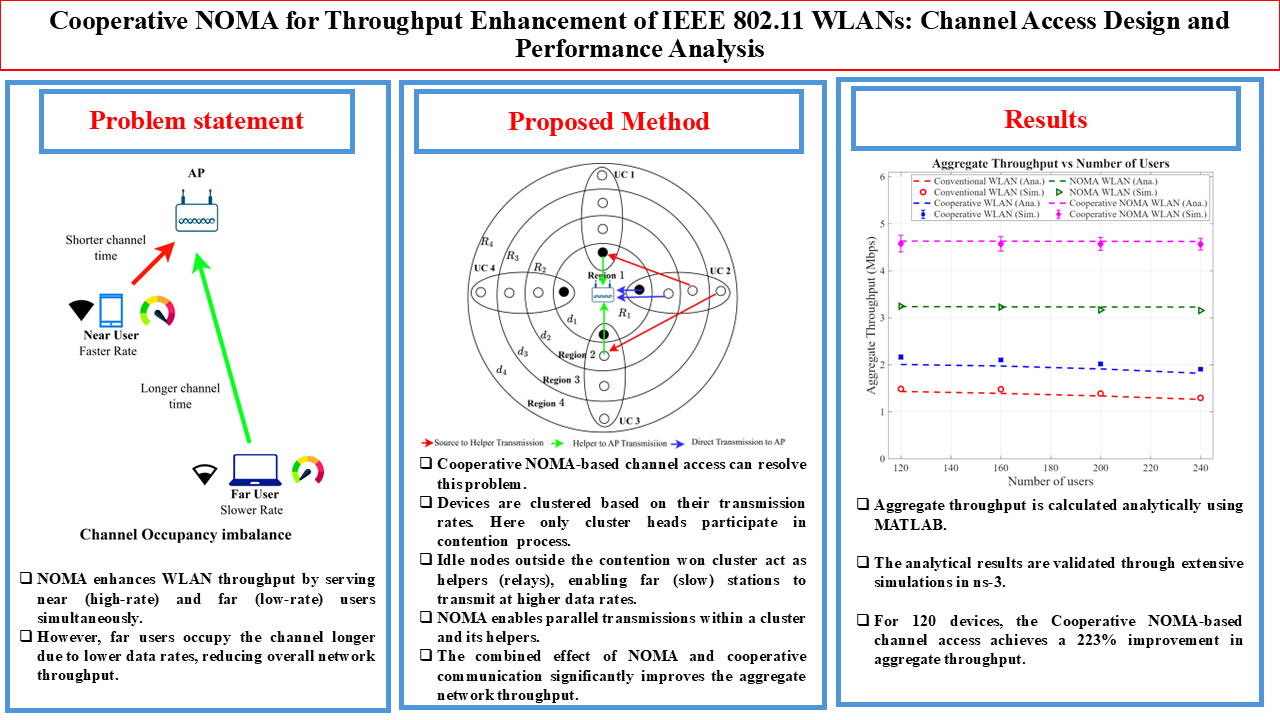
Cooperative NOMA for Throughput Enhancement of IEEE 802.11 WLANs: Channel Access Design and Performance Analysis
Keywords:
Cooperative communication, NOMA, CNOMA, Wi-Fi, WLANAbstract
In this research work, we propose cooperative non-orthogonal multiple access (CNOMA) based IEEE 802.11 wireless local area network (WLAN) and design a novel channel access scheme for CNOMA based WLAN. The proposed scheme integrates the resource efficiency of NOMA with cooperative relaying technique to enhance the throughput performance. In this scheme, stations (STAs) in the nearer regions act as the relay nodes for the STAs farther from the access point (AP). The novel channel access scheme form clusters by selecting STAs from the various data rate regions and allows nearest region nodes (cluster heads) alone to take part in the contention. This scheme also includes a procedure to select helper nodes from the high data rate regions. Additionally, we present an accurate analytical model for calculating the throughput of CNOMA based WLANs. Analytical and simulation results demonstrate that the proposed approach can significantly enhance the throughput performance of NOMA based WLANs.
Downloads
References
B. P. Crow, I. Widjaja, J. G. Kim, and P. T. Sakai, ”IEEE 802.11 Wireless
Local Area Networks,” IEEE Commun. Mag., vol. 35, no. 9, pp. 116
, Sep. 1997, doi: 10.1109/35.620533.
R. O. LaMaire, A. Krishna, P. Bhagwat, and J. Panian, ”Wireless
LANs and Mobile Networking: Standards and Future Directions,”
IEEE Commun. Mag., vol. 34, no. 8, pp. 86–94, Aug. 1996, doi:
1109/35.533925.
G. Bianchi, ”Performance Analysis of the IEEE 802.11 Distributed
Coordination Function,” IEEE J. Sel. Areas Commun., vol. 18, no. 3,
pp. 535–547, Mar. 2000, doi: 10.1109/49.840210.
Y. Song, K. W. Sung, and Y. Han, ”Coexistence of Wi-Fi and
Cellular With Listen-Before-Talk in Unlicensed Spectrum,” IEEE
Commun. Lett., vol. 20, no. 1, pp. 161–164, Jan. 2016, doi:
1109/LCOMM.2015.2504509.
S. V. Rakhmanov and D. A. Loktev, ”Wi-Fi Signal Propaga
tion Modeling,” in Proc. 7th Int. Youth Conf. Radio Electron.,
Electr. Power Eng. (REEPE), Moscow, Russia, 2025, pp. 1–6, doi:
1109/REEPE63962.2025.10971051.
P. Liu, Z. Tao, S. Narayanan, T. Korakis, and S. S. Panwar, ”CoopMAC:
A Cooperative MAC for Wireless LANs,” IEEE J. Sel. Areas Commun.,
vol. 25, no. 2, pp. 340–354, Feb. 2007, doi: 10.1109/JSAC.2007.070210.
Q. Xia and M. Hamdi, ”Smart Sender: A Practical Rate Adapta
tion Algorithm for Multirate IEEE 802.11 WLANs,” IEEE Trans.
Wireless Commun., vol. 7, no. 5, pp. 1764–1775, May 2008, doi:
1109/TWC.2008.061047.
M. Heusse, F. Rousseau, G. Berger-Sabbatel, and A. Duda, ”Per
formance Anomaly of 802.11b,” in Proc. IEEE INFOCOM, San
Francisco, CA, USA, 2003, vol. 2, pp. 836–843, doi: 10.1109/INF
COM.2003.1208921.
Y. Saito, Y. Kishiyama, A. Benjebbour, T. Nakamura, A. Li, and
K. Higuchi, ”Non-Orthogonal Multiple Access (NOMA) for Cellu
lar Future Radio Access,” in Proc. IEEE 77th Veh. Technol. Conf.
(VTC Spring), Dresden, Germany, 2013, pp. 1–5, doi: 10.1109/VTC
Spring.2013.6692652.
L. Galati-Giordano, G. Geraci, M. Carrascosa, and B. Bellalta, ”What
Will Wi-Fi 8 Be? A Primer on IEEE 802.11bn Ultra High Reliability,”
IEEE Commun. Mag., vol. 62, no. 8, pp. 126–132, Aug. 2024, doi:
1109/MCOM.001.2300728.
Y. Liu et al., ”Nonorthogonal Multiple Access for 5G and Be
yond,” Proc. IEEE, vol. 105, no. 12, pp. 2347–2381, Dec. 2017, doi:
1109/JPROC.2017.2768666.
S. M. R. Islam, N. Avazov, O. A. Dobre, and K.-S. Kwak, ”Power
Domain Non-Orthogonal Multiple Access (NOMA) in 5G Systems:
Potentials and Challenges,” IEEE Commun. Surv. Tuts., vol. 19, no. 2,
pp. 721–742, 2nd Quart. 2017, doi: 10.1109/COMST.2016.2621116.
B. S. Pavan and V. P. Harigovindan, ”A Novel Channel Access Scheme
for NOMA Based IEEE 802.11 WLAN,” S¯adhan¯a, vol. 46, no. 144,
, doi: 10.1007/s12046-021-01669-2.
N. Otao, Y. Kishiyama, and K. Higuchi, ”Performance of Non
Orthogonal Access With SIC in Cellular Downlink Using Propor
tional Fair-Based Resource Allocation,” in Proc. Int. Symp. Wire
less Commun. Syst. (ISWCS), Paris, France, 2012, pp. 476–480, doi:
1109/ISWCS.2012.6328413.
Y. Saito et al., ”Non-Orthogonal Multiple Access (NOMA) for Cellular
Future Radio Access,” in Proc. IEEE 77th Veh. Technol. Conf. (VTC
Spring), Dresden, Germany, Jun. 2013, pp. 1–5, doi: 10.1109/VTC
Spring.2013.6692652.
Y. Qi and M. Vaezi, ”Secure Transmission in MIMO-NOMA Networks,”
IEEE Commun. Lett., vol. 24, no. 12, pp. 2696–2700, Dec. 2020, doi:
1109/LCOMM.2020.3016999.
A. S. de Sena et al., ”Massive MIMO-NOMA Networks With Im
perfect SIC: Design and Fairness Enhancement,” IEEE Trans. Wire
less Commun., vol. 19, no. 9, pp. 6100–6115, Sep. 2020, doi:
1109/TWC.2020.3000192.
P. Jain et al., ”Performance Evaluation of Cooperative OMA and NOMA
Systems in 6G Deployment Scenarios,” Sensors, vol. 22, no. 11, 3986,
, doi: 10.3390/s22113986.
M. Miriyala et al., ”NOMA-Based RAW Mechanism for Performance
Enhancement of IEEE 802.11ah Dense IoT Networks,” S¯adhan¯a, vol.
, no. 196, 2022, doi: 10.1007/s12046-022-01915-1.
E. Khorov, A. Kureev, I. Levitsky, and I. F. Akyildiz, ”Prototyping
and Experimental Study of Non-Orthogonal Multiple Access in Wi-Fi
Networks,” IEEE Netw., vol. 34, no. 4, pp. 210–217, Jul./Aug. 2020,
doi: 10.1109/MNET.011.1900498.
P. K. Sangdeh et al., ”A Practical Downlink NOMA Scheme for Wireless
LANs,” IEEE Trans. Commun., vol. 68, no. 4, pp. 2236–2250, Apr. 2020,
doi: 10.1109/TCOMM.2020.2965951.
K.-S. Shin and O. Jo, ”Joint Scheduling and Power Allocation Using
NOMA in Directional Beam-Based WLAN Systems,” IEEE Wire
less Commun. Lett., vol. 6, no. 4, pp. 482–485, Aug. 2017, doi:
1109/LWC.2017.2707087.
H. R. Shamna, N. L. Appari, and L. Jacob, ”Cooperative MAC Protocol:
Performance Modeling and Analysis,” in Proc. IEEE Recent Adv. Intell.
Comput. Syst. (RAICS), Trivandrum, India, 2013, pp. 233–238, doi:
1109/RAICS.2013.6745479.
H. Shan, H. T. Cheng, and W. Zhuang, ”Cross-Layer Cooperative
MAC Protocol in Distributed Wireless Networks,” IEEE Trans. Wire
less Commun., vol. 10, no. 8, pp. 2603–2615, Aug. 2011, doi:
1109/TWC.2011.060811.101196.
Z. Elsaraf et al., ”Cooperative Non-Orthogonal Multiple Access for
Wireless Communication Networks by Exploiting the EXIT Chart
Analysis,” EURASIP J. Wireless Commun. Netw., vol. 2021, no. 79, pp.
–15, 2021, doi: 10.1186/s13638-021-01961-z.
S. Beddiaf et al., ”A Unified Performance Analysis of Cooperative
NOMA with Practical Constraints,” IEEE Access, vol. 10, pp. 132931
, 2022, doi: 10.1109/ACCESS.2022.3230650.
C. Zhai et al., ”Wireless Powered Cooperative NOMA With Alamouti
Coding and Selection Relaying,” IEEE Trans. Mobile Comput., vol. 23,
no. 2, pp. 1366–1381, Feb. 2024, doi: 10.1109/TMC.2023.3235394.
V. Goutham and V. P. Harigovindan, ”NOMA-Based Cooperative Relay
ing Strategy for Underwater Acoustic Sensor Networks Under Imperfect
SIC and CSI,” IEEE Access, vol. 9, pp. 32857–32872, 2021, doi:
1109/ACCESS.2021.3060784.
M. K. Beuria and S. S. Singh, ”Performance Analysis of Cooper
ative NOMA with Optimized Power Allocation Using Deep Learn
ing Approach,” Wireless Netw., vol. 30, pp. 819–834, 2024, doi:
1007/s11276-023-03522-2.
V. P. Harigovindan, A. V. Babu, and L. Jacob, ”Proportional Fair
Resource Allocation in Vehicle-to-Infrastructure Networks for Drive
Thru Internet Applications,” Comput. Commun., vol. 40, pp. 33–50,
, doi: 10.1016/j.comcom.2013.12.001.
A. V. Babu and L. Jacob, ”Fairness Analysis of IEEE 802.11 Multirate
Wireless LANs,” IEEE Trans. Veh. Technol., vol. 56, no. 5, pp. 3073
, Sep. 2007, doi: 10.1109/TVT.2007.898397.
The ns-3 Project, ”Wi-Fi Module– Design Documentation,” ns-3 Model
Library Documentation, version 3.44, Jun. 2025. [Online]. Available: