Concentration and Diversity in Collaboration Networks in Electrical Engineering: Evidence from Brazilian Researchers
Keywords:
Scientific collaboration networks, CNPq productivity grants, collaboration clustersAbstract
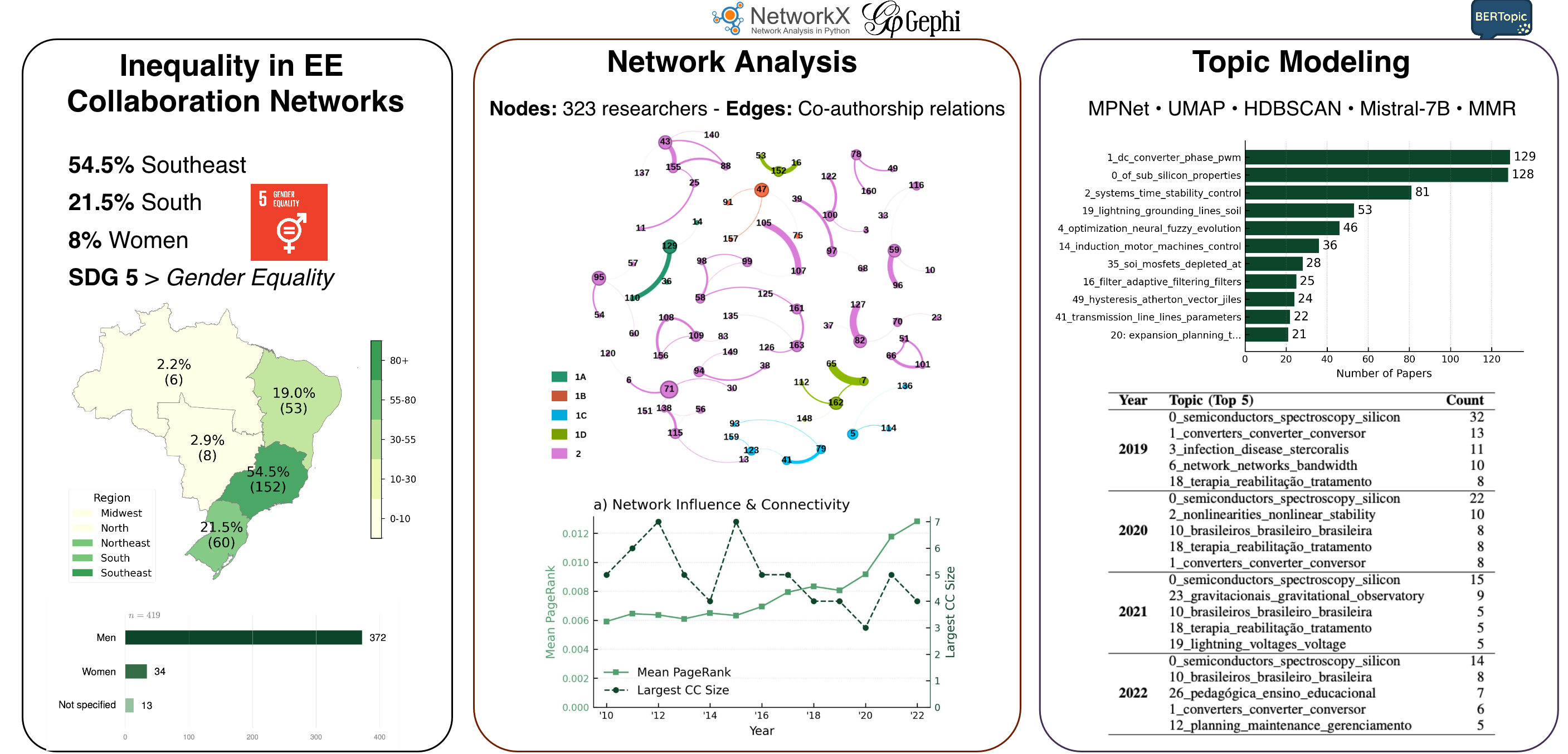
Scientific collaboration networks shape research dynamics in fields such as Electrical Engineering, where Brazil’s CNPq productivity grants play a pivotal role. Expanding upon previous analyzes focused on Microelectronics, this study broadens the scope to encompass the major field of Electrical Engineering, covering seven subareas: Electrical Materials; Electrical, Magnetic, and Electronic Measurements; Instrumentation; Electrical, Magnetic, and Electronic Circuits; Power Systems; Industrial Electronics, Systems, and Electronic Controls; and Telecommunications. The analysis considers collaboration networks among 419 CNPq productivity grant holders based on 18,386 publications. The results reveal a hierarchical structure in which top-tier researchers form a highly influential core, while lower-level researchers remain peripheral. The network exhibits a pronounced geographic concentration in Brazil’s Southeast and South regions, accompanied by notable gender disparities. Over time, the average author influence has increased, and collaboration clusters have become more compact, suggesting a trend toward smaller, more centralized groups. Despite its thematic diversity, the network exhibits structural inequality and limited cross-level integration. Future research could further investigate temporal shifts, inter-institutional collaboration patterns, and the co-evolution of network structures and research focuses.
Downloads
References
S. H. Kang, J. Shin, and J. Choi, How Do Researchers Conduct Scientific
Collaboration across Universities?, ser. HICSS. Hawaii International
Conference on System Sciences, 2025, doi: 10.24251/hicss.2025.056.
S. B. d. Jesus and K. d. O. Rodrigues, “Coautoria internacional em
artigos cient´ıficos: uma an´alise na produc¸ ˜ao intelectual dos programas
de p´os-graduac¸ ˜ao no campo das engenharias da universidade federal da
bahia,” Em Quest˜ao, vol. 31, 2025, doi: 10.1590/1808-5245.31.140393.
M. A. Lopes and R. A. Martins, “Mapping the impacts of industry 4.0 on
performance measurement systems,” IEEE Latin America Transactions,
vol. 19, no. 11, pp. 1912–1923, 2021, doi: 10.1109/TLA.2021.9475625.
B. S. Santos, I. Silva, and D. G. Costa, “Symmetry in scientific
collaboration networks: A study using temporal graph data science
and scientometrics,” Symmetry, vol. 15, no. 3, p. 601, Feb. 2023, doi:
3390/sym15030601.
M. Mamat, Z. Wang, L. Jin, K. He, L. Li, and Y. Chen, “Beyond
nodes and edges: a bibliometric analysis on graph theory and neu-
roimaging modalities,” Frontiers in Neuroscience, vol. 18, Apr. 2024,
doi: 10.3389/fnins.2024.1373264.
A. Justino, F. Nhoatto, E. Souza, and F. Lobato, “An´alise orientada a
dados como aux´ılio para tomada de decis˜ao em gest˜ao de pesquisa,”
Revista da CGU, vol. 15, no. 27, Jul. 2023, doi: 10.36428/revis-
tadacgu.v15i27.565.
T. Bol, M. de Vaan, and A. van de Rijt, “The matthew effect in science
funding,” Proceedings of the National Academy of Sciences, vol. 115,
no. 19, p. 4887–4890, Apr. 2018, doi: 10.1073/pnas.1719557115.
Y. L. Katchanov, Y. V. Markova, and N. A. Shmatko, “Empirical
demonstration of the matthew effect in scientific research careers,”
Journal of Informetrics, vol. 17, no. 4, p. 101465, Nov. 2023, doi:
1016/j.joi.2023.101465.
F. A. Carmo, G. S. Silva, A. F. L. Jacob, and F. M. F. Lobato, “Con-
centration and diversity in collaboration networks in microelectronics:
A study on cnpq productivity fellows,” in 2025 39th Symposium on
Microelectronics Technology and Devices (SBMicro), vol. 1, 2025, pp.
–4, doi: 10.1109/SBMicro66945.2025.11197788.
N. Albis, I. ´Alvarez, Y. Castillo, and K. Santos-Pavez, “University-
industry linkages through the lens of national innovation systems in
latin america,” Industry and Innovation, p. 1–22, Oct. 2025, doi:
1080/13662716.2025.2560929.
S. Ma, “Technological obsolescence,” The Review of Financial Studies,
Oct. 2025, doi: 10.1093/rfs/hhaf059.
M. Broy, I. H. Kruger, A. Pretschner, and C. Salzmann, “Engineering
automotive software,” Proceedings of the IEEE, vol. 95, no. 2, p.
–373, Feb. 2007, doi: 10.1109/jproc.2006.888386.
O. Burkacky, J. Deichmann, G. Doll, and C. Knochen-
hauer, “Rethinking car software and electronics architecture,”
McKinsey & Company, Tech. Rep., 2023. [Online]. Avail-
able: https://www.mckinsey.com/industries/automotive-and-assembly/
our-insights/rethinking-car-software-and-electronics-architecture
J. Assandre and R. Martins, “Analysis of scientific production on the
use of big data analytics in performance measurement systems,” IEEE
Latin America Transactions, vol. 21, no. 3, pp. 367–380, 2023, doi:
1109/TLA.2023.10068840.
G. J. P. Junior, T. M. R. Dias, T. H. P. Silva, and A. H. F. Laender,
“On interdisciplinary collaborations in scientific coauthorship networks:
the case of the brazilian community,” Scientometrics, vol. 124, no. 3, p.
–2360, Jul. 2020, doi: 10.1007/s11192-020-03605-3.
R. Andrade and L. Rˆego, “A influˆencia da rede de coautoria no n´ıvel
de produtividade dos bolsistas de produtividade em engenharia de
produc¸ ˜ao,” in Anais do Brazilian Workshop on Social Network Analysis
and Mining (BraSNAM), ser. BraSNAM 2015. Sociedade Brasileira de
Computac¸ ˜ao - SBC, Aug. 2015, doi: 10.5753/brasnam.2015.6786.
I. T. Afolabi, J. Badejo, S. A. Adubi, and O. A. Odetunmibi, “Identifying
major civil engineering research influencers and topics using social
network analysis,” Cogent Engineering, vol. 7, no. 1, Jan. 2020, doi:
1080/23311916.2020.1835147.
L. M. Welter, ˆA. R. L. d. Souza, B. B. Trajano, and A. Behr, “Redes de
coautoria dos programas brasileiros de p´os-graduac¸ ˜ao em contabilidade,”
Contextus: Revista Contemporˆanea de Economia e Gest˜ao, vol. 19,
no. 10, pp. 146–159, 2021, doi: 10.19094/contextus.2021.61274.
F. Martinez-Plumed, L. Contreras-Ochando, C. Ferri, J. Hernandez-
Orallo, M. Kull, N. Lachiche, M. J. Ramirez-Quintana, and P. Flach,
“Crisp-dm twenty years later: From data mining processes to
data science trajectories,” IEEE Transactions on Knowledge and
Data Engineering, vol. 33, no. 8, p. 3048–3061, Aug. 2021, doi:
1109/tkde.2019.2962680.
N. A. Aziz and M. P. Rozing, “Profit (p)-index: The degree to which
authors profit from co-authors,” PLOS ONE, vol. 8, no. 4, p. e59814,
, doi: 10.1371/journal.pone.0059814.
M. E. J. Newman, “Scientific collaboration networks. II. shortest paths,
weighted networks, and centrality,” Physical Review E, vol. 64, no. 1,
p. 016132, 2001, doi: 10.1103/PhysRevE.64.016132.
A. J. Parish, K. W. Boyack, and J. P. A. Ioannidis, “Dynamics of co-
authorship and productivity across different fields of scientific research,”
PLOS ONE, vol. 13, no. 1, p. e0189742, 2018, doi: 10.1371/jour-
nal.pone.0189742.