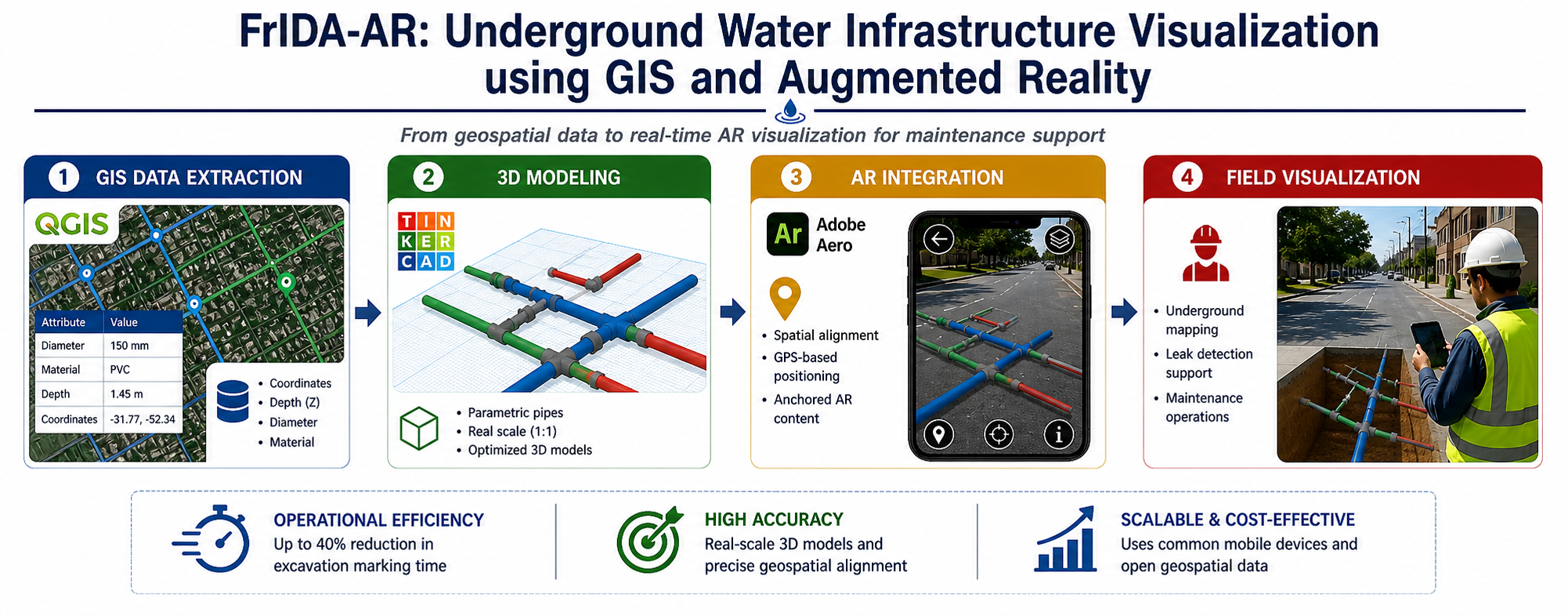
FrIDA-AR: An Integrated Framework for Underground Water Infrastructure Visualization using GIS and Augmented Reality
Keywords:
Water Management, Water Distribution, Water Monitoring, Urban Water Systems, Virtual Reality, Augmented Reality, 3D Visualization, Internet of ThingsAbstract
This paper presents FrIDA-AR, an integrated framework designed to enhance the management of Water Distribution Networks (WDNs) through Geospatial Information Systems (GIS) and Augmented Reality (AR). Unlike traditional methods that rely on 2D maps and physical excavations, FrIDA-AR provides a 3D overlay of underground infrastructure in realtime. The methodology employs a quadrant-based segmentation logic to ensure mobile scalability and low latency. Results from a case study in Pelotas-RS, Brazil, demonstrate that the framework achieves a stable AR registration with high visual fidelity, offering a scalable solution for utility maintenance in low-resource settings.
Downloads
References
L. M. Ribas, A. B. Savioli, and H. Pinheiro, “A Agencia Nacional
de Aguas e a coordenacao federativa no Novo Marco do Saneamento
Basico,” Revista de Direito Administrativo, vol. 281, no. 2, pp.
–137, 2022, acessado em: 12 de novembro de 2025. [Online].
Available: https://doi.org/10.12660/rda.v281.2022.86047
M. F. Goodchild, “Geographical information science,” International
Journal of Geographical Information Systems, vol. 6, no. 1, pp. 31–45,
[Online]. Available: https://doi.org/10.1080/02693799208901919
R. Tori and M. d. S. Hounsell, Eds., Introducao a Realidade Virtual
e Aumentada. Sociedade Brasileira de Computacao (SBC), 2018.
[Online]. Available: https://doi.org/10.5753/sbc.6654.2
Mensah, A. Komi, Etonam, A. Kokougan, A. O. Mayabi, and C. C.
Di Gravio, Giulio, “A real-time augmented reality system for water
distribution system,” International Journal of Recent Technology and
Engineering (IJRTE), vol. 8, no. 3, pp. 3098–3101, Sep. 2019. [Online].
Available: https://doi.org/10.35940/ijrte.C4974.098319
R. B. A. d. Araujo, A. d. A. Bezerra, and M. A. H. d. Castro, “Leakage
detection in water distribution networks by applying the Alternative
Hydraulic Gradient Iterative Method (MIGHA) to calibrate flows
through computational modeling,” Revista DAE, vol. 69, no. 232, pp.
–56, 2021. [Online]. Available: https://doi.org/10.36659/dae.2021.060
R. Sitzenfrei, J. Zischg, M. Sitzmann, and P. M. Bach, “Impact of Hybrid
Water Supply on the Centralised Water System,” Water, vol. 9, no. 11,
p. 855, 2017. [Online]. Available: https://doi.org/10.3390/w9110855
L. F. d. Araujo, F. P. Camargo, A. T. Netto, N. S. Vernin, and R. C. d.
Andrade, “Analysis of the coverage of supply and of the water quality
distributed in different regions of Brazil in 2019,” Ciencia & Saude
Coletiva, vol. 27, no. 7, pp. 2935–2947, 2022. [Online]. Available:
https://doi.org/10.1590/1413-81232022277.16472021
N. Moyroud and F. Portet, “Introduction to qgis,” QGIS and
Generic Tools, pp. 1–17, JAN 2018. [Online]. Available: https:
//dx.doi.org/10.1002/9781119457091.ch1
D. Garlisi, G. Restuccia, I. Tinnirello, F. Cuomo, and I. Chatzigiannakis,
“Leakage detection via edge processing in lorawan-based smart water
distribution networks,” pp. 223–230, 2022. [Online]. Available:
https://doi.org/10.1109/MSN57253.2022.00047
P. Milgram, H. Takemura, A. Utsumi, and F. Kishino, “Augmented
Reality: A class of displays on the Reality-Virtuality continuum,” in
Telemanipulator and Telepresence Technologies, vol. 2351. SPIE, 1994,
pp. 282–298. [Online]. Available: https://doi.org/10.1117/12.197321
L. M. Prestes and M. G. Cleto, “FERRAMENTAS DA INDUSTRIA
0: REALIDADE VIRTUAL E AUMENTADA. CONCEITOS E
APLICACAO,” Universidade Federal do Parana, Tech. Rep., sep 2019.
[Online]. Available: https://doi.org/10.13140/RG.2.2.22380.31368
F. M. Fan and W. Collischonn, “Integração do modelo mgb-iph
com sistema de informação geográfica,” RBRH: Revista Brasileira de
Recursos Hídricos, vol. 19, no. 1, pp. 243–254, jan./mar. 2014, porto
Alegre, RS. [Online]. Available: http://dx.doi.org/10.21168/rbrh.v19n1.
p243-254
P. Misra and P. Enge, “Global Positioning System,” in Springer
Handbook of Global Navigation Satellite Systems, P. J. Teunissen and
O. Montenbruck, Eds. Springer International Publishing, 2017, pp. 121–
[Online]. Available: https://doi.org/10.1007/978-3-319-42928-1_5
C. Kirner and R. Siscoutto, Eds., Realidade Virtual
e Aumentada: Conceitos, Projeto e Aplicações. Sociedade
Brasileira de Computação (SBC), 2007. [Online]. Available:
https://doi.org/10.11606/9786587596280
M. J. Page, J. E. McKenzie, P. M. Bossuyt, I. Boutron, T. C.
Hoffmann, C. D. Mulrow, L. Shamseer, J. M. Tetzlaff, E. A. Akl, S. E.
Brennan et al., “The PRISMA 2020 statement: an updated guideline
for reporting systematic reviews,” BMJ, vol. 372, 2021. [Online].
Available: https://doi.org/10.1136/bmj.n71