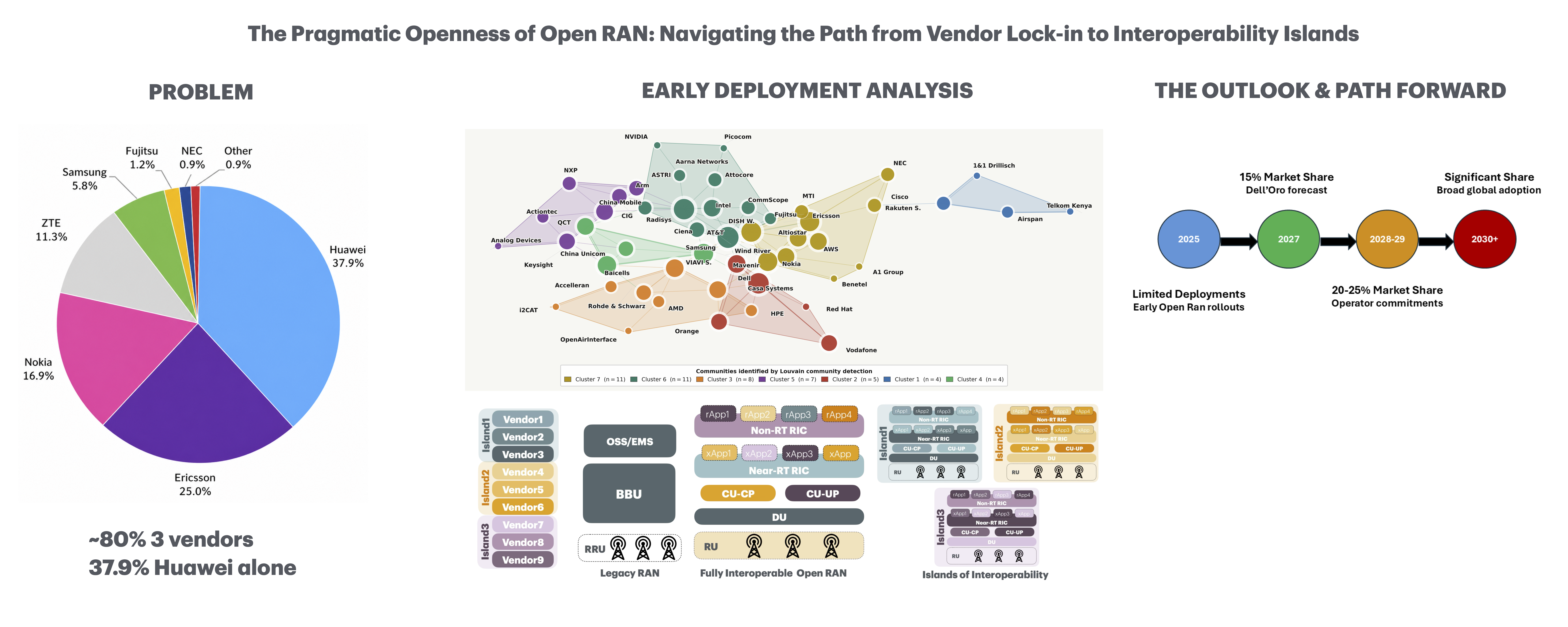
The Pragmatic Openness of Open RAN: Navigating the Path from Vendor Lock-in to Interoperability Islands
Keywords:
Open RAN, o-ran, oran, Islands of Interoperability, Radio access networks, 5g, 6gAbstract
Open Radio Access Network (Open RAN) promises to dismantle traditional vendor lock-in through disaggregation and standardization. This article analyzes its current trajectory, finding that the ecosystem is not evolving toward universal interoperability but is instead consolidating into “islands of interoperability” or pre-validated multi-vendor clusters that risk becoming new forms of lock-in. Through a review of global deployments and industry collaboration patterns, we examine the technical and market forces that may contribute to this fragmentation. We argue that while these islands represent a pragmatic compromise that increases operator choice, they also pose a significant long-term risk to the open ecosystem by stifling innovation and competition. Ultimately, we conclude that avoiding permanent fragmentation is not a technical challenge alone but a strategic imperative. It requires a concerted shift from writing standards to enforcing rigorous, transparent certification and fostering a market that rewards true interoperability over closed partnerships. The future of Open RAN depends on building bridges between these islands to preserve its foundational promise.
Downloads
References
K. Alam, M. A. Habibi, M. Tammen, D. Krummacker, W. Saad,
M. D. Renzo, T. Melodia, X. Costa-P´erez, M. Debbah, A. Dutta,
and H. D. Schotten, “A comprehensive tutorial and survey of o-ran:
Exploring slicing-aware architecture, deployment options, use cases, and
challenges,” IEEE Communications Surveys & Tutorials, vol. 28, pp.
–1678, 2026. doi: 10.1109/COMST.2025.3598406 .
JOURNAL OF LATEX CLASS FILES, VOL. 14, NO. 8, NOV 2025 12
Y. I. H. Aljanabi, S. Y. Hussain, P. T. Mamataevna, V. S. Al-
Doori, and J. M. Brieg, “Advancements in open ran and the de-
centralization of telecom networks,” Journal of Information Process-
ing and Management, vol. Special Issue, pp. 1213–1245, 2025. doi:
22034/jipm.2025.728406 .
“Ieee standard glossary of software engineering terminology,” IEEE Std
12-1990, pp. 1–84, 1990. doi: 10.1109/IEEESTD.1990.101064 .
A. S. Abdalla, P. S. Upadhyaya, V. K. Shah, and V. Marojevic, “Toward
next generation open radio access networks: What o-ran can and
cannot do!” IEEE Network, vol. 36, no. 6, pp. 206–213, 2022. doi:
1109/MNET.108.2100659 .
X. Krasniqi, E. Hajrizi, and B. Qehaja, “Challenges and lessons learned
during private 5g open ran deployments,” in Proc. Int. Conf. on Electri-
cal, Computer, Communications and Mechatronics Engineering (ICEC-
CME), 2023, pp. 1–7. doi: 10.1109/ICECCME57830.2023.10252662 .
V. Yanover, Vendor Interoperability, System Integration, and
Maintenance. John Wiley & Sons, 2025, pp. 83–87. doi:
1002/9781394241170.ch4 .
M. H. Pinson, M. Poletti, J. E. Kub, J. Glenn, S. T. Thompson,
R. Kupsh, N. Areqat, O. Dharmadhikari, A. George, T. L.
Hardin, C. Johnson, S. Kapoulas, and S. Sriram, “5g challenge
preliminary event: Evaluating modular, interoperable, multi-vendor,
open ran solutions,” U.S. Department of Commerce, National
Telecommunications and Information Administration, Institute for
Telecommunication Sciences, Technical Memorandum NTIA TM-
-568, May 2023. doi: 10.70220/nlkk7f2g . [Online]. Available:
https://doi.org/10.70220/nlkk7f2g
J. Groen, S. D’Oro, U. Demir, L. Bonati, M. Polese, T. Melodia,
and K. Chowdhury, “Implementing and evaluating security in o-ran:
Interfaces, intelligence, and platforms,” IEEE Network, vol. 39, no. 1,
pp. 227–234, Jan 2025. doi: 10.1109/MNET.2024.3434419 .
F. Mehran, C. Turyagyenda, and D. Kaleshi, “Experimental evaluation of
multi-vendor 5g open rans: Promises, challenges, and lessons learned,”
IEEE Access, vol. 12, pp. 152 241–152 261, 2024. doi: 10.1109/AC-
CESS.2024.3476963 .
I. Wong, Open RAN Test and Integration, 2024, pp. 172–190. doi:
1002/9781119886020.ch11 .
T. V. Ngo, M. V. Ngo, B. Chen, G. Gemmi, E. Baena, M. Polese,
T. Melodia, W. Chien, and T. Quek, “Consistent and repeatable testing
of o-ran distributed unit (o-du) across continents,” in 2024 IEEE 100th
Vehicular Technology Conference (VTC2024-Fall), 2024, pp. 1–5. doi:
1109/VTC2024-Fall63153.2024.10757917 .
A. Wadud, F. Golpayegani, and N. Afraz, “Qacm: Qos-aware xapp
conflict mitigation in open ran,” IEEE Transactions on Green Com-
munications and Networking, vol. 8, no. 3, pp. 978–993, 2024. doi:
1109/TGCN.2024.3431945 .
Vodafone and N. DOCOMO, “O-ru/o-du integration challenges in an
open ran,” White Paper, 2023, describes the work needed to integrate
radio units and distributed units from different vendors.
O-RAN ALLIANCE WG5, “O-ran interoperability test specification,
version 11.0,” Tech. Rep., 2024.
O-RAN ALLIANCE, “O-ran certification and badging program,” 2023,
available at https://www.o-ran.org/certification-badging.
——, “Overview of open testing and integration centre (otic) and o-
ran certification and badging program,” 2023, white Paper, accessed
Jan. 2025.
C. A. Gutierrez, O. Caicedo, and D. U. Campos-Delgado, “5g and
beyond: Past, present and future of the mobile communications,” IEEE
Latin America Transactions, vol. 19, no. 10, pp. 1702–1736, 2021. doi:
1109/TLA.2021.9477273 .
A. Kord, J. B. Coder, and V. Le, “Evolving open ran interoperability:
A large-scale definition,” in 2024 IEEE International Conference on
Communications Workshops (ICC Workshops), 2024, pp. 2095–2100.
doi: 10.1109/ICCWorkshops59551.2024.10615745 .
S. Singh and U. Samal, “Insights and trends in open ran: The future
of mobile networks,” Journal of Network and Systems Management,
vol. 33, no. 1, pp. 1–22, 2025. doi: 10.1007/s10922-025-09920-5 .