A State-Space Time Series Modeling of Long-Term River Flow and Precipitation Trends across Chile (1910–2015)
Keywords:
state-space modeling, Kalman filter, Mann– Kendall test, Theil–Sen, river flow, precipitation, Hovmöller diagramAbstract
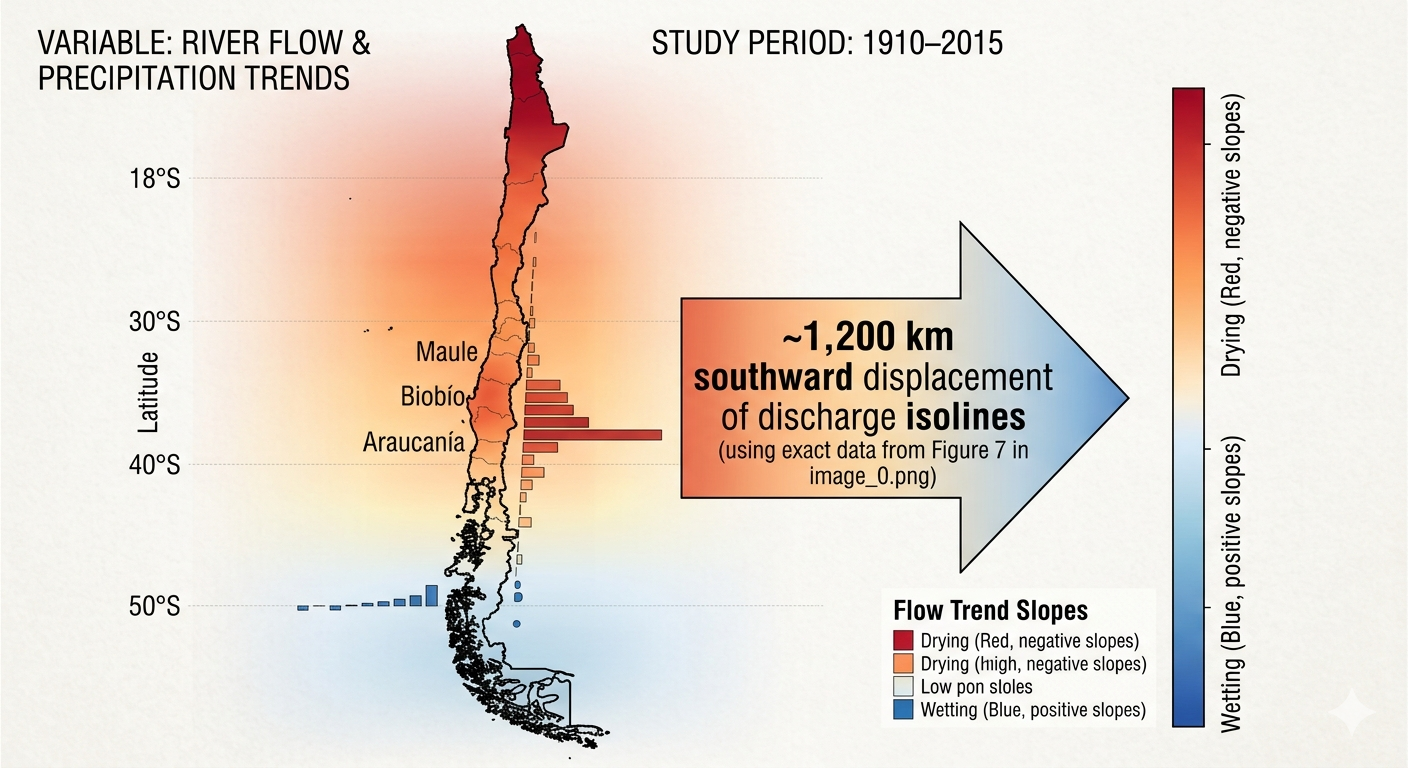
This study provides a comprehensive century-scale assessment of river discharge and precipitation trends across Chile (18◦S–56◦S). We reconstruct regional monthly series from 604 flow and 831 precipitation stations using a statespace model (Durbin & Koopman, 2001) that separates level, trend and seasonal components and allows imputation via the Kalman filter/smoother. Trend detection combines parametric linear regression with non-parametric Mann–Kendall and Theil–Sen estimators. Cross-correlation analysis and decadal Hovmöller diagrams are used to characterize rainfall–discharge coupling and the spatiotemporal propagation of hydrological signals. Results show marked drying trends in northern and central Chile and wetter signals in the far south, with an approximate 1,200 km southward displacement of discharge isolines since 1950. The paper documents the statistical framework in full mathematical detail to support reproducibility.
Downloads
References
I. Fuentes, R. Fuster, D. Avilés, and W. Vervoort, “Water scarcity in central Chile: The effect of climate and land cover changes on hydrologic resources,” Hydrological Sciences Journal, vol. 66, no. 6, pp. 1028–1044, 2021. https://doi.org/10.1080/02626667.2021.1903475
P. Meseguer-Ruiz et al., “General dry trends in Chile: Grid-based analysis 1979-2019,” Frontiers in Earth Science, vol. 12, article 1355443, 2024. https://doi.org/10.3389/feart.2024.1355443
D. Latoja, M. Lillo-Saavedra, C. Gonzalo-Martin, et al., “Decadal variability of dry days in central Chile,” Earth System and Environment, vol. 9, pp. 1117–1134, 2025. https://doi.org/10.1007/s41748-024-00526-6
A. Montecinos and P. Aceituno, “Seasonality of the ENSOrelated rainfall variability in central Chile and associated circulation anomalies,” Journal of Climate, vol. 16, pp. 281–296, 2003. https://doi.org/10.1175/1520-0442(2003)016<0281:SOTERR>2.0.CO;2.
M. I. Brunner, B. Hingray, M. Zappa, and A.-C. Favre, “Future trends in the interdependence between flood peaks and volumes: Hydroclimatological drivers and uncertainty,” Water Resources Research, vol. 55, no. 6, pp. 4745–4759, 2019. https://doi.org/10.1029/2019WR024701
J. A. Rutllant, H. Fuenzalida, and P. Aceituno, “Climate dynamics along the arid northern coast of Chile: The 1997-1998 Dinámica del Clima de la Región de Antofagasta (DICLIMA) experiment”, J. Geophys. Res. Atmos., vol. 108, D17, 2003. https://doi.org/10.1029/2002JD003357
C. Álvarez-Garreton, J. P. Boisier, and R. D. Garreaud, J. Seibert, and M. Vis, “Progressive water deficits during multiyear droughts in basins with long hydrological memory in Chile", Hydrology and Earth System Sciences, vol. 25, pp. 429-446, 2021. https://doi.org/10.5194/hess-25-429-2021
R. D. Garreaud, J. P. Boisier, R. Rondanelli, A. Montecinos, H. H. Sepúlveda, and D. Veloso-Aguila, “The Central Chile Mega Drought (2010-2018): A climate dynamics perspective,” International Journal of Climatology, vol. 40, no. 1, pp. 421–439, 2020. https://doi.org/10.1002/joc.6219.
A. Muñoz, A. González-Reyes, et al. “Streamflow variability in the Chilean Temperate-Mediterranean climate transition (35◦S-42◦S) during the last 400 years inferred from tree-ring records", Climate Dynamics. 47, 4051-4066, 2016. https://doi.org/10.1007/s00382-016-3068-947.
IPCC, Climate Change 2013: The Physical Science Basis. Cambridge, U.K.: Cambridge University Press, 2014. https://doi.org/10.1017/CBO9781107415324
N. W. Arnell and S. N. Gosling, “The impacts of climate change on river flow regimes at the global scale”, J. Hydrol., vol. 486, pp. 351–364, 2013. https://doi.org/10.1016/j.jhydrol.2013.02.010
P. Döll, B. Jiménez-Cisneros, T. Oki, N. W. Arnell, G. Benito, J. G. Cogley, and A. Nishijima, “Integrating risks of climate change into water management,” Hydrol. Sci. J., vol. 60, no. 1, pp. 4–13, 2015.
https://doi.org/10.1080/02626667.2014.967250
Y. Hirabayashi, R. Mahendran, S. Koirala, L. Konoshima, D. Yamazaki, S. Watanabe, H. Kim, and S. Kanae, “Global flood risk under climate change,” Nat. Clim. Change, vol. 3, no. 9, pp. 816–821, 2013. https://doi.org/10.1038/nclimate1911
J. Durbin and S. J. Koopman, Time Series Analysis by State Space Methods, 2nd edn. Oxford, UK: Oxford University Press, 2012. https://doi.org/10.1093/acprof:oso/9780199641178.001.0001
H. B. Mann, “Nonparametric tests against trend”, Econometrica, vol. 13, no. 3, pp. 245–259, 1945. http://dx.doi.org/10.2307/1907187
D. R. Helsel and R. M. Hirsch, K. R. Ryberg, S. A. Archfield, and E. J. Gilroy. Statistical Methods in Water Resources. Amsterdam, Netherlands: Elsevier, 2023. https://doi.org/10.3133/tm4A3
P. K. Sen, “Estimates of the regression coefficient based on Kendall’s tau,” J. Amer. Stat. Assoc., vol. 63, no. 324, pp. 1379–1389, 1968.
https://doi.org/10.1080/01621459.1968.10480934
R. Mendelssohn, “The STAMP software for state space models,” Journal of Statistical Software, vol. 41, no. 2, pp. 1–18, 2011. https://doi.org/10.18637/jss.v041.i02
W. Zhao and R. Prado, “Efficient Bayesian PARCOR approaches
for dynamic modeling of multivariate time series,” Journal
of Time Series Analysis, vol. 41, no. 5, pp. 759–784, 2020.
https://doi.org/10.1111/jtsa.12534
R. Prado, M. A. R. Ferreira, and M. West, Time Series: Modeling, Computation, and Inference, 2nd ed. Boca Raton, FL: Chapman and Hall/CRC, 2021. https://doi.org/10.1201/9781351259422
M. I. Brunner and L. Slater, “Future trends in river floods: An emerging hydrological-climatic typology,” Nature Reviews Earth & Environment, vol. 2, pp. 681–694, 2021. doi: 10.1038/s43017-021-00223-1.
A. Ramanathan, P. A. Versini, D. Schertzer, R. Perrin, L. Sindt, and I. Tchiguirinskaia, “Stochastic simulation of reference rainfall scenarios for hydrological applications using a universal multi-fractal approach", Hydrology and Earth System Sciences, vol. 26, pp. 6477–6491, 2022.
https://doi.org/10.5194/hess-26-6477-2022
J. Helske, “KFAS: Exponential family state space models in R,” Journal of Statistical Software, vol. 78, no. 10, pp. 1–39, 2017. https://doi.org/10.18637/jss.v078.i10
K. H. Hamed and A. R. Rao, “A modified Mann-Kendall trend test for autocorrelated data,” Journal of Hydrology, vol. 204, no. 1-4, pp. 182-196, 1998. https://doi.org/10.1016/S0022-1694(97)00125-X
S. Yue and C. Y. Wang, “Applicability of prewhitening to eliminate the influence of serial correlation on the Mann-Kendall test,” Water Resources Research, vol. 38, no. 6, pp. 4-1–4-7, 2002. https://doi.org/10.1029/2001WR000861
C. Escobar-Avaria, R. Fuster, K. Silva-Urrutia, C. Bauer, A. de la Fuente, “Understanding Conditioning Factors for Hydroelectric Development in Chile: Bases for Community Acceptance". Sustainability. 2022; 14(22):15224. https://doi.org/10.3390/su142215224
Cressie, N. & Wikle, C.K. Statistics for Spatio-Temporal Data. Wiley, 2011.
Gelfand, A.E. et al. Handbook of Spatial Statistics. CRC Press, 2010.