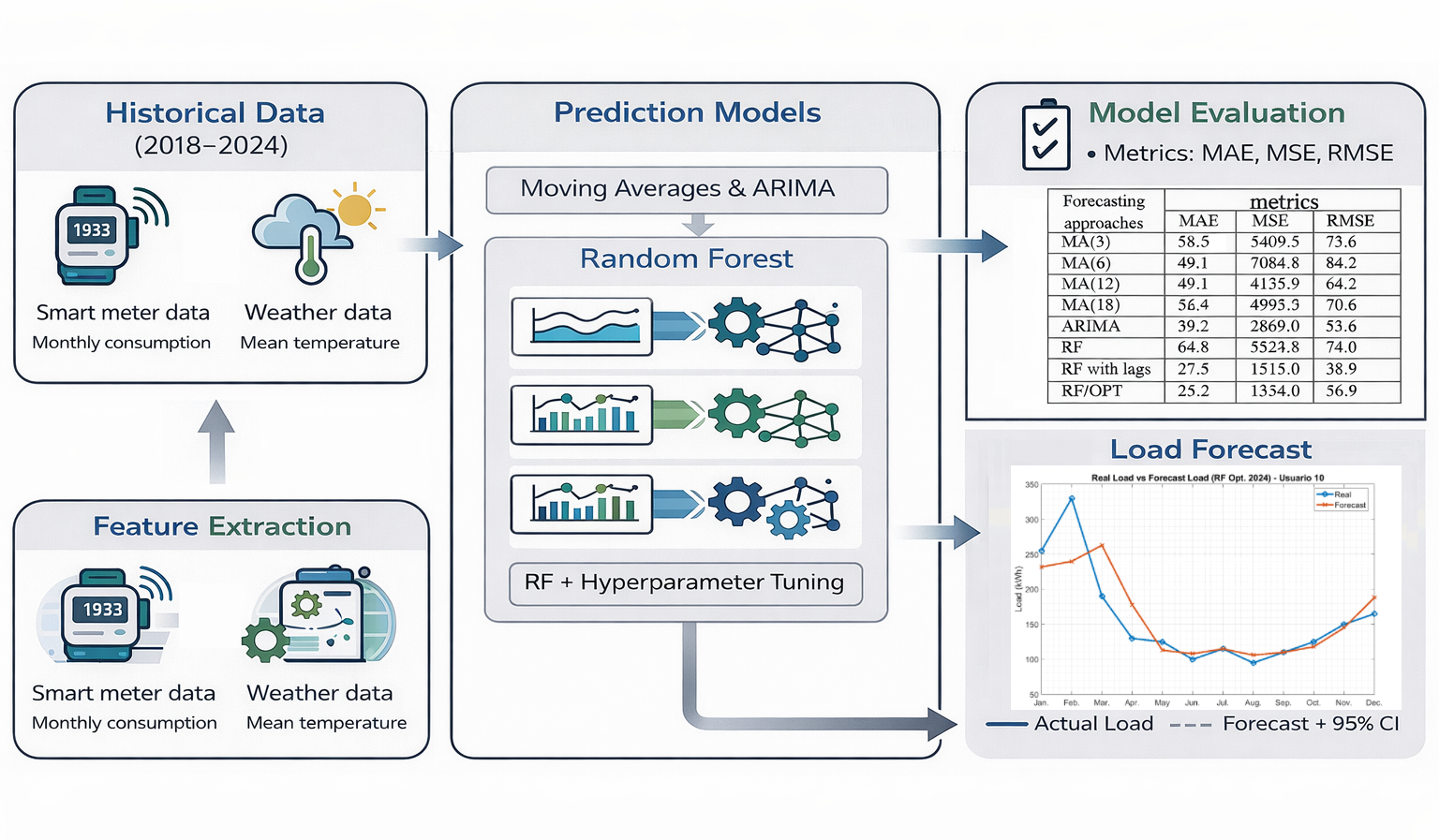
Residential Energy Consumption Forecasting in Electric Utilities: An Approach Based on Random Forests and Time Series
Keywords:
Forecasting, time series, ARIMA, Random Forests, residential usersAbstract
Forecasting the monthly electricity consumption of residential users is a critical task for improving energy planning, demand management, and the efficient integration of renewable energy sources into the electrical system. This study predicts the consumption of a single residential user based on historical data, including monthly consumption and average temperature records from November 2018 to December 2024. Five forecasting approaches are compared: moving averages, ARIMA, standard Random Forest, Random Forest with lag variables, and Random Forest with hyperparameter optimization using RandomizedSearchCV. The models’ performance is evaluated using MAE, MSE, and RMSE metrics over the last 12 months of the analyzed period, with 95% confidence intervals calculated via bootstrapping for both the validation phase and the estimation for January 2025. The results show that Random Forest models with lag variables and hyperparameter optimization outperform traditional methods such as moving averages and ARIMA in terms of accuracy. Additionally, the use of confidence intervals provides a more robust assessment of prediction reliability. It is concluded that the combined use of machine learning techniques, selection of relevant historical variables, and uncertainty quantification methods offers an effective tool for anticipating residential electricity consumption behavior. This approach can be valuable for electric utilities and policymakers seeking datadriven, reliable, and reproducible decisions.
Downloads
References
International Energy Agency. (2022). Smart Grids. https://www.iea.org/reports/smart-grids
World Bank. (2020). Deployment of smart meters: Benefits and barriers. https://openknowledge.worldbank.org/handle/10986/33969
Huishan Yu & Chuankao Yao. (2014, March). A Low Cost Design of the Rural Intelligent Meter Reading System. In Proceedings of the 2014 International Conference on Future Computer and Communication Engineering. Advances in Intelligent Systems Research, Atlantis Press. https://doi.org/10.2991/icfcce-14.2014.30
Guan, Y. L., Chen, B. Q., & Liu, X. Y. (2021). Smart meter data analytics for accurate billing and fraud detection. IEEE Transactions on Smart Grid, 12(4), 3364-3373. https://doi.org/10.1109/TSG.2020.3026512
L. M. Zeger, Information reliability essential for use of smart grid DER behind the meter,IEEE Smart Grid eBulletin, Jul. 2022.
Jokar, P., Arianpoo, N., & Leung, V. C. M. (2016). Electricity theft detection in AMI using customers’ consumption patterns. IEEE Transactions on Smart Grid, 7(1), 216-226.
Hyndman, R. J., & Athanasopoulos, G. (2021). Forecasting: Principles and Practice (3rd ed.). OTexts. https://otexts.com/fpp3/.
Box, G. E. P., Jenkins, G. M., Reinsel, G. C., & Ljung, G. M. (2015). Time Series Analysis: Forecasting and Control (5th ed.). Wiley.
Hewamalage, H., Bergmeir, C., & Bandara, K. (2021). Recurrent neural networks for time series forecasting: Current status and future directions. International Journal of Forecasting, 37(1), 388-427.
Makridakis, S., Spiliotis, E., & Assimakopoulos, V. (2018). Statistical and Machine Learning forecasting methods: Concerns and ways forward. PLOS ONE, 13(3), e0194889.7
Lago, J., De Ridder, F., & De Schutter, B. (2018). Forecasting spot electricity prices: Deep learning approaches and empirical comparison of traditional algorithms. Applied Energy, 221, 386-405.
Y. Yorozu, M. Hirano, K. Oka, and Y. Tagawa. Electron spectroscopy studies on magneto-optical media and plastic substrate interface, IEEE Transl. J. Magn. Japan, vol. 2, pp. 740-741, August 1987 [Digests 9th Annual Conf. Magnetics Japan, p. 301, 1982].
Kumar, R., & Singh, A. (2024). Residential electricity consumption prediction using hybrid CNN-BiLSTM and Random Forest model. International Journal of Intelligent Systems and Applications in Engineering, 12(1), 55-63.
Shumway, R. H., & Stoffer, D. S. (2017). Time Series Analysis and Its Applications: With R Examples. IEEE Signal Processing Magazine, vol. 34, no. 6, pp. 89-100. DOI: 10.1109/MSP.2017.2710958.
Chan, K. S., & Ma, X. (2003). The decompose-and-forecast approach for time series analysis. IEEE Transactions on Signal Processing, 51(2), 503-515
Kalogirou, S. A. (2001). Artificial intelligence in renewable energy applications in buildings. IEEE Transactions on Energy Conversion, 19(3), 409-418.
Hong, T., Pinson, P., & Fan, S. (2014). Global Energy Forecasting Competition 2012: Hierarchical Load Forecasting. IEEE Transactions on Smart Grid, 5(4), 2078-2084.
Zhang, G., Eddy Patuwo, B., & Hu, M. Y. (1998). Forecasting with artificial neural networks: The state of the art. International Journal of Forecasting, 14(1), 35-62
Box, G. E. P., Jenkins, G. M., Reinsel, G. C., & Ljung, G. M. (2015). Time Series Analysis: Forecasting and Control (5th ed.). Wiley.
Jordan, M. I., & Mitchell, T. M. (2015). Machine learning: Trends, perspectives, and prospects. Science, 349(6245), 255-260
Hong, T., Pinson, P., & Fan, S. (2014). Global Energy Forecasting Competition 2012: Hierarchical Load Forecasting. IEEE Transactions on Smart Grid, 5(2), 446-454.
C. M. Bishop, Pattern Recognition and Machine Learning, New York, NY, USA: Springer, 2006.
S. Makridakis, E. Spiliotis, and V. Assimakopoulos, "Statistical and Machine Learning forecasting methods: Concerns and ways forward, IEEE Transactions on Engineering Management, vol. 67, no. 4, pp. 1286-1296, Nov. 2020
T. Bandara, C. Bergmeir, and S. Smyl, "Forecasting across time series databases using recurrent neural networks on groups of similar series: A clustering approach,IEEE Transactions on Neural Networks and Learning Systems, vol. 33, no. 7, pp. 3139-3151, July 2022
L. Breiman, J. Friedman, R. Olshen y C. J. Stone, Classification and Regression Trees, Belmont, CA, USA: Wadsworth, 1984