A Future-Looking Methodology for Estimating CO2 Emissions Reductions Linked to Transmission Projects That Increase Renewable Generation Capacity
Keywords:
Energy transition, Variable renewable generation, Power transmission expansion, Reduction in CO2 emissionsAbstract
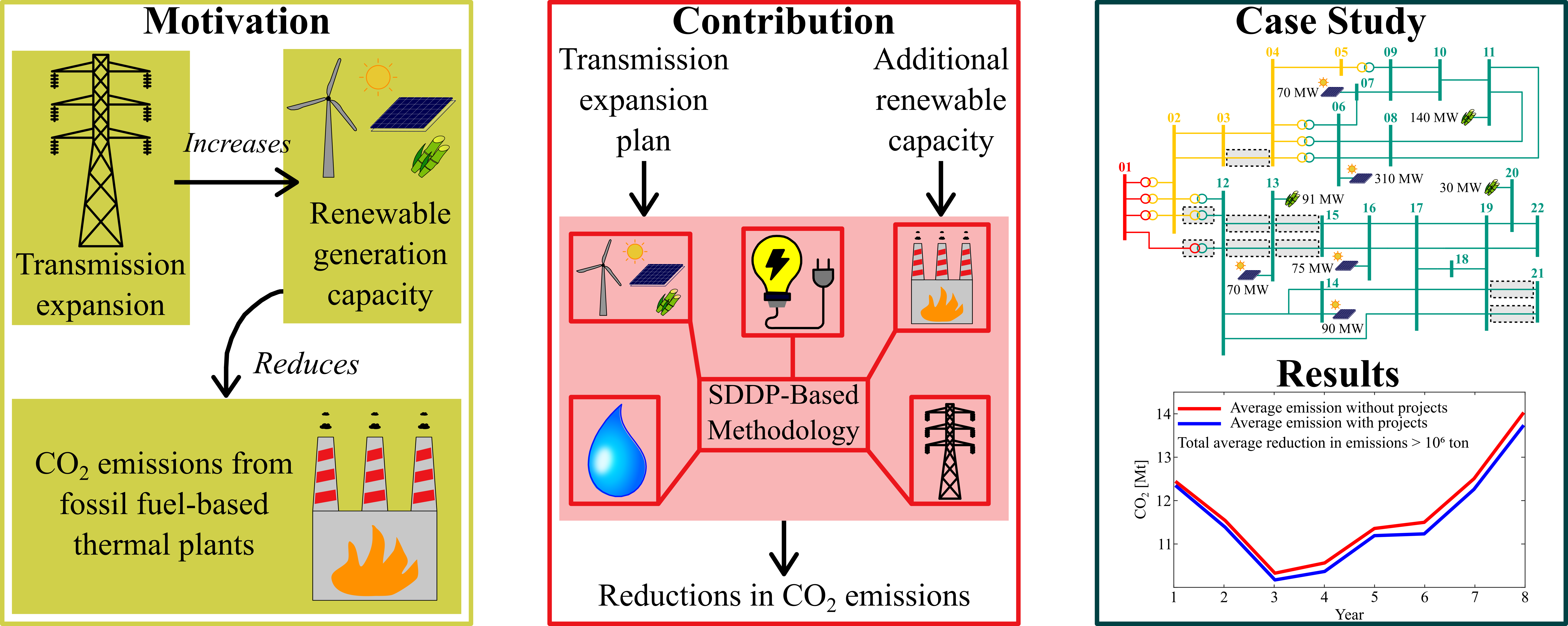
This paper introduces a methodology that allows estimating, in a future time horizon, the reductions in systemic CO2 emissions associated with transmission projects that allow increasing the dispatch of renewable generation in a given region. This methodology relies on stochastic dual dynamic programming, and by providing quantitative results, reinforces the fundamental role of transmission expansion in the transition towards a scenario of increasingly sustainable grids. This work also presents a case study that consists of estimating the reduction of emissions involved with transmission projects in Southeast Brazil that will enable the flow of +615 MW of photovoltaic and +261 MW of biomass thermal generation, in a future horizon covering eight years. The main results are that the new transmission projects contribute to an average net reduction of about 1.13 million tons of CO2 emissions over the horizon and that, in less than four years, these projects will offset the emissions from their implementation and construction.
Downloads
References
D. Gielen et al. The role of renewable energy in the global energy
transformation, Energy Strategy Rev., vol. 24, pp. 38-50, Apr. 2019, DOI:
1016/j.esr.2019.01.006.
X. Zeng et al. Highly-efficient single-level robust transmission expansion
planning approach applicable to large-scale renewable energy integration,
Sust. Energy Grids Netw., vol. 39, pp. 101486, Sep. 2024, DOI:
1016/j.segan.2024.101486.
R. Golombek et al. The role of transmission and energy storage in
European decarbonization towards 2050, Energy, vol. 239, pp. 122159,
Jan. 2022, DOI: 10.1016/j.energy.2021.122159.
J. Lotze et al. The complementary role of energy system and power
grid models: An analysis of the European energy transformation from
a holistic perspective, Energy Conv. Manag., vol. 315, pp. 118761, 2024,
DOI: 10.1016/j.enconman.2024.118761.
M. Mier et al. Collaboration, decarbonization, and distributional
effects. Appl. Energy, vol. 341, pp. 121050, July 2023, DOI:
1016/j.apenergy.2023.121050.
S. Karlsson et al. The roles of permitting times and grid expansion
capacity in industrial decarbonization – A case study of the electrification
of Swedish industry, Ener. Conv. Manag. X, vol. 26, pp. 100962, Apr.
, DOI: 10.1016/j.ecmx.2025.100962.
H. Fell et al. Emissions, Transmission, and the Environmental Value of
Renewable Energy, American Economic Journal: Economic Policy, vol.
, no. 2, pp. 241-272, May 2021, DOI: 10.1257/pol.20190258.
L. W. Davis et al. Transmission Impossible? Prospects for Decarbonizing
the US Grid, Journal of Economic Perspectives, vol. 37, no. 4, pp. 155-
, Fall 2023, DOI: 10.1257/jep.37.4.155.
S. Zapata et al. Investigating the concurrence of transmission grid
expansion and the dissemination of renewables, Energy, vol. 276, pp.
, Aug. 2023, DOI: 10.1016/j.energy.2023.127571.
W. Wang , Q. Tang and B. Gao. Exploration of CO2 emission reduction
pathways: identification of influencing factors of CO2 emission and
CO2 emission reduction potential of power industry, Clean Technologies
and Environmental Policy, vol. 25, pp. 1589–1603, 2023, DOI:
1016/j.jenvman.2022.114925.
J. Xiao et al. Decarbonizing China’s power sector by 2030 with
consideration of technological progress and cross-regional power transmission,
Energy Policy, vol. 150, pp. 112150, March 2021, DOI:
1016/j.enpol.2021.112150.
T. J. Hammons et al. State of the Art in Ultrahigh-Voltage Transmission,
Proceedings of the IEEE, vol. 100, no. 2, pp. 360-390, Feb. 2012, DOI:
1109/JPROC.2011.2152310.
H. Wang et al. Transregional electricity transmission and carbon
emissions: Evidence from ultra-high voltage transmission projects in
China, Energy Economics, vol. 123, pp. 106751, July 2023, DOI:
1016/j.eneco.2023.106751.
T. Liu et al. Carbon Emission Accounting during the Construction of
Typical 500 kV Power Transmissions and Substations Using the Carbon
Emission Factor Approach, Buildings, vol. 14, no. 1, pp. 145, Jan. 2024,
DOI: 10.3390/buildings14010145.
X. Chen and Y. Ou. Carbon emission accounting for power transmission
and transformation equipment: An extended life cycle approach,
Energy Reports, vol. 10, pp. 1369-1378, Nov. 2023, DOI:
1016/j.egyr.2023.08.010.
M. V. Pereira and L. M. Pinto. Multi-stage stochastic optimization
applied to energy planning, Math. Prog., vol. 52, pp. 359-375, 1991,
DOI: 10.1007/BF01582895.
J. Zhu et al. Spatiotemporal decomposed dispatch of integrated
electricity-gas system via stochastic dual dynamic programming-based
value function approximation, Energy, vol. 282, pp. 128247, Nov. 2023,
DOI: 10.1016/j.energy.2023.128247.
A. Helseth and B. Mo. Hydropower Aggregation by Spatial Decomposition—
An SDDP Approach, IEEE Trans. Sust. Energy, vol. 14, no. 1,
pp. 381-392, Jan. 2023, DOI: 10.1109/TSTE.2022.3214497.
PSR. SDDP User Manual, available here, last accessed: Oct. 2025.
Empresa de Pesquisa Energética. Plano Decenal de Expansão de Energia
- Estudos de Apoio, available here, last accessed: Oct. 2025.
Operador Nacional do Sistema. Sobre o SIN - O Sistema em Números,
available here, last accessed: Oct. 2025.
Empresa de Pesquisa Energética. Estudo Prospectivo para Escoamento
do Potencial de Fotovoltaica/Biomassa na Região Noroeste do Estado de
São Paulo, available here, last accessed: Oct. 2025.
J. M. Coelho. A Bioeletricidade e o Planejamento Energético, VII
Seminário Brasileiro de Bioeletricidade, 2017, available here.
Operador Nacional do Sistema. Geração Média Diária e Horária, available
here, last accessed: Oct. 2025.