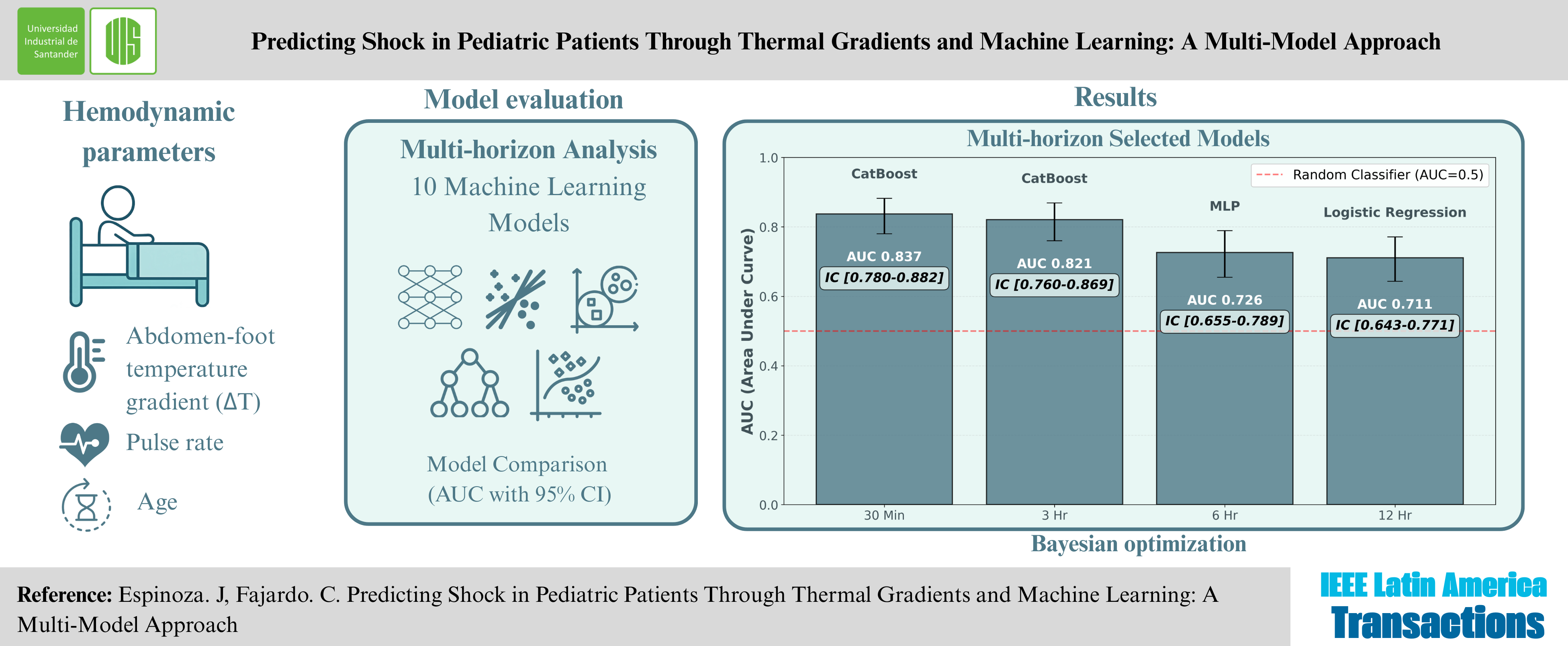
Predicting Shock in Pediatric Patients Through Thermal Gradients and Machine Learning: A Multi-Model Approach
Keywords:
Shock Index, hemodynamic monitoring, pediatric critical care, machine learning, circulatory compromise, non-invasive assessmentAbstract
Early detection of hemodynamic compromise in pediatric patients is critical for timely and effective intervention in intensive care. This study evaluates the use of thermal gradients, specifically the temperature difference between the abdomen and foot, as non-invasive physiological markers to improve prediction of shock. The dataset included thermal gradients, pulse rate, age, and four time-stamped measurements, enabling models to anticipate circulatory deterioration across different prediction horizons. These forecasting windows were examined to assess how far in advance the onset of shock could be reliably predicted. Several machine learning models were compared, and the best approach achieved an AUC of 0.84, with sensitivity of 0.90 and specificity of 0.74. Although methodological differences make direct comparison with previous studies challenging, this performance surpasses that reported in the existing literature. These findings highlight the potential of combining thermal gradients with conventional vital signs to enhance early and reliable risk stratification and support clinical decision-making in pediatric intensive care.
Downloads
References
@misc{sethi2018automated,
author = {Tavpritesh Sethi},
title = {Data for manuscript on automated shock detection in the ICU using Thermal Imaging},
year = {2018},
note = {doi: 10.17605/OSF.IO/VP86J},
}
@article{Garcia2020,
author = {Pedro Celiny Ramos Garcia and Cristian Tedesco Tonial and Jefferson Pedro Piva},
title = {Septic shock in pediatrics: the state-of-the-art},
journal = {Jornal de Pediatria},
volume = {96 Suppl 1},
number = {Suppl 1},
pages = {87--98},
year = {2020},
month = {Mar-Apr},
note = {doi: 10.1016/j.jped.2019.10.007},
pmid = {31843507},
issn = {1678-4782},
publisher = {Elsevier Editora Ltda. on behalf of Sociedade Brasileira de Pediatria},
}
@Article{Biomedical-aplications,
AUTHOR = {Vardasca, Ricardo and Magalhaes, Carolina and Mendes, Joaquim},
TITLE = {Biomedical Applications of Infrared Thermal Imaging: Current State of Machine Learning Classification},
JOURNAL = {Proceedings},
VOLUME = {27},
YEAR = {2019},
NUMBER = {1},
ARTICLE-NUMBER = {46},
URL = {https://www.mdpi.com/2504-3900/27/1/46},
ISSN = {2504-3900},
note = {doi: 10.3390/proceedings2019027046}
}
@article{Core-to-skin,
title = {Core-to-skin temperature gradient measured by thermography predicts day-8 mortality in septic shock: A prospective observational study},
journal = {Journal of Critical Care},
volume = {60},
pages = {294-299},
year = {2020},
issn = {0883-9441},
note = {doi: 10.1016/j.jcrc.2020.08.022},
url = {https://www.sciencedirect.com/science/article/pii/S0883944120306687},
author = {Harry Amson and Charles-Hervé Vacheron and Fabrice Thiolliere and Vincent Piriou and Mathieu Magnin and Bernard Allaouchiche}
}
@article{procine,
author = {Magnin, Mathieu and Junot, Stephane and Cardinali, Martina and Ayoub, Jean Yves and Paquet, Christian and Louzier, Vanessa and Garin, Jeanne Marie Bonnet and Allaouchiche, Bernard},
title = {Use of infrared thermography to detect early alterations of peripheral perfusion: evaluation in a porcine model},
journal = {Biomed Opt Express},
year = {2020},
volume = {11},
number = {5},
pages = {2431--2446},
note = {doi: 10.1364/BOE.387481},
url = {https://doi.org/10.1364/BOE.387481},
pmid = {32499935},
pmc = {PMC7249846},
publisher = {Optical Society of America},
date = {2020-04-08},
issn = {2156-7085},
}
@article{article_2019,
author = {Nagori, Aditya and Dhingra, Lovedeep and Bhatnagar, Ambika and Lodha, Rakesh and Sethi, Tavpritesh},
year = {2019},
month = {01},
title = {Predicting Hemodynamic Shock from Thermal Images using Machine Learning},
volume = {9},
journal = {Scientific Reports},
note = {doi: 10.1038/s41598-018-36586-8}
}
@article{article_Philippe,
author = {Bridier, Armelle and Shcherbakova, Monisha and Kawaguchi, Atsushi and Poirier, Nancy and Said, Carla and Noumeir, Rita and Jouvet, Philippe},
year = {2023},
month = {04},
pages = {1083962},
title = {Hemodynamic assessment in children after cardiac surgery: A pilot study on the value of infrared thermography},
volume = {11},
journal = {Frontiers in pediatrics},
note = {doi: 10.3389/fped.2023.1083962}
}
@Article{es1367,
author="Sudhi, Manu and Shetty, Dasharathraj K. and Balakrishnan, Jayaraj Mymbilly and Prabhu, Deekshith R and Kamath, Ritesh and Girisha, S.",
title="Thermal Imaging Applications in Shock Detection: Technological Advancements and Clinical Implications",
journal="Engineered Science",
year="2025",
volume="33",
pages="1367",
issn="2576-9898",
note="doi: 10.30919/es1367",
url="http://dx.doi.org/10.30919/es1367"
}
@article{Hassanzad2024,
author = {Hassanzad, Mojtaba and Hajian-Tilaki, Karimollah},
title = {Methods of determining optimal cut-point of diagnostic biomarkers with application of clinical data in ROC analysis: an update review},
journal = {BMC Medical Research Methodology},
year = {2024},
volume = {24},
number = {1},
pages = {84},
note = {doi: 10.1186/s12874-024-02198-2},
url = {https://doi.org/10.1186/s12874-024-02198-2}
}
@article{doi:10.1177/2050313X14561779,
author = {Alejandra Ortiz-Dosal and Eleazar S Kolosovas-Machuca and Rosalina Rivera-Vega and Jorge Simón and Francisco J González},
title ={Use of infrared thermography in children with shock: A case series},
journal = {SAGE Open Medical Case Reports},
volume = {2},
number = {},
pages = {2050313X14561779},
year = {2014},
note = {doi: 10.1177/2050313X14561779},
URL = { https://doi.org/10.1177/2050313X14561779}
}
@article{Ochagavía2014,
author = {Ochagavía, A. and Baigorri, F. and Mesquida, J. and Ayuela, J.M. and Ferrándiz, A. and García, X. and Monge, M.I. and Mateu, L. and Sabatier, C. and Clau-Terré, F. and Vicho, R. and Zapata, L. and Maynar, J. and Gil, A.},
title = {Hemodynamic monitoring in the critically patient. Recommendations of the Cardiological Intensive Care and CPR Working Group of the Spanish Society of Intensive Care and Coronary Units},
journal = {Medicina Intensiva (English Edition)},
year = {2014},
volume = {38},
number = {3},
pages = {154--169},
note = {doi: 10.1016/j.medine.2013.10.002},
}
@article{Bourcier2016,
author = {Bourcier, Simon and Pichereau, Claire and Boelle, Pierre-Yves and Nemlaghi, Safaa and Dubée, Vincent and Lejour, Gabriel and Baudel, Jean-Luc and Galbois, Arnaud and Lavillegrand, Jean-Rémi and Bigé, Naïke and Tahiri, Jalel and Leblanc, Guillaume and Maury, Eric and Guidet, Bertrand and Ait-Oufella, Hafid},
title = {Toe-to-room temperature gradient correlates with tissue perfusion and predicts outcome in selected critically ill patients with severe infections},
journal = {Annals of Intensive Care},
year = {2016},
volume = {6},
number = {1},
pages = {63},
note = {doi: 10.1186/s13613-016-0164-2},
url = {https://doi.org/10.1186/s13613-016-0164-2}
}
@article{Berger2013,
author = {Tony Berger and Jeffrey Green and Timothy Horeczko and Yolanda Hagar and Nidhi Garg and Alison Suarez and Edward Panacek and Nathan Shapiro},
title = {Shock index and early recognition of sepsis in the emergency department: pilot study},
journal = {The Western Journal of Emergency Medicine},
volume = {14},
number = {2},
pages = {168--174},
year = {2013},
month = mar,
publisher = {University of California},
issn = {1936-900X},
eissn = {1936-9018},
note = {doi: 10.5811/westjem.2012.8.11546},
url = {https://doi.org/10.5811/westjem.2012.8.11546}
}
@article{Youden,
author = {Ruopp, Marcus D and Perkins, Neil J and Whitcomb, Brian W and Schisterman, Enrique F},
title = {Youden Index and optimal cut-point estimated from observations affected by a lower limit of detection},
journal = {Biometrical Journal. Biometrische Zeitschrift},
year = {2008},
volume = {50},
number = {3},
pages = {419--430},
note = { doi: 10.1002/bimj.200710415},
publisher = {WILEY-VCH Verlag GmbH & Co. KGaA},
url = {https://doi.org/10.1002/bimj.200710415}
}
@ARTICLE{10.3389/fphys.2022.862411,
AUTHOR={Vats, Vanshika and Nagori, Aditya and Singh, Pradeep and Dutt, Raman and Bandhey, Harsh and Wason, Mahika and Lodha, Rakesh and Sethi, Tavpritesh },
TITLE={Early Prediction of Hemodynamic Shock in Pediatric Intensive Care Units With Deep Learning on Thermal Videos},
JOURNAL={Frontiers in Physiology},
VOLUME={13},
YEAR={2022},
URL={https://www.frontiersin.org/journals/physiology/articles/10.3389/fphys.2022.862411},
note={doi: 10.3389/fphys.2022.862411}}
@article{PHILLIPS2020690,
title = {The shock index, pediatric age-adjusted (SIPA) enhanced: Prehospital and emergency department SIPA values forecast transfusion needs for blunt solid organ injured children},
journal = {Surgery},
volume = {168},
number = {4},
pages = {690-694},
year = {2020},
issn = {0039-6060},
note = {doi: 10.1016/j.surg.2020.04.061},
url = {https://www.sciencedirect.com/science/article/pii/S0039606020302750},
author = {Ryan Phillips and Shannon Acker and Niti Shahi and Gabrielle Shirek and Maxene Meier and Adam Goldsmith and John Recicar and Steven Moulton and Denis Bensard}
}
@article{Koch31122019,
author = {Erica Koch, Shannon Lovett, Trac Nghiem, Robert A Riggs and Megan A Rech},
title = {Shock index in the emergency department: utility and limitations},
journal = {Open Access Emergency Medicine},
volume = {11},
number = {},
pages = {179--199},
year = {2019},
publisher = {Dove Medical Press},
note = {doi: 10.2147/OAEM.S178358},
URL = {https://www.tandfonline.com/doi/abs/10.2147/OAEM.S178358
},
}
@article{RADY1992227,
title = {Shock index: a re-evaluation in acute circulatory failure},
journal = {Resuscitation},
volume = {23},
number = {3},
pages = {227-234},
year = {1992},
issn = {0300-9572},
note = {doi: 10.1016/0300-9572(92)90006-X},
url = {https://www.sciencedirect.com/science/article/pii/030095729290006X},
author = {Mohamed Y. Rady and Peter Nightingale and Roderick A. Little and J.Denis Edwards}
}
@article{Ospina-Tascon2020,
author = {Gustavo A. Ospina-Tascón and Jean-Louis Teboul and Glenn Hernandez and Ingrid Alvarez and Alvaro I. Sánchez-Ortiz and Luis E. Calderón-Tapia and Ramiro Manzano-Nunez and Edgardo Quiñones and Humberto J. Madriñan-Navia and Juan E. Ruiz and José L. Aldana and Jan Bakker},
title = {Diastolic shock index and clinical outcomes in patients with septic shock},
journal = {Annals of Intensive Care},
year = {2020},
volume = {10},
number = {1},
pages = {41},
note = {doi: 10.1186/s13613-020-00658-8},
url = {https://doi.org/10.1186/s13613-020-00658-8}
}
@article{Acker2017,
title = {Shock index, pediatric age-adjusted (SIPA) is more accurate than age-adjusted hypotension for trauma team activation},
author = {Acker, Shannon N. and Bredbeck, Brooke and Partrick, David A. and Kulungowski, Ann M. and Barnett, Carlton C. and Bensard, Denis D.},
journal = {Surgery},
volume = {161},
number = {3},
pages = {803--807},
year = {2017},
month = mar,
publisher = {Elsevier},
note = {doi: 10.1016/j.surg.2016.08.050},
url = {https://doi.org/10.1016/j.surg.2016.08.050}
}