Word-Line-Aware Garbage Collector for QLC-based NAND Flash Memories
Keywords:
NAND-Flash Memory, Garbage Collector, QLC Cells, Word-Line AwarenessAbstract
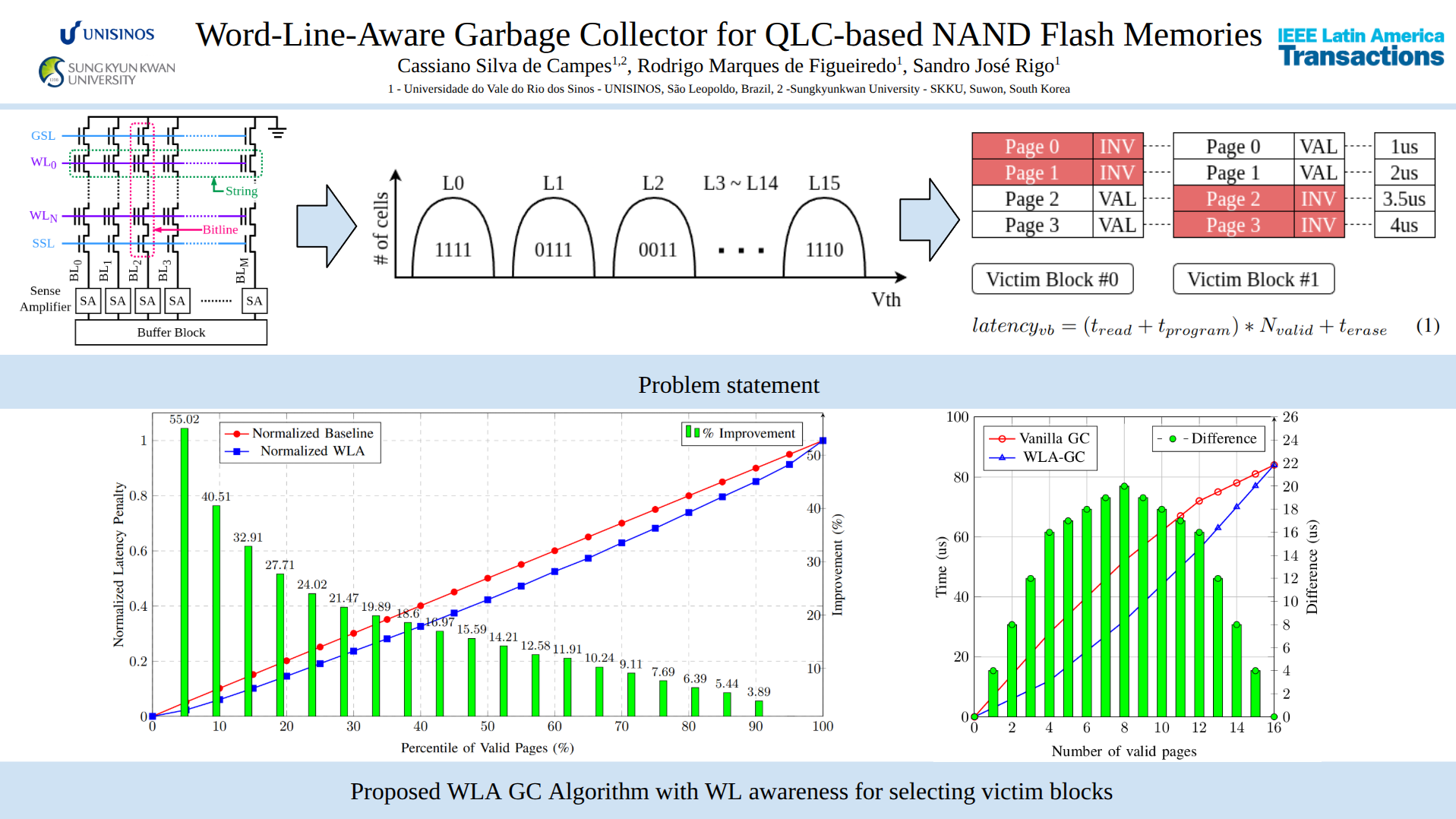
The Garbage Collector (GC) on NAND Flash memories is one of the most expensive operations in modern Solid-State Drives (SSD). However, it is essential to claim more free pages on SSDs. Various researches attempt to reduce the penalty of GC operations at different levels of the Input/Output (IO) path. Nevertheless, within the reviewed related works in Host-side, Open-Channel SSDs, and Device-side areas, we did not observe overlap with our research scope in how the logical pages are scattered in the NAND Word-Lines (WL) at the physical level, and how they impact performance degradation during the Garbage Collection operation. To reduce this bridge gap, we propose a new GC policy: Word-Line Aware Garbage Collector (WLA-GC). The WLA-GC focuses on reducing the Garbage Collector overhead by observing the physical distribution of valid logical pages within the WLs of a NAND Flash block to best select the victim blocks to be erased. Based on these criteria, the GC decisions are made by considering the latency the victim block will take to be fully erased. Analytical modeling shows that the proposed method outperforms the Vanilla GC in all cases, with an average performance of 25.4%. In comparison, the experimental results present a performance improvement of 55% in best-case scenarios.
Downloads
References
L. Shijun, Z. Xuecheng, and W. Baocun, “Program and read methods with offset in quad-level-cell nand design,” in 2017 International Conference on Electron Devices and Solid-State Circuits (EDSSC). IEEE, 2017, pp. 1–2. [Online]. Available: https://doi.org/10.1109/EDSSC.2017.8126461
T. Garrett, J. Yang, and Y. Zhang, “Enabling intra-plane parallel block erase in nand flash to alleviate the impact of garbage collection,” in Proceedings of the International Symposium on Low Power Electronics and Design, 2018, pp. 1–6. [Online]. Available: https://doi.org/10.1145/3218603.3218627
N. Li, M. Hao, H. Li, X. Lin, T. Emami, and H. S. Gunawi, “Fantastic ssd internals and how to learn and use them,” in Proceedings of the 15th ACM International Conference on Systems and Storage, ser. SYSTOR ’22. New York, NY, USA: Association for Computing Machinery, 2022, p. 72–84. [Online]. Available: https://doi.org/10.1145/3534056.3534940
W. Wang, W. Pan, T. Xie, and D. Zhou, “How many mlcs should impersonate slcs to optimize ssd performance?” in Proceedings of the Second International Symposium on Memory Systems, ser. MEMSYS ’16. New York, NY, USA: Association for Computing Machinery, 2016, p. 238–247. [Online]. Available: https://doi.org/10.1145/2989081.2989095
C.-W. Yoon, “The fundamentals of nand flash memory: Technology for tomorrow’s fourth industrial revolution,” IEEE Solid-State Circuits Magazine, vol. 14, no. 2, pp. 56–65, 2022. [Online]. Available: https://doi.org/10.1109/MSSC.2022.3166466
W. Sul, K. Kim, M. Ryu, H. Jung, and H. Han, “Fast journaling made simple with nvm,” in Proceedings of the 35th Annual ACM Symposium on Applied Computing, ser. SAC ’20. New York, NY, USA: Association for Computing Machinery, 2020, p. 1214–1221. [Online]. Available: https://doi.org/10.1145/3341105.3373865
K. Koo, J. Oh, K. Min, Y. Kwon, and Y. Won, “C2j: compulsory compound transaction for journaling file system,” in Proceedings of the 12th ACM SIGOPS Asia-Pacific Workshop on Systems, ser. APSys ’21. New York, NY, USA: Association for Computing Machinery, 2021, p. 17–24. [Online]. Available: https://doi.org/10.1145/3476886.3477514
H. Park, E. Lee, J. Kim, and S. H. Noh, “Lightweight data lifetime classification using migration counts to improve performance and lifetime of flash-based ssds,” in Proceedings of the 12th ACM SIGOPS Asia-Pacific Workshop on Systems, 2021, pp. 25–33. [Online]. Available: https://doi.org/10.1145/3476886.3477520
S. Li, W. Tong, J. Liu, B. Wu, and Y. Feng, “Accelerating garbage collection for 3d mlc flash memory with slc blocks,” in 2019 IEEE/ACM International Conference on Computer-Aided Design (ICCAD). IEEE, 2019, pp. 1–8. [Online]. Available: https://doi.org/10.1109/ICCAD45719.2019.8942097
J. Cui, Y. Zhang, J. Huang, W. Wu, and J. Yang, “Shadowgc: Cooperative garbage collection with multi-level buffer for performance improvement in nand flash-based ssds,” in 2018 Design, Automation & Test in Europe Conference & Exhibition (DATE). IEEE, 2018, pp. 1247–1252. [Online]. Available: https://doi.org/10.23919/DATE.2018.8342206
Y.-i. Choi, S. Ahn et al., “Separating the file system journal to reduce write amplification of garbage collection on zns ssds,” Journal of Multimedia Information System, vol. 9, no. 4, pp. 261–268, 2022. [Online]. Available: https://doi.org/10.33851/JMIS.2022.9.4.261
J. Kim, M. Kim, M. D. Tehseen, J. Oh, and Y. Won, “{IPLFS}:{Log-Structured} file system without garbage collection,” in 2022 USENIX Annual Technical Conference (USENIX ATC 22), 2022, pp. 739–754. [Online]. Available: https://www.usenix.org/conference/atc22/presentation/kim-juwon
J. Lee and J.-S. Kim, “An empirical study of hot/cold data separation policies in solid state drives (ssds),” in Proceedings of the 6th International Systems and Storage Conference, ser. SYSTOR ’13. New York, NY, USA: Association for Computing Machinery, 2013. [Online]. Available: https://doi.org/10.1145/2485732.2485745
S. Gong, H. Sun, Z. Fang, L. Liu, L. Chen, and Y. Gao, “Vstream: A distributed streaming vector search system,” Proc. VLDB Endow., vol. 18, no. 6, p. 1593–1606, Aug. 2025. [Online]. Available: https://doi.org/10.14778/3725688.3725692
H. Lee, W. Choi, and Y. Hong, “On-demand garbage collection algorithm with prioritized victim blocks for ssds,” Electronics, vol. 12, no. 9, p. 2142, 2023. [Online]. Available: https://doi.org/10.3390/electronics12092142
T. Wang, P. Li, P. Xie, and X. Wang, “Ssd multi-level parallel garbage collection,” in 2023 4th International Conference on Information Science, Parallel and Distributed Systems (ISPDS). IEEE, 2023, pp. 301–306. [Online]. Available: https://doi.org/10.1109/ISPDS58840.2023.10235643
Y.-Y. Lu, C.-H. Wu, and Y.-S. Chen, “A machine-learning-based data classifier to reduce the write amplification in ssds,” in Proceedings of the International Conference on Research in Adaptive and Convergent Systems, ser. RACS ’20. New York, NY, USA: Association for Computing Machinery, 2020, p. 213–218. [Online]. Available: https://doi.org/10.1145/3400286.3418239
D. Hong, M. Kim, G. Cho, D. Lee, and J. Kim, “{GuardedErase}: Extending {SSD} lifetimes by protecting weak wordlines,” in 20th USENIX Conference on File and Storage Technologies (FAST 22), 2022, pp. 133–146. [Online]. Available: https://www.usenix.org/conference/fast22/presentation/hong
R. Zhang, D. Liu, C. Yang, X. Chen, L. Qiao, and Y. Tan, “Optimizing cow-based file systems on open-channel ssds with persistent memory,” in Proceedings of the 2022 Conference & Exhibition on Design, Automation & Test in Europe, ser. DATE ’22. Leuven, BEL: European Design and Automation Association, 2022, p. 496–501. [Online]. Available: https://doi.org/10.23919/DATE54114.2022.9774695
P. Singh et al., “Mfgc: Minimal first garbage collection for monitoring of context-aware victim selection,” Journal of Electrical Systems, vol. 20, no. 2s, pp. 92–101, 2024. [Online]. Available: https://doi.org/10.52783/jes.1092
Y.-S. Tsai, S.-H. Chen, Y.-C. Liaw, and C.-Y. Wu, “Exploring hot/cold data separation for garbage collection efficiency enhancement on ocssds,” in 2023 20th International SoC Design Conference (ISOCC). IEEE, 2023, pp. 241–242. [Online]. Available: https: //doi.org/10.1109/ISOCC59558.2023.10396140
S. Son and S. Ahn, “Optimizing garbage collection overhead of host-level flash translation layer for journaling filesystems,” International Journal of Internet, Broadcasting and Communication, vol. 13, no. 2, pp. 27–35, 2021. [Online]. Available: https: //doi.org/10.7236/IJIBC.2021.13.2.27
X. Zhang, J. Bhimani, S. Pei, E. Lee, S. Lee, Y. J. Seong, E. J. Kim, C. Choi, E. H. Nam, J. Choi, and B. S. Kim, “Storage abstractions for ssds: The past, present, and future,” ACM Trans. Storage, vol. 21, no. 1, Jan. 2025. [Online]. Available: https://doi.org/10.1145/3708992
Z. Tan, L. Long, J. Shen, R. Liu, C. Gao, K. Zhong, and Y. Jiang, “Optimizing garbage collection for zns ssds via in-storage data migration and address remapping,” ACM Trans. Archit. Code Optim., vol. 21,
no. 4, Nov. 2024. [Online]. Available: https://doi.org/10.1145/3689336
J.-U. Kang, J. Hyun, H. Maeng, and S. Cho, “The multi-streamed solid-state drive,” in 6th USENIX Workshop on Hot Topics in Storage and File Systems (HotStorage 14). Philadelphia, PA: USENIX Association, Jun. 2014. [Online]. Available: https: //dl.acm.org/doi/10.5555/2696578.2696591