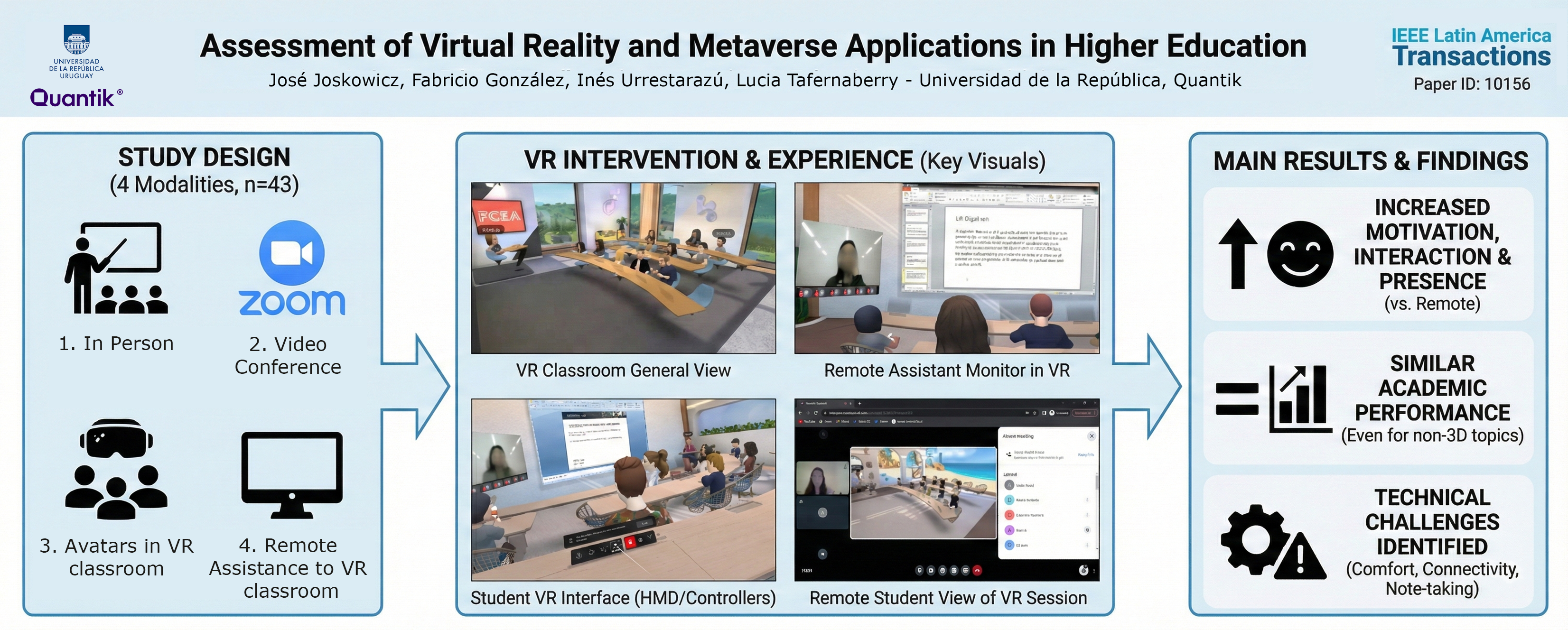
Assessment of Virtual Reality and Metaverse Applications in Higher Education
Keywords:
Virtual Reality, Quality of Experience, MetaverseAbstract
This paper examines the use and effectiveness of consumer-grade Virtual Reality (VR) technology in traditional university courses. At the School of Economics, Universidad de la República in Uruguay, students were divided into four groups: in-person, standard video conferencing, VR with avatars in a metaverse classroom, and remote participation in the metaverse. The study assessed various Quality of Experience (QoE) factors for students and professors, such as audiovisual quality, comfort, immersion, fatigue, and cognitive load. Findings reveal that VR promotes high student satisfaction, motivation, and interaction, reaching levels similar to in-person classes. However, issues like technical difficulties and discomfort with extended VR use were noted. The paper discusses the broader potential of VR for non-STEM higher education and offers recommendations for future implementation of immersive technologies.
Downloads
References
“Online University Education - Global | Market Forecast,” Statista. Accessed: July 07, 2024. [Online]. Available: https://www.statista.com/outlook/emo/online-education/online-university-education/worldwide
F. Makda, “Digital education: Mapping the landscape of virtual teaching in higher education – a bibliometric review,” Educ. Inf. Technol., pp. 1–29, July 2024, doi: 10.1007/s10639-024-12899-2.
J. Joskowicz, “A Historical and Current Review of Extended Reality Technologies and Applications,” Aug. 2024, Accessed: Aug. 17, 2024. [Online]. Available: https://www.authorea.com/doi/full/10.36227/techrxiv.24716454.v1?commit=77753056aafbf71e2f15720c534f360b1fd255d7
J. Joskowicz, F. González, and I. Urrestarazú, “Using VR in a Two-Month University Course,” in 2024 IEEE Conference on Virtual Reality and 3D User Interfaces Abstracts and Workshops (VRW), Mar. 2024, pp. 699–700. doi: 10.1109/VRW62533.2024.00146.
R. Liu, J. Kang, L. Wang, and M. Fan, “Exploring Primary School Students’ Academic Emotions and Learning Achievement in an Immersive Virtual Reality Science Classroom,” in 2022 International Symposium on Educational Technology (ISET), July 2022, pp. 163–167. doi: 10.1109/ISET55194.2022.00042.
N. Pellas, S. Mystakidis, and I. Kazanidis, “Immersive Virtual Reality in K-12 and Higher Education: A systematic review of the last decade scientific literature,” Virtual Real., vol. 25, no. 3, pp. 835–861, Sept. 2021, doi: 10.1007/s10055-020-00489-9.
J. A. di Lanzo, A. Valentine, F. Sohel, A. Y. T. Yapp, K. C. Muparadzi, and M. Abdelmalek, “A review of the uses of virtual reality in engineering education,” Comput. Appl. Eng. Educ., vol. 28, no. 3, Art. no. 3, 2020, doi: 10.1002/cae.22243.
A. R. Muzata, G. Singh, M. S. Stepanov, and I. Musonda, “Immersive Learning: A Systematic Literature Review on Transforming Engineering Education Through Virtual Reality,” Virtual Worlds, vol. 3, no. 4, Art. no. 4, Dec. 2024, doi: 10.3390/virtualworlds3040026.
J. Kim, K. Kim, and W. Kim, “Impact of Immersive Virtual Reality Content Using 360-Degree Videos in Undergraduate Education,” IEEE Trans. Learn. Technol., vol. 15, no. 1, pp. 137–149, Feb. 2022, doi: 10.1109/TLT.2022.3157250.
N. Pellas, A. Dengel, and A. Christopoulos, “A Scoping Review of Immersive Virtual Reality in STEM Education,” IEEE Trans. Learn. Technol., vol. 13, no. 4, Art. no. 4, Oct. 2020, doi: 10.1109/TLT.2020.3019405.
S. Porcu, A. Floris, and L. Atzori, “Will Virtual Reality Transform Online Synchronous Learning? Evidence From a Quality of Experience Subjective Assessment,” IEEE Trans. Learn. Technol., vol. 18, pp. 606–618, 2025, doi: 10.1109/TLT.2025.3572175.
I. S. Khukalenko, R. Kaplan-Rakowski, Y. An, and V. D. Iushina, “Teachers’ perceptions of using virtual reality technology in classrooms: A large-scale survey,” Educ. Inf. Technol., vol. 27, no. 8, pp. 11591–11613, Sept. 2022, doi: 10.1007/s10639-022-11061-0.
Á. Antón-Sancho, P. Fernández-Arias, and D. Vergara, “Assessment of Virtual Reality among University Professors: Influence of the Digital Generation,” Computers, vol. 11, no. 6, Art. no. 6, June 2022, doi: 10.3390/computers11060092.
M. I. Berkman and E. Akan, “Presence and Immersion in Virtual Reality,” in Encyclopedia of Computer Graphics and Games, N. Lee, Ed., Cham: Springer International Publishing, 2024, pp. 1461–1470. doi: 10.1007/978-3-031-23161-2_162.
Y. Lee, D. Park, and Y. M. Kim, “The effect of wearing a head-mounted display on the boundaries of the cervical range of motion based on perceived comfort in a static posture,” Virtual Real., vol. 27, no. 2, Art. no. 2, June 2023, doi: 10.1007/s10055-022-00684-w.
N. O. Conner et al., “Virtual Reality Induced Symptoms and Effects: Concerns, Causes, Assessment & Mitigation,” Virtual Worlds, vol. 1, no. 2, Art. no. 2, Dec. 2022, doi: 10.3390/virtualworlds1020008.
S. Katsigiannis, R. Willis, and N. Ramzan, “A QoE and Simulator Sickness Evaluation of a Smart-Exercise-Bike Virtual Reality System via User Feedback and Physiological Signals,” IEEE Trans. Consum. Electron., vol. 65, no. 1, pp. 119–127, Feb. 2019, doi: 10.1109/TCE.2018.2879065.
H. Mazumdar, M. Sathvik, C. Chakraborty, B. Unhelkar, and S. Mahmoudi, “Real-Time Mental Health Monitoring for Metaverse Consumers to Ameliorate the Negative Impacts of Escapism and Post Trauma Stress Disorder,” IEEE Trans. Consum. Electron., vol. 70, no. 1, pp. 2129–2136, Feb. 2024, doi: 10.1109/TCE.2024.3364169.
S. Vlahovic, M. Suznjevic, and L. Skorin-Kapov, “A survey of challenges and methods for Quality of Experience assessment of interactive VR applications,” J. Multimodal User Interfaces, vol. 16, no. 3, pp. 257–291, Sept. 2022, doi: 10.1007/s12193-022-00388-0.
W. Huang, “Evaluating the Effectiveness of Head-Mounted Display Virtual Reality (HMD VR) Environment on Students’ Learning for a Virtual Collaborative Engineering Assembly Task,” in 2018 IEEE Conference on Virtual Reality and 3D User Interfaces (VR), Mar. 2018, pp. 827–829. doi: 10.1109/VR.2018.8446508.
E. Hedrick, M. Harper, E. Oliver, and D. Hatch, “Teaching & Learning in Virtual Reality: Metaverse Classroom Exploration,” in 2022 Intermountain Engineering, Technology and Computing (IETC), May 2022, pp. 1–5. doi: 10.1109/IETC54973.2022.9796765.
X. Zhang, Y. Chen, L. Hu, and Y. Wang, “The metaverse in education: Definition, framework, features, potential applications, challenges, and future research topics,” Front. Psychol., vol. 13, Oct. 2022, doi: 10.3389/fpsyg.2022.1016300.
“P.1320 : Quality of experience assessment of extended reality meetings.” Accessed: July 14, 2024. [Online]. Available: https://www.itu.int/rec/T-REC-P.1320-202207-I
“P.800: Methods for subjective determination of transmission quality.” Accessed: July 14, 2024. [Online]. Available: https://www.itu.int/rec/T-REC-P.800-199608-I/es
A. Zheleva, W. Durnez, K. Bombeke, G. Van Wallendael, and L. De Marez, “Seeing is Believing: The Effect of Video Quality on Quality of Experience in Virtual Reality,” in 2020 Twelfth International Conference on Quality of Multimedia Experience (QoMEX), May 2020, pp. 1–4. doi: 10.1109/QoMEX48832.2020.9123075.
A. Covaci et al., “Multisensory 360° Videos Under Varying Resolution Levels Enhance Presence,” IEEE Trans. Vis. Comput. Graph., vol. 29, no. 4, Art. no. 4, Apr. 2023, doi: 10.1109/TVCG.2022.3140875.
T. Potter, Z. Cvetković, and E. De Sena, “On the Relative Importance of Visual and Spatial Audio Rendering on VR Immersion,” Front. Signal Process., vol. 2, Sept. 2022, doi: 10.3389/frsip.2022.904866.
M. S. Anwar, J. Wang, A. Ullah, W. Khan, S. Ahmad, and Z. Fei, “Measuring quality of experience for 360-degree videos in virtual reality,” Sci. China Inf. Sci., vol. 63, no. 10, Art. no. 10, Aug. 2020, doi: 10.1007/s11432-019-2734-y.
K. Ito, M. Tada, H. Ujike, and K. Hyodo, “Effects of the Weight and Balance of Head-Mounted Displays on Physical Load,” Appl. Sci., vol. 11, no. 15, Art. no. 15, Jan. 2021, doi: 10.3390/app11156802.
T. Hirzle et al., “Understanding, Addressing, and Analysing Digital Eye Strain in Virtual Reality Head-Mounted Displays,” ACM Trans Comput-Hum Interact, vol. 29, no. 4, Art. no. 4, Mar. 2022, doi: 10.1145/3492802.
A. Graybiel, C. D. Wood, and D. B. Cramer, “Diagnostic Criteria for Grading M E Severity of Acute Motion Sickness,” Nav. Aerosp. Med. Inst. Pensacola, 1968.
R. S. Kennedy, N. E. Lane, K. S. Berbaum, and M. G. Lilienthal, “Simulator Sickness Questionnaire: An Enhanced Method for Quantifying Simulator Sickness,” Int. J. Aviat. Psychol., vol. 3, no. 3, Art. no. 3, July 1993, doi: 10.1207/s15327108ijap0303_3.
P. Perez, N. Oyaga, J. J. Ruiz, and A. Villegas, “Towards Systematic Analysis of Cybersickness in High Motion Omnidirectional Video,” in 2018 Tenth International Conference on Quality of Multimedia Experience (QoMEX), May 2018, pp. 1–3. doi: 10.1109/QoMEX.2018.8463377.
B. G. Witmer and M. J. Singer, “Measuring Presence in Virtual Environments: A Presence Questionnaire,” Presence Teleoperators Virtual Environ., vol. 7, no. 3, Art. no. 3, June 1998, doi: 10.1162/105474698565686.
C. Jennett et al., “Measuring and defining the experience of immersion in games,” Int. J. Hum.-Comput. Stud., vol. 66, no. 9, Art. no. 9, Sept. 2008, doi: 10.1016/j.ijhcs.2008.04.004.
Y. Georgiou and E. A. Kyza, “The development and validation of the ARI questionnaire: An instrument for measuring immersion in location-based augmented reality settings,” Int. J. Hum.-Comput. Stud., vol. 98, pp. 24–37, Feb. 2017, doi: 10.1016/j.ijhcs.2016.09.014.
J. Blascovich, “Social Influence within Immersive Virtual Environments,” in The Social Life of Avatars, R. Schroeder, Ed., London: Springer London, 2002, pp. 127–145. Accessed: July 15, 2024. [Online]. Available: http://link.springer.com/10.1007/978-1-4471-0277-9_8
I. Bergström, S. Azevedo, P. Papiotis, N. Saldanha, and M. Slater, “The Plausibility of a String Quartet Performance in Virtual Reality,” IEEE Trans. Vis. Comput. Graph., vol. 23, no. 4, Art. no. 4, Apr. 2017, doi: 10.1109/TVCG.2017.2657138.
B. Gore, “NASA TLX Task Load Index.” Accessed: July 18, 2024. [Online]. Available: https://humansystems.arc.nasa.gov/groups/TLX/
F. F. Reichheld, “The One Number You Need to Grow,” Harvard Business Review, Dec. 01, 2003. Accessed: July 18, 2024. [Online]. Available: https://hbr.org/2003/12/the-one-number-you-need-to-grow