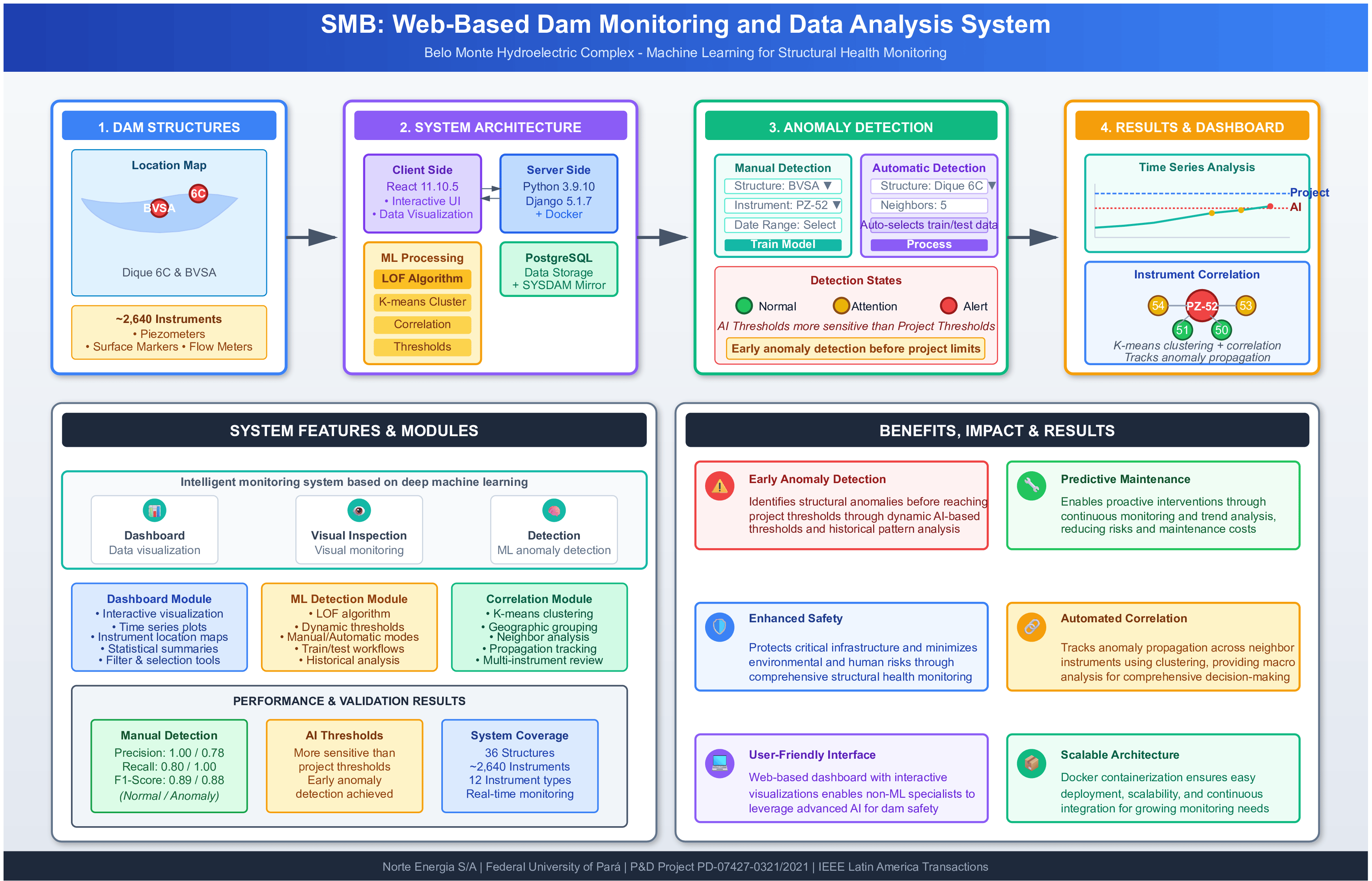
SMB: Web-Based Dam Monitoring and Data Analysis System
Keywords:
Dam safety, machine learning, web applicationAbstract
The monitoring and supervision of complex infrastructures, such as the dams and dikes of the Belo Monte Hydroelectric Plant, demand continuous data collection and analysis from various instruments (e.g., piezometers, surface markers, flow meters). In the context of structural health monitoring, recent advances propose the use of machine learning to recognize patterns and detect anomalies in monitoring data. This study presents a web-based application designed to support the early detection of structural anomalies through machine learning algorithms for anomaly detection, coupled with an interactive dashboard for data visualization. The system enables the establishment of baseline structural behavior and the identification of deviations that may indicate potential risks. Models were trained and tested with historical data, and multiple visualization tools were developed to facilitate the interpretation of results by engineers and decision-makers. The outcomes demonstrate that the proposed solution introduces innovative and effective technologies for the structural monitoring domain, contributing to the modernization of diagnostic processes and enhancing safety in critical energy infrastructure.
Downloads
References
R. Gomasa, V. Talakokula, S. Kalyana Rama Jyosyula, and T. Bansal, “A review on health monitoring of concrete structures using embedded piezoelectric sensor,” Construction and Building Materials, vol. 405, p. 133179, 2023. [Online]. Available: https://doi.org/10.1016/j.conbuildmat.2023.133179.
J. Hu and S. Wu, “Statistical modeling for deformation analysis of concrete arch dams with influential horizontal cracks,” Structural Health Monitoring, vol. 18, no. 2, pp. 546–562, 2019. [Online]. Available: https://doi.org/10.1177/1475921718760309
W. B. C. M. Flah, I. Nunez, and M. L. Nehdi, “Machine learning algorithms in civil structural health monitoring: A systematic review,” Archives of Computational Methods in Engineering, vol. 28, pp. 2621–2643, June 2021. [Online]. Available: https://doi.org/10.1007/s11831-020-09471-9
L. C. d. S. M. Ozelim, L. P. d. F. Borges, A. L. B. Cavalcante, E. A. C. Albuquerque, M. d. S. Diniz, M. S. Góis, K. R. C. B. d. Costa, P. F. d. Sousa, A. P. d. N. Dantas, R. M. Jorge, et al., “Structural health monitoring of dams based on acoustic monitoring, deep neural networks, fuzzy logic and a cusum control algorithm,” Sensors, vol. 22, no. 7, p. 2482, 2022. [Online]. Available: https://doi.org/10.3390/s22072482
J. Morales Valdez, L. Alvarez-Icaza, and J. A. Escobar, “Online identification system for damage location in building structures,” IEEE Latin America Transactions, vol. 17, no. 08, pp. 1283–1290, 2019. [Online]. Available: https://doi.org/10.1109/TLA.2019.8932337
B. Quiero Hernández and G. Rojas, “Automatic code generation of data visualization for structural health monitoring,” IEEE Latin America Transactions, vol. 20, no. 7, pp. 1041–1050, 2022. [Online]. Available: https://doi.org/10.1109/TLA.2021.9827466
J. Mata, J. P. Gomes, S. Pereira, F. Magalhães, and Álvaro Cunha, “Analysis and interpretation of observed dynamic behaviour of a large concrete dam aided by soft computing and machine learning techniques,”
Engineering Structures, vol. 296, p. 116940, 2023. [Online]. Available: https://doi.org/10.1016/j.engstruct.2023.116940
J. Mata, F. N. Miranda, A. Antunes, X. Romão, and J. P. Santos, “Characterization of relative movements between blocks observed in a concrete dam and definition of thresholds for novelty identification based on machine learning models,” Water, vol. 15, no. 2, pp. 297–297, 2023. [Online]. Available: https://doi.org/10.3390/w15020297
S. Pereira, J. Mata, F. Magalhães, J. Gomes, and Álvaro Cunha, “Predicting the dynamic behaviour of a concrete dam using statistical and machine learning models,” E-Journal of Nondestructive Testing, vol. 29, no. 7, 2024. [Online]. Available: https://doi.org/10.58286/29856
X. Liu, F. Kang, C. Ma, and H. Li, “Concrete arch dam behavior prediction using kernel-extreme learning machines considering thermal effect,” Journal of Civil Structural Health Monitoring, vol. 11, no. 2, pp. 283–299, 2021. [Online]. Available: https://doi.org/10.1007/S13349-020-00452-X
F. Kang, X. Liu, J. Li, and J. Li, “Concrete dam behavior prediction using multivariate adaptive regression splines with measured air temperature,” Arabian Journal for Science and Engineering, vol. 44, no. 10, pp. 8661–8673, 2019. [Online]. Available: https://doi.org/10.1007/S13369-019-04095-Z
J. R. d. Sousa, J. F. Antunes, I. A. d. Oliveira, J. C. R. Leite, T. M. d. S. M. Souza, and T. G. S. d. Santos, “Python and data prediction using multi-layered neural networks,” Brazilian Journal of Development, vol. 6, pp. 54181–54185, Aug. 2020. [Online]. Available: https://doi.org/10.34117/bjdv6n7-897
K. Worden and G. Manson, “The application of machine learning to structural health monitoring,” Philosophical Transactions of the Royal Society A: Mathematical, Physical and Engineering Sciences, vol. 365, no. 1851, pp. 515–537, 2007. [Online]. Available: https://doi.org/10.1098/rsta.2006.1938
A. B. Nassif, M. A. Talib, Q. Nasir, and F. M. Dakalbab, “Machine learning for anomaly detection: A systematic review,” IEEE Access, vol. 9, pp. 78658–78700, 2021. [Online]. Available: https://doi.org/10.1109/ACCESS.2021.3083060
M. M. Breunig, H.-P. Kriegel, R. T. Ng, and J. S. Sander, “LOF: Identifying density-based local outliers,” SIGMOD Record, vol. 29, pp. 93–104, May 2000. [Online]. Available: https://doi.org/10.1145/335191.335388
J. A. Hartigan and M. A. Wong, “Algorithm AS 136: A k-means clustering algorithm,” Journal of the Royal Statistical Society. Series C (Applied Statistics), vol. 28, no. 1, pp. 100–108, 1979. [Online]. Available: https://doi.org/10.2307/2346830