SensorApp: A Digital Mirror Personality Recognition with Deep Learning Using a Mobile Usage Dataset
Keywords:
Personality Recognition, Mobile Sensors, Accelerometer and Gyroscope data, CNN, Deep Learning, LSTM, MLP, TransformerAbstract
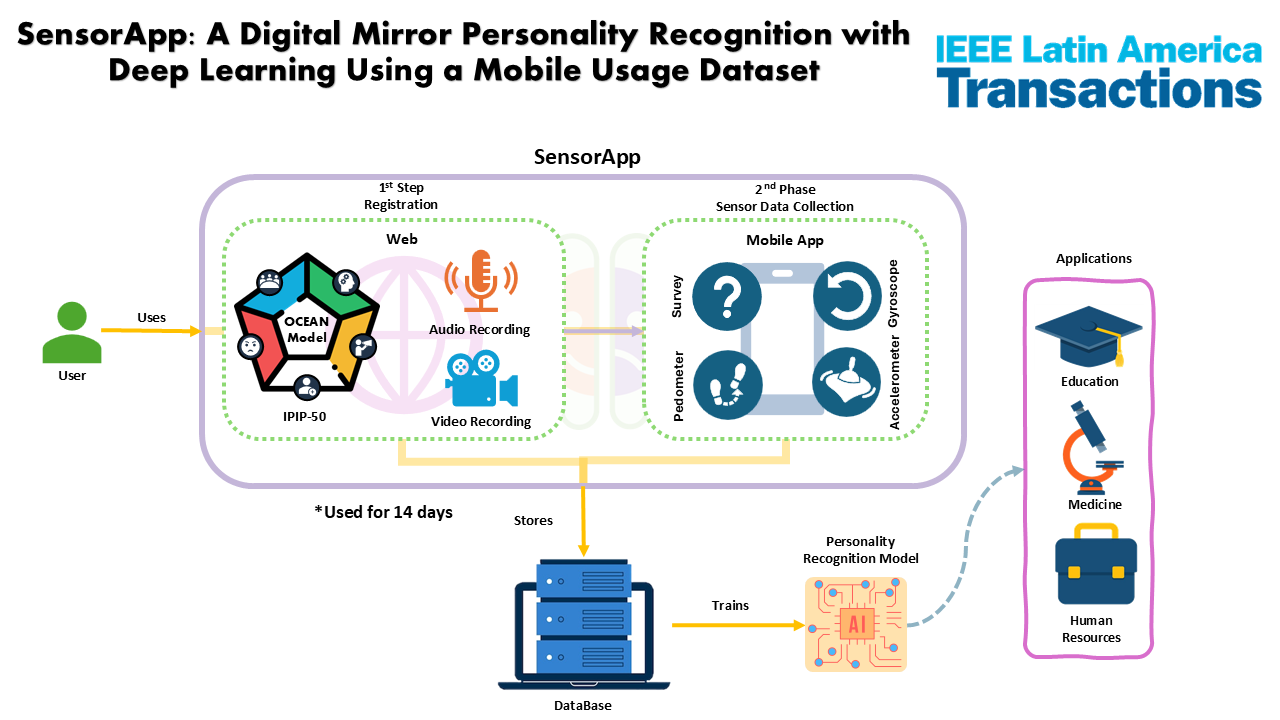
Automatic personality recognition has become relevant due to the advancement of artificial intelligence and the widespread use of mobile devices. This study proposes predicting personality traits according to the OCEAN model by integrating mobile sensor data and self-reports using deep neural networks. Through a mobile application, sensor data and daily surveys related to device usage were collected. Four model architectures (MLP, CNN, LSTM and Transformer) were evaluated, finding that CNN is most effective with raw data, while the Transformer excels at including temporal and frequential attributes. These results represent a breakthrough in customized and empathic technologies in mobile data-based personality recognition.
Downloads
References
. G. R. VandenBos, Ed., APA Dictionary of Psychology, 2nd ed. Washington, DC: American Psychological Association, 2015. [Online]. doi: https://doi.org/10.1037/14646-000
. Olson, J. A., Sandra, D. A., Colucci, É. S., Al Bikaii, A., Chmoulevitch, D., Nahas, J., & Veissière, S. P. (2022). Smartphone addiction is increasing across the world: A meta-analysis of 24 countries. Computers in Human Behavior, 129, 107138. doi: https://doi.org/10.1016/j.chb.2021.107138
. Islas Fosados, A., Vera Pedroza, A., Cárcamo Segura, F. G., & Gómez Fajardo, E. (2025). El uso de dispositivo móvil en estudiantes universitarios: un estudio cuantitativo: The use of mobile devices in university students: a quantitative study. LATAM Revista Latinoamericana De Ciencias Sociales Y Humanidades, 6(3), 1222 – 1232. doi: https://doi.org/10.56712/latam.v6i3.4019
. S. Love and J. Kewley, “Does personality affect peoples’ attitude towards mobile phone use in public places?” in Mobile Communications: Re-negotiation of the Social Sphere, London: Springer London, 2005, pp. 273–284. doi: http://dx.doi.org/10.1007/1-84628-248-9_18
. Costa, P. T., Jr., & John, O. P. (1992). An introduction to the five-factor model and its applications. Journal of Personality, 60(2), 175–215. doi: https://doi.org/10.1111/j.1467-6494.1992.tb00970.x
. I. M. Pires, N. M. Garcia, N. Pombo, F. Flórez-Revuelta, S. Spinsante, and M. C. Teixeira, “Identification of activities of daily living through data fusion on motion and magnetic sensors embedded on mobile devices,” Pervasive and Mobile Computing, vol. 47, pp. 78–93, 2018. [Online]. doi: https://doi.org/10.1016/j.pmcj.2018.05.005
. G. Li and P. Bours, “A novel mobile phone application authentication approach based on accelerometer and gyroscope data,” in Proc. Int. Conf. Biometrics Special Interest Group (BIOSIG), Sep. 2018, pp. 1–4. doi: https://doi.org/10.23919/BIOSIG.2018.8553503
. E. Al-Mahadeen, M. Alghamdi, A. S. Tarawneh, M. A. Alrowaily, M. Alrashidi, I. S. Alkhazi, A. Mbaidin, A. A. Alkasasbeh, M. A. Abbadi, and A. B. Hassanat, “Smartphone user identification/authentication using accelerometer and gyroscope data,” Sustainability (Switzerland), vol. 15, no. 13, 2023. [Online]. doi: https://doi.org/10.3390/su151310456
. Prajapati, N. & Jethva, H. (2025). Ensemble Approach for Human Personality Classification using Textual Data. Journal of Information Systems Engineering & Management, 10(14s), 493-504. doi: https://doi.org/10.52783/jisem.v10i14s.2319
. V. M. Bátiz-Beltrán, M. L. Barrón-Estrada, R. Zatarain-Cabada, and J. I. Roldán-Arana, “Creation of a corpus in Spanish for the recognition of personality traits,” Computación y Sistemas, vol. 28, no. 3, pp. 1115–1126, 2024. doi: https://doi.org/10.13053/cys-28-3-4619
. W. Tinwala and S. Rauniyar, “Big Five Personality Detection Using Deep Convolutional Neural Networks,” 2023 IEEE International Engineering and Management Conference (IEMCON), Jakarta, Indonesia, 2023, pp. 248-251, doi: 10.1109/IEMCON58661.2023.10260492
. D. Xenakis, E. Samikwa, J. Ajayi, A. Di Maio, T. Braun, and K. Schlegel, “Towards personality detection and prediction using smartphone sensor data,” in Proc. 21st Mediterranean Communication and Computer Networking Conf. (MedComNet), Jun. 2023, pp. 121–130. doi: https://doi.org/10.1109/MedComNet58619.2023.10168869
. K. Ibrar, A. M. Fayyaz, M. A. Khan, M. Alhaisoni, U. Tariq, and S. Jeon, “Human personality assessment based on gait pattern recognition using smartphone sensors,” Computer Systems Science & Engineering, vol. 46, no. 2, 2023. doi: https://doi.org/10.32604/csse.2023.036185
. P. Bhatele and M. Bedekar, “Machine learning based smartphone screen gesture recognition using smartphone embedded accelerometer and gyroscope,” Int. J. Comput. Digit. Syst., vol. 16, no. 1, pp. 911–924, 2024. doi: https://doi.org/10.21203/rs.3.rs-3925474/v1
. Sze, W. Y. S., Herrero, M. P., & Garriga, R. (2024). Personality Trait Inference via Mobile Phone Sensors: A Machine Learning Approach. Doi: https://doi.org/10.48550/arXiv.2401.10305
. Kovačević, N., Holz, C., Günther, T., Gross, M., & Wampfler, R. (2023). Personality Trait Recognition Based on Smartphone Typing Characteristics in the Wild. IEEE Transactions on Affective Computing, 14(4), 3207–3217. doi: 10.1109/TAFFC.2023.3253202
. S. Ali, G. Wang, and S. Riaz, “Aspect Based Sentiment Analysis of Ridesharing Platform Reviews for Kansei Engineering,” IEEE Access, vol. 8, pp. 173186–173197, 2020. doi: https://doi.org/10.1109/ACCESS.2020.3025823
. C. Huang, “Combining Convolutional Neural Networks for Emotion Recognition,” in Proceedings of the IEEE MIT Undergraduate Research Technology Conference (URTC), Cambridge, MA, USA, 2017, pp. 1–4. doi: https://doi.org/10.1109/URTC.2017.8284169
. S. Gao, X. Zhang, W. Li, and M. Lin, "PersonalitySensing: A Multi-View Multi-Task Learning Approach for Personality Detection based on Smartphone Usage," in Proceedings of the 28th ACM International Conference on Multimedia (MM '20), Seattle, WA, USA, 2020, pp. 2636–2644. doi: https://doi.org/10.1145/3394171.3413591
. J. Z. Leibo, C. de Masson d’Autume, D. Zoran, D. Amos, C. Beattie, K. Anderson, A. García Castañeda, M. Sanchez, S. Green, A. Gruslys, S. Legg, D. Hassabis, and M. M. Botvinick, “Psychlab: A Psychology Laboratory for Deep Reinforcement Learning Agents,” arXiv preprint, arXiv:1801.08116, 2018. [Online]. Available: https://doi.org/10.48550/arXiv.1801.08116
. L. R. Goldberg, “The development of markers for the Big-Five factor structure,” Psychological Assessment, vol. 4, no. 1, pp. 26–42, 1992. [Online]. doi: https://doi.org/10.1037/1040-3590.4.1.26
. L. Mezquita, A. J. Bravo, J. Morizot, A. Pilatti, M. R. Pearson, M. I. Ibáñez, and G. Ortet, “Cross-cultural examination of the Big Five personality trait short questionnaire: Measurement invariance testing and associations with mental health,” PLoS ONE, vol. 14, no. 12, 2019. [Online]. doi: https://doi.org/10.1371/journal.pone.0226223
. Goldberg, L. R., Johnson, J. A., Eber, H. W., Hogan, R., Ashton, M. C., Cloninger, C. R. & Gough, H. G. (2006). The International Personality Item Pool and the future of public-domain personality measures. Journal of Research in Personality, 40(1), 84–96. doi: https://doi.org/10.1016/j.jrp.2005.08.007
. H. Gil de Zúñiga, T. Diehl, B. Huber, and J. Liu, “Personality traits and social media use in 20 countries: How personality relates to frequency of social media use, social media news use, and social media use for social interaction,” Cyberpsychol. Behav. Soc. Netw., vol. 20, no. 9, pp. 540–552, 2017. doi: https://doi.org/10.1089/cyber.2017.0295
. C. Stachl, S. Hilbert, J. Q. Au, D. Buschek, A. De Luca, B. Bischl, and M. Bühner, “Personality traits predict smartphone usage,” Eur. J. Personality, vol. 31, no. 6, pp. 701–722, 2017. doi: https://doi.org/10.1002/per.2113
. M. Stade, S. A. Scherr, P. Mennig, F. Elberzhager, and N. Seyff, “Don’t worry, be happy–exploring users’ emotions during app usage for requirements engineering,” in Proc. 27th Int. Requirements Eng. Conf. (RE), Sep. 2019, pp. 375–380. doi: http://dx.doi.org/10.1109/RE.2019.00048
. R. Valanarasu, “Comparative analysis for personality prediction by digital footprints in social media,” J. Inf. Technol. Digit. World, vol. 3, no. 2, pp. 77–91, 2021. doi: http://dx.doi.org/10.36548/jitdw.2021.2.002
. M. De Choudhury, S. Counts, and M. Gamon, “Not all moods are created equal! Exploring human emotional states in social media,” in Proc. Int. AAAI Conf. Web and Social Media, vol. 6, no. 1, pp. 66–73, 2012. doi: https://doi.org/10.1609/icwsm.v6i1.14279
. E. Bisong, “The Multilayer Perceptron (MLP),” in Building Machine Learning and Deep Learning Models on Google Cloud Platform, Apress, 2019. doi: https://doi.org/10.1007/978-1-4842-4470-8_31
. Y. LeCun,Y. Bengio,. & G. Hinton, Deep learning. Nature 521, 436–444 (2015). https://doi.org/10.1038/nature14539
. B. Lindemann, T. Müller, H. Vietz, N. Jazdi, M. Weyrich, A survey on long short-term memory networks for time series prediction, Procedia CIRP, Volume 99, 2021, Pages 650-655, https://doi.org/10.1016/j.procir.2021.03.088
. A. Vaswani, N. Shazeer, N. Parmar, J. Uszkoreit, L. Jones, A. N. Gomez, L. Kaiser, and I. Polosukhin, “Attention Is All You Need,” arXiv, abs/1706.03762, 2017. doi: https://doi.org/10.48550/arXiv.1706.03762
. R. Z. Cabada, M. L. B. Estrada, N. L. López, H. J. E. Balderas and V. M. B. Beltrán, "SensorAPP: A Methodology to Create a Dataset for Personality Recognition Using Mobile Devices," 2024 13th International Conference On Software Process Improvement (CIMPS), Mérida, Yucatán, Mexico, 2024, pp. 01-06, doi: 10.1109/CIMPS65195.2024.11095920.