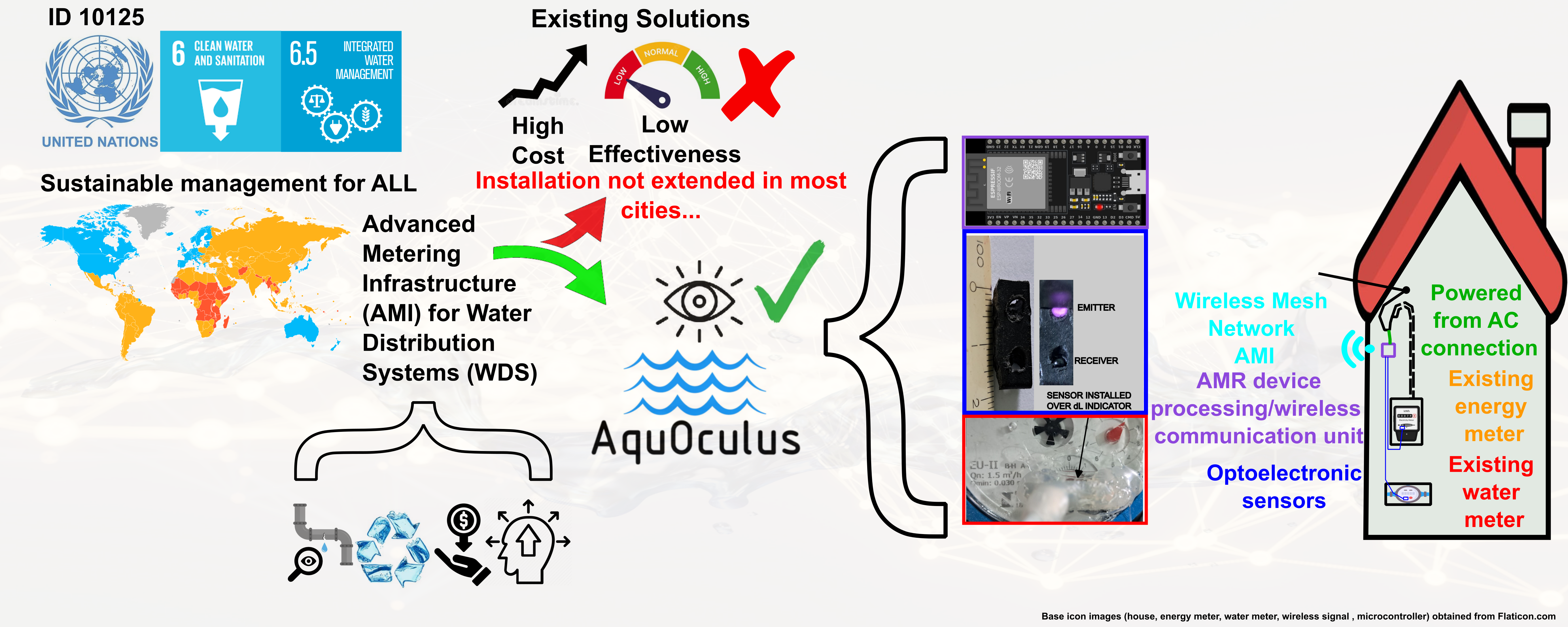
AquOculus: A Cost-effective Advanced Metering Infrastructure for Urban Water Distribution Systems
Keywords:
Sustainable Development Goals (SDG), Water Distribution Systems (WDS), Automated Meter Reading (AMR), Leakage Detection and Localization (LDL), Optoelectronics, Low-cost, ESP32, Wi-FiAbstract
Water consumption Automated Meter Reading (AMR) devices are fundamental to achieving sustainable management in Water Distribution Systems (WDS). However, available solutions are still relatively expensive, and don't feature adequate and synchronized network throughput to attain Leakage Detection and Localization (LDL). As a consequence, AMR installation isn't extended in most cities. As an alternative, we propose the so-called AquOculus Advanced Metering Infrastructure (AMI) system, intended to be a cost-effective solution. This article presents the first results obtained while developing the embryonic AquOculus AMR prototype, consistent with Technology Readiness Level (TRL) 3. It was based on an ESP32 microcontroller and communicated the correct consumed water volume to a remote application via Wi-Fi. An ordinary water meter was leveraged as the main reading instrument, coupled with the developed optoelectronic pulse counter. It doesn't require specific color, metallic, or magnetic parts on the monitored indicator, applying to a wider variety of water meter models. As the water volume counting is indirect, the measurement relies on the factory-calibrated water meter; so the initial validation setup was very simple, using a hairdryer to move the water meter mechanism. Sunlight sensitivity was observed, and the sensor positioning process was demanding. These issues were figured out and discussed for future work. Despite the TRL achieved, this article also addresses the main steps towards the complete AquOculus system. The cost-effective characteristics are expected to boost further studies to allow massive installations by water distribution companies. The developed software repository link was provided for reproducibility.
Downloads
References
W. P. Cantos, I. Juran, and S. Tinelli, “Machine-learning–based risk assessment method for leak detection and geolocation in a water distribution system,” Journal of Infrastructure Systems, vol. 26, no. 1, p. 04019039, 2020. doi: 10.1061/(ASCE)IS.1943-555X.0000517 .
A. Rajeswaran, S. Narasimhan, and S. Narasimhan, “A graph partitioning algorithm for leak detection in water distribution networks,” Computers & Chemical Engineering, vol. 108, pp. 11–23, 2018. doi: 10.1016/j.compchemeng.2017.08.007 .
I. Marzola, F. Mazzoni, S. Alvisi, and M. Franchini, “Leakage detection and localization in a water distribution network through comparison of observed and simulated pressure data,” Journal of Water Resources Planning and Management, vol. 148, no. 1, p. 04021096, 2022. doi: 10.1061/(ASCE)WR.1943-5452.0001503 .
D. B. Steffelbauer, J. Deuerlein, D. Gilbert, E. Abraham, and O. Piller, “Pressure-leak duality for leak detection and localization in water distribution systems,” Journal of Water Resources Planning and Management, vol. 148, no. 3, p. 04021106, 2022. doi: 10.1061/(ASCE)WR.1943-5452.0001515 .
G. Sanz, R. Perez, Z. Kapelan, and D. Savic, “Leak detection and localization through demand components calibration,” Journal of Water Resources Planning and Management, vol. 142, no. 2, p. 04015057, 2016. doi: 10.1061/(ASCE)WR.1943-5452.0000592 .
L. Romero-Ben, D. Alves, J. Blesa, G. Cembrano, V. Puig, and E. Duviella, “Leak detection and localization in water distribution networks: Review and perspective,” Annual Reviews in Control, vol. 55, pp. 392–419, 2023. doi: 10.1016/j.arcontrol.2023.03.012 .
X. Wan, P. K. Kuhanestani, R. Farmani, and E. Keedwell, “Literature review of data analytics for leak detection in water distribution networks: A focus on pressure and flow smart sensors,” Journal of Water Resources Planning and Management, vol. 148, no. 10, p. 03122002, 2022. doi: 10.1061/(ASCE)WR.1943-5452.0001597 .
L. J. Varghese, D. V., K. V., P. R, and S. S. Jacob, “Iot based smart water meter for domestic utility,” in 2025 International Conference on Inventive Computation Technologies (ICICT), 2025, pp. 1601–1608. doi: 10.1109/ICICT64420.2025.11005058 .
P. Neve, “Digital transformation of conventional water meter using esp32-cam,” INTERNATIONAL JOURNAL OF SCIENTIFIC RESEARCH IN ENGINEERING AND MANAGEMENT, vol. 09, no. 06, p. 1–9, Jun. 2025. doi: 10.55041/ijsrem48197 .
S. Zhang, Y. Wei, Y. Li, and C. Zhou, “Water meter reading recognition method based on character attention mechanism,” PLoS One, vol. 20, no. 9, p. e0332119, 2025. doi: 10.1371/journal.pone.0332119 .
L. M. Ramadhan, R. P. Astuti, and H. Fakhrurroja, “Compact smart water meter development for smart city,” in 2023 IEEE International Conference on Communication, Networks and Satellite (COMNETSAT), 2023, pp. 677–682. doi: 10.1109/COMNETSAT59769.2023.10420528 .
F. Martinelli, F. Mercaldo, and A. Santone, “Water meter reading for smart grid monitoring,” Sensors (Basel), vol. 23, no. 1, p. 75, Dec. 2022. doi: 10.3390/s23010075 .
J. Ktari, T. Frikha, M. Hamdi, H. Elmannai, and H. Hmam, “Lightweight ai framework for industry 4.0 case study: water meter recognition,” Big Data and Cognitive Computing, vol. 6, no. 3, p. 72, 2022. doi: 10.3390/bdcc6030072 .
D. Bhoyar, B. Katey, and M. Ingle, “Lora technology based low cost water meter reading system,” SSRN Electronic Journal, 2018. doi: 10.2139/ssrn.3172772 .
T. AL-Washali, M. Mahardani, S. Sharma, F. Arregui, and M. Kennedy, “Impact of float-valves on water meter performance under intermittent and continuous supply conditions,” Resources, Conservation and Recycling, vol. 163, p. 105091, 2020. doi: 10.1016/j.resconrec.2020.105091 .
C. Bazan Prieto and A. Bazán Guillén, “Evaluation of wi-fi mesh networks for reading electricity consumption,” ITEGAM-JETIA: Journal of Engineering and Technology for Industrial Applications, vol. 10, no. 50, pp. 238–245, Dec. 2024. doi: 10.5935/jetia.v10i50.1452 .
J. A. Cujilema Paguay, G. A. Hidalgo Brito, D. L. Hernandez Rojas, and J. J. Cartuche Calva, “Secure home automation system based on esp-now mesh network, mqtt and home assistant platform,” IEEE Latin America Transactions, vol. 21, no. 7, pp. 829–838, 2023. doi: 10.1109/TLA.2023.10244182 .
M. Nguyen, M. Nguyen, D. Nguyen, L. Dinh Quy, T. Chien, L. Tizon, N. Le, and T. Quang Anh, “A comparative study of wi-fi technologies in wireless sensor networks,” Computer Networks and Communications, vol. 3, p. 75, 02 2025. doi: 10.37256/cnc.3120256070 .
S. Ramadhan, I. Syafalni, N. Sutisna, and T. Adiono, “Implementation of multi-hop mesh networking using esp32 for iot communication,” in 2024 International Conference on Intelligent Cybernetics Technology & Applications (ICICyTA), 2024, pp. 1055–1059. doi: 10.1109/ICICYTA64807.2024.10912962 .
M. Kanyama, F. Bhunu Shava, A. Gamundani, and A. Hartmann, “Machine learning applications for anomaly detection in smart water metering networks: A systematic review,” Physics and Chemistry of the Earth, vol. 134, p. 103558, 2024. doi: 10.1016/j.pce.2024.103558 .
N. Sushma, H. Suresh, L. J. Mohana, and K. Santhosh Kumar, “Experimental investigation on wireless integrated smart system for energy and water resource management in indian smart cities,” Results in Engineering, vol. 23, p. 102687, 2024. doi: 10.1016/j.rineng.2024.102687 .
L. Li, D. Zhao, W. Sun, and Q. Huang, “A micro francis turbine for smart water meter self-generation: Study on the effects of structural parameters on turbine performance based on cfd simulations and experiments,” Energy, vol. 328, p. 135865, 2025. doi: 10.1016/j.energy.2025.135865 .
D.-Q. Cao, X.-D. Liu, R.-K. Fang, G. Yihuo, Y.-F. Wu, Z.-G. Huang, W.-Y. Zhang, X. Chen, and X.-D. Hao, “Self-powered and self-sensing water meter using contact-separation triboelectric nanogenerator with harvesting local head loss,” Journal of Water Process Engineering, vol. 72, p. 107397, 2025. doi: 10.1016/j.jwpe.2025.107397 .