Structural Breaks as Investment Signals: BFAST vs. CUSUM in Quito’s Stock Market During COVID-19 Pandemic
Keywords:
BFAST, CUSUM, Time Series Analysis, COVID-19, Structural Break, Stock MarketsAbstract
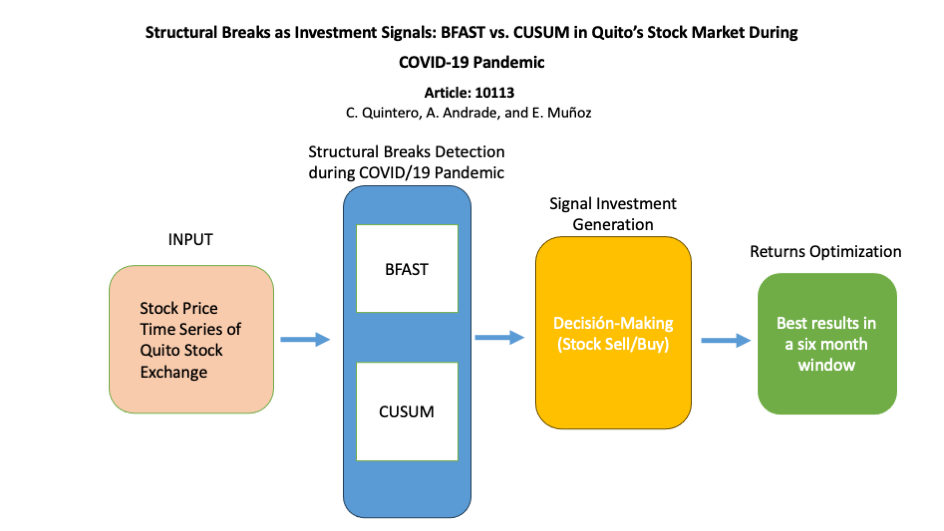
This study investigates the potential of structural
break detection in stock price time series as a tool for investment
decision-making in emerging markets. Operating under the
hypothesis that structural breaks reflect shifts in underlying
price trends, we conduct an empirical analysis of investment
performance in the Quito Stock Exchange (QSE) using monthly
average prices from 2013 to 2022 for the ten most actively
traded companies, selected for their transaction volume and
sectoral representativeness. Importantly, this period coincided
with the COVID-19 pandemic, providing a natural context to
explore how structural breaks behave under heightened market
volatility. Two algorithms—CUSUM and BFAST—are applied
and compared in terms of their ability to identify actionable
breakpoints and generate profitable buy/sell signals. Results show
that BFAST, originally developed for remote sensing applications,
consistently outperforms CUSUM: it detects a higher proportion
of successful signals, yields stronger average returns over a
six-month evaluation window (+17% in the financial sector and
+18.75% in the productive/commercial sector), and achieves
superior risk-adjusted performance as measured by Sharpe
ratios. Statistical validation using the Wilcoxon signed-rank test
confirms the significance of BFAST’s advantage (p = 0.004).
Taken together, these findings position BFAST as a robust
and economically relevant tool for financial time-series analysis,
extending its utility beyond traditional domains and offering in-
vestors a methodologically sound framework for decision-making
in volatile market environments.
Downloads
References
M. De los Baños and J. Roldán-Casas, “Análisis del grado
de eficiencia débil en algunos mercados financieros europeos.
Primer impacto del COVID-19,” Revista de economía mundial,
no. 59, pp. 243–269, 2021, number: 59. [Online]. Available:
https://doi.org/10.33776/rem.v0i59.5157
W. Li, F. Chien, H. Kamran, T. M. Aldeehani, M. Sadiq, V. Nguyen, and
F. Taghizadeh-Hesary, “The nexus between COVID-19 fear and stock
market volatility,” Economic research-Ekonomska istraživanja, vol. 35,
no. 1, pp. 1765–1785, 2022, number: 1 Publisher: Taylor & Francis.
[Online]. Available: https://doi.org/10.1080/1331677X.2021.1914125
H. Lee, “Exploring the initial impact of COVID-19 sentiment on
US stock market using big data,” Sustainability, vol. 12, no. 16,
p. 6648, 2020, number: 16 Publisher: MDPI. [Online]. Available:
https://doi.org/10.3390/su12166648
R. J. Mendoza-Rivera, J. A. Lozano-Díez, and F. Venegas-
Martínez, “Impacto de la pandemia Covid-19 en variables financieras
relevantes en las principales economías de Latinoamérica,” Economía:
teoría y práctica, no. SPE5, pp. 125–144, 2020, number:
SPE5 Publisher: Universidad Autónoma Metropolitana, a través
de la Unidad Iztapalapa, la Unidad Azcapotzalco y la Unidad
Xochimilco, División de Ciencias Sociales. [Online]. Available:
https://doi.org/10.24275/etypuam/ne/e052020/mendoza
M. L. Alzúa and P. Gosis, “Impacto Social y Económico de la COVID-
y Opciones de Políticas en Argentina,” PNUD América Latina y el
Caribe, vol. 6, pp. 1–27, 2020.
J. R. Huamán, “Impacto económico y social de la COVID-19 en el Perú,”
Revista de Ciencia e Investigación en Defensa-CAEN, vol. 2, no. 1, pp.
–42, 2021, number: 1.
K. Ceballos-Palma, K. Bermeo-Pazmiño, and L. Vásconez-Acuña,
“Covid-19 y su impacto contable en las PYMES del cantón Cuenca,”
Revista Arbitrada Interdisciplinaria Koinonía, vol. 5, no. 4, pp.
–298, 2020, number: 4 Publisher: Fundación Koinonía. [Online].
Available: https://doi.org/10.35381/r.k.v5i4.958
N. Huilcapi, K. Troya, and W. Ocampo, “Impacto del COVID-19
en la planeación estratégica de las pymes ecuatorianas,” Recimundo,
vol. 4, no. 3, pp. 76–85, 2020, number: 3. [Online]. Available:
https://doi.org/10.26820/recimundo/4.(3).julio.2020.76-85
D. Jumbo, J. Campuzano, F. Vega, and Luna, “Crisis económicas y
covid-19 en ecuador: impacto en las exportaciones,” 2020. [Online].
Available: http://scielo.sld.cu/pdf/rus/v12n6/2218-3620-rus-12-06-103.
J. Cadena, H. Pinargote, and K. Solorzano, “Mercado de valores y
su contribución al crecimiento de la economía ecuatoriana,” Revista
Venezolana de Gerencia, vol. 23, pp. 562–574, 2018. [Online].
Available: https://biblat.unam.mx/hevila/Revistavenezolanadegerencia/
/vol23/no83/4.pdf
S. K. Maya Chávez, “Impacto financiero del covid19 en empresas
que cotizan en la bolsa de valores,” Ph.D. dissertation, Politécnica
Salesiana Ecuador, Guayaquil, 2022. [Online]. Available: http:
//dspace.ups.edu.ec/handle/123456789/22307
B. EC, “Bolsa de valores de quito reporte diario 30-dic-2019,” BCE,
Quito, Tech. Rep., 2019. [Online]. Available: https://www.bce.fin.ec/
index.php/component/k2/item/281-bolsa-de-valores-de-quito
E. Muñoz, A. Zozaya, and E. Lindquist, “Satellite remote sensing
of forest degradation using NDFI and the BFAST algorithm,”
IEEE Latin America Transactions, vol. 18, no. 07, pp. 1288–
, 2020, number: 07 Publisher: IEEE. [Online]. Available:
https://doi.org/10.1109/TLA.2020.9099771
P. Verma, A. Dumka, A. Bhardwaj, A. Ashok, M. C. Kestwal, and
P. Kumar, “A Statistical Analysis of Impact of COVID19 on the
Global Economy and Stock Index Returns,” SN Computer Science,
vol. 2, no. 1, p. 27, Jan. 2021, number: 1. [Online]. Available:
https://doi.org/10.1007/s42979-020-00410-w
D. Rapach, J. Strauss, and M. Wohar, “Chapter 10 Forecasting
Stock Return Volatility in the Presence of Structural Breaks,”
vol. 3. Elsevier, 2008, pp. 381–416, book Title: Frontiers of
Economics and Globalization. [Online]. Available: https://doi.org/10.
/S1574-8715(07)00210-2
D. E. Rapach and J. K. Strauss, “Structural breaks and GARCH
models of exchange rate volatility,” Journal of Applied Econometrics,
vol. 23, no. 1, pp. 65–90, Jan. 2008, number: 1. [Online]. Available:
https://doi.org/10.1002/jae.976
V. Chatzikonstanti, “Breaks and outliers when modelling the volatility
of the U.S. stock market,” Applied Economics, vol. 49, no. 46,
pp. 4704–4717, Oct. 2017, number: 46. [Online]. Available: https:
//doi.org/10.1080/00036846.2017.1293785
K.-L. Xu, “Powerful tests for structural changes in volatility,” Journal
of Econometrics, vol. 173, no. 1, pp. 126–142, Mar. 2013, number: 1.
[Online]. Available: https://doi.org/10.1016/j.jeconom.2012.11.001
R. L. Brown, J. Durbin, and J. M. Evans, “Techniques for
Testing the Constancy of Regression Relationships Over Time,”
Journal of the Royal Statistical Society: Series B (Methodological),
vol. 37, no. 2, pp. 149–163, 1975. [Online]. Available: https:
//doi.org/10.1111/j.2517-6161.1975.tb01532.x
D. W. K. Andrews, “Tests for Parameter Instability and Structural
Change With Unknown Change Point,” Econometrica, vol. 61, no. 4,
pp. 821–856, 1993, number: 4 Publisher: [Wiley, Econometric Society].
[Online]. Available: https://doi.org/10.2307/2951764
D. W. K. Andrews and W. Ploberger, “Optimal Tests when a Nuisance
Parameter is Present Only Under the Alternative,” Econometrica, vol. 62,
no. 6, pp. 1383–1414, 1994, number: 6 Publisher: [Wiley, Econometric
Society]. [Online]. Available: https://doi.org/10.2307/2951753
C.-M. Kuan and K. Hornik, “The generalized fluctuation test: A
unifying view,” Econometric Reviews, vol. 14, no. 2, pp. 135–161, Jan.
[Online]. Available: https://doi.org/10.1080/07474939508800311
P. Sánchez, “Cambios estructurales en series de tiempo: una
revisión del estado del arte,” pp. 115–140, Apr. 2008. [Online].
Available: http://www.scielo.org.co/scielo.php?script=sci_arttext&pid=
S1692-33242008000100007
IEEE LATIN AMERICA TRANSACTIONS , Vol. 7, No. 7, Oct 2020
J. Bai and P. Perron, “Computation and analysis of multiple structural
change models,” Journal of Applied Econometrics, vol. 18, no. 1, pp.
–22, 2003. [Online]. Available: https://doi.org/10.1002/jae.659
A. Zeileis, C. Kleiber, W. Krämer, and K. Hornik, “Testing and dating
of structural changes in practice,” Computational Statistics & Data
Analysis, vol. 44, no. 1, pp. 109–123, Oct. 2003, number: 1. [Online].
Available: https://doi.org/10.1016/S0167-9473(03)00030-6
J. Haywood and J. Randal, “Trending seasonal data with multiple
structural breaks. NZ visitor arrivals and the minimal effects of
/11,” Mar. 2008. [Online]. Available: https://www.researchgate.net/
publication/253383381
G. V. P. Alarcón and J. C. O. Maldonado, “Impacto financiero
del COVID 19 en las instituciones de economía popular y
solidaria del Ecuador, año 2021,” Visionario Digital, vol. 6,
no. 3, pp. 97–122, Jul. 2022, number: 3. [Online]. Available:
https://doi.org/10.33262/visionariodigital.v6i3.2197
J. C. Chia-Shang, K. Hornik, and K. Chung-Ming, “MOSUM tests for
parameter constancy,” Biometrika, vol. 82, no. 3, pp. 603–617, Sep.
, number: 3. [Online]. Available: https://doi.org/10.1093/biomet/
3.603
J. Verbesselt, R. Hyndman, G. Newnham, and D. Culvenor, “Detecting
trend and seasonal changes in satellite image time series,” Remote
Sensing of Environment, vol. 114, no. 1, pp. 106–115, Jan. 2010,
number: 1. [Online]. Available: https://doi.org/10.1016/j.rse.2009.08.014
M. Schultz, J. Verbesselt, V. Avitabile, C. Souza, and M. Herold,
“Error Sources in Deforestation Detection Using BFAST Monitor on
Landsat Time Series Across Three Tropical Sites,” IEEE Journal of
Selected Topics in Applied Earth Observations and Remote Sensing,
vol. 9, no. 8, pp. 3667–3679, Aug. 2016. [Online]. Available:
https://doi.org/10.1109/JSTARS.2015.2477473
K. Grogan, D. Pflugmacher, P. Hostert, J. Verbesselt, and R. Fensholt,
“Mapping Clearances in Tropical Dry Forests Using Breakpoints,
Trend, and Seasonal Components from MODIS Time Series: Does
Forest Type Matter?” Remote Sensing, vol. 8, no. 8, pp. 1–27, Aug.
, number: 8. [Online]. Available: http://doi.org/10.3390/rs8080657
J. Reiche, S. de Bruin, D. Hoekman, J. Verbesselt, and M. Herold, “A
Bayesian Approach to Combine Landsat and ALOS PALSAR Time
Series for Near Real-Time Deforestation Detection,” Remote Sensing,
vol. 7, no. 5, pp. 4973–4996, Apr. 2015, number: 5. [Online]. Available:
http://doi.org/10.3390/rs70504973
Y. Gao, J. V. Solórzano, A. Quevedo, and J. O. Loya-Carrillo, “How
BFAST Trend and Seasonal Model Components Affect Disturbance
Detection in Tropical Dry Forest and Temperate Forest,” Remote
Sensing, vol. 13, no. 11, p. 2033, Jan. 2021, number: 11 Publisher:
Multidisciplinary Digital Publishing Institute. [Online]. Available:
https://doi.org/10.3390/rs13112033
Z. Zhu and C. E. Woodcock, “Continuous change detection and
classification of land cover using all available Landsat data,” Remote
Sensing of Environment, vol. 144, pp. 152–171, Mar. 2014. [Online].
Available: https://doi.org/10.1016/j.rse.2014.01.011
J. Verbesselt, R. Hyndman, A. Zeileis, and D. Culvenor, “Phenological
change detection while accounting for abrupt and gradual trends in
satellite image time series,” Remote Sensing of Environment, vol. 114,
no. 12, pp. 2970–2980, Dec. 2010, number: 12. [Online]. Available:
https://doi.org/10.1016/j.rse.2010.08.003
W. N. Venables and B. D. Ripley, Modern Applied Statistics with
S-PLUS. Springer Science & Business Media, Apr. 2013, google-
Books-ID: tovgBwAAQBAJ. [Online]. Available: https://doi.org/10.
/2532871
“Evaluation of polarimetry and interferometry of sentinel-1A SAR data
for land use and land cover of the Brazilian Amazon Region | Semantic
Scholar.” [Online]. Available: https://www.semanticscholar.org/paper/
Evaluation-of-polarimetry-and-interferometry-of-SAR-Diniz-Gama/
abe6bae11afac257ab220047203ee6213f0f6a2f
J. Verbesselt, D. Masili¯unas, A. Zeileis, R. Hyndman, M. Appel,
M. Jung, A. Mîrt,, P. N. Bernardino, and D. Kong, “bfast: Breaks
for Additive Season and Trend,” Oct. 2024. [Online]. Available: