Mobile App for Tuberculosis Detection Using Deep Learning and NLP-Based Recommendations
Keywords:
Medical diagnosis, artificial intelligence, deep learning, radiography, information technology, tuberculosisAbstract
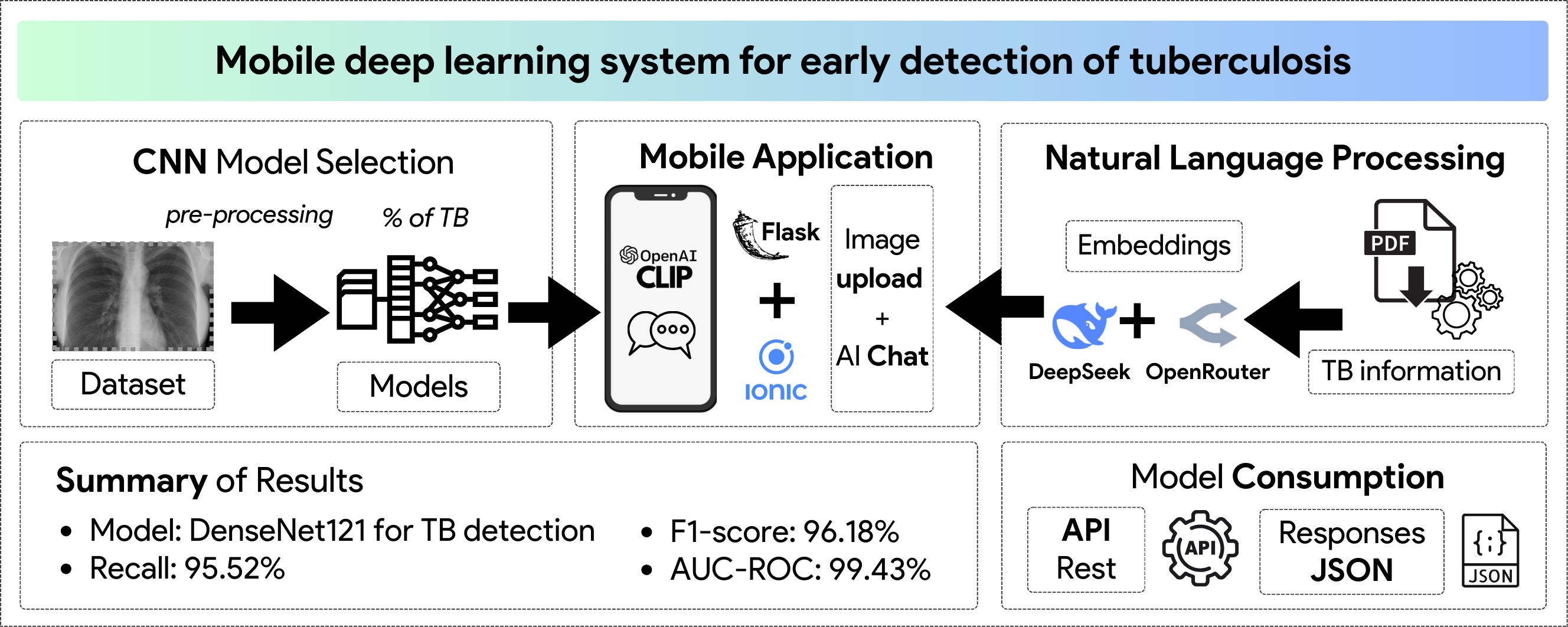
Tuberculosis remains one of the leading causes of mortality from infectious diseases and conventional diagnostic methods are often limited by subjectivity. This study presents a mobile application for automated tuberculosis diagnosis, integrating a convolutional neural network (CNN) for chest X-ray classification with a natural language processing (NLP) module for clinical recommendations. Three CNN architectures were evaluated (DenseNet121, ResNet50, and MobileNetV2) using the CRISP-DM methodology, with a Kaggle dataset. DenseNet121 achieved the most balanced performance (Accuracy = 96.2%, Recall = 95.5%, F1-score = 96.2%), prioritizing the reduction of false positives and negatives. The model was integrated into a mobile application developed under the Extreme Programming methodology, employing a client-server architecture with RESTful APIs. The NLP component, based on the DeepSeek-R1 model through the OpenRouter platform, generated contextually relevant clinically responses. Validation with healthcare professionals showed that 91.7% would recommend it as a support tool for tuberculosis diagnosis, due to its diagnostic reliability, usability, and clinical recommendations. These findings confirm the clinical viability and practical utility of the application, positioning it as a valuable resource in healthcare contexts with limited specialist availability
Downloads
References
F. Estaji, A. Kamali, and M. Keikha, “Strengthening the global Response to Tuberculosis: Insights from the 2024 WHO global TB report,” J Clin Tuberc Other Mycobact Dis, vol. 39, p. 100522, May 2025, doi: 10.1016/J.JCTUBE.2025.100522.
D. C. Falcón Córdova, J. C. Carrasquel Herrera, K. F. Viteri Tigse, H. P. Velasco Molina, and L. D. Sánchez Jaya, “Tuberculosis en el mundo y en el Ecuador, en la actualidad (2021),” LATAM Rev. Latinoam. Cienc. Soc. Humanid., vol. 4, no. 6, pp. 658–673, Dec. 2023, doi: 10.56712/latam.v4i6.1476.
M. Z. Apolo Bravo and D. P. Andrade Campoverdeo, “Mycobacterium tuberculosis resistente a Rifampicina en la provincia de El Oro-Ecuador,” Revista Vive, vol. 7, no. 19, Jan. 2024, doi: 10.33996/revistavive.v7i19.283.
L. S. Sánchez Figueroa, V. A. Guillén Muñóz, J. D. Pérez Pérez, P. A. Rodríguez Abrego, C. M. Caprile Mata, and K. L. Cartagena López, “Actualización en la detección de la tuberculosis a través de pruebas moleculares,” Alerta, Revista científica del Instituto Nacional de Salud, vol. 7, no. 2, pp. 184–190, Jul. 2024, doi: 10.5377/alerta.v7i2.17129.
T. Rahman et al., “Reliable Tuberculosis Detection Using Chest X-Ray With Deep Learning, Segmentation and Visualization,” IEEE Access, vol. 8, pp. 191586–191601, Oct. 2020, doi: 10.1109/access.2020.3031384.
E. Kotei and R. Thirunavukarasu, “Tuberculosis Detection From Chest X-Ray Image Modalities Based on Transformer and Convolutional Neural Network,” IEEE Access, vol. 12, pp. 97417–97427, Jul. 2024, doi: 10.1109/ACCESS.2024.3428446.
E. Kotei and R. Thirunavukarasu, “A Comprehensive Review on Advancement in Deep Learning Techniques for Automatic Detection of Tuberculosis from Chest X-ray Images,” Archives of Computational Methods in Engineering 2023 31:1, vol. 31, no. 1, pp. 455–474, Aug. 2023, doi: 10.1007/S11831-023-09987-W.
G. Ramirez-Alonso, O. Prieto-Ordaz, R. López-Santillan, and M. Montes-Y-Gómez, “Medical Report Generation through Radiology Images: An Overview,” IEEE Latin America Transactions, vol. 20, no. 6, pp. 986–999, Jun. 2022, doi: 10.1109/TLA.2022.9757742.
D. A. Guanca, C. J. Izetta, N. M. Pérez, and A. M. Verazay, “Diagnóstico Automático de Tuberculosis en Radiografías de Tórax aplicando Aprendizaje Automático,” Investigaciones en Facultades de Ingeniería del NOA, pp. 108–119, 2023.
G. Y. Angulo Pupo, L. I. Saraiba Nuñez, and M. R. Moreno Pino, “Toma de decisiones con inteligencia artificial en el diagnóstico del paciente neonatal,” RILCO DS: Revista de Desarrollo sustentable, Negocios, Emprendimiento y Educación, vol. 6, no. 62, pp. 80–88, Dec. 2024, doi: 10.51896/rilcods.v6i62.734.
A. K. Guerrero-Solís, G. F. Ruiz-Muñoz, D. A. Yépez-González, and M. N. Sánchez-Lascano, “El impacto de la inteligencia artificial en la producción científica,” Multidiscip. Lat. Am. J., vol. 3, no. 1, pp. 629–649, Apr. 2025, doi: 10.62131/mlaj-v3-n1-031.
N. Jiménez, S. Orellana, B. Mazon-Olivo, W. Rivas-Asanza, and I. Ramírez-Morales, “Detection of Leaf Diseases in Banana Crops Using Deep Learning Techniques,” AI 2025, Vol. 6, Page 61, vol. 6, no. 3, p. 61, Mar. 2025, doi: 10.3390/ai6030061.
B. S. Guncay Saldaña, B. S. Guevara Pando, B. E. Mazón Olivo, and W. B. Rivas Asanza, “Diagnóstico de enfermedades bucales en imágenes basado en machine learning,” Revista Científica Arbitrada Multidisciplinaria PENTACIENCIAS, vol. 7, no. 3, pp. 176–195, Mar. 2025, doi: 10.59169/pentaciencias.v7i3.1484.
H. E. Kim, A. Cosa-Linan, N. Santhanam, M. Jannesari, M. E. Maros, and T. Ganslandt, “Transfer learning for medical image classification: a literature review,” BMC Medical Imaging 2022 22:1, vol. 22, no. 1, pp. 1–13, Apr. 2022, doi: 10.1186/S12880-022-00793-7.
A. W. Salehi et al., “A Study of CNN and Transfer Learning in Medical Imaging: Advantages, Challenges, Future Scope,” Sustainability 2023, Vol. 15, Page 5930, vol. 15, no. 7, p. 5930, Mar. 2023, doi: 10.3390/SU15075930.
S. Jácobo-Zavaleta and J. Zavaleta, “A Deep Learning Approach for Epilepsy Seizure Identification Using Electroencephalogram Signals: A Preliminary Study,” IEEE Latin America Transactions, vol. 21, no. 3, pp. 419–426, Mar. 2023, doi: 10.1109/TLA.2023.10068845.
G. K. Sun and A. P. Ambrosy, “Applying Natural Language Processing to Electronic Health Record Data—From Text to Triage,” JAMA Netw Open, vol. 7, no. 11, pp. e2443934–e2443934, Nov. 2024, doi: 10.1001/JAMANETWORKOPEN.2024.43934.
J. A. Calderón Blas, M. A. Cerdán, A. J. Sánchez García, and S. Domínguez Isidro, “Inteligencia Artificial en Sistemas de recomendación Médica: Una revisión de la Literatura,” ReCIBE, Revista electrónica de Computación, Informática, Biomédica y Electrónica, vol. 12, no. 2, pp. C3-20, Nov. 2023, doi: 10.32870/recibe.v12i2.311.
D. F. Terraza Arciniegas, M. Amaya, A. Piedrahita Carvajal, P. A. Rodriguez-Marin, L. Duque-Munoz, and J. D. Martinez-Vargas, “Students’ Attention Monitoring System in Learning Environments based on Artificial Intelligence,” IEEE Latin America Transactions, vol. 20, no. 1, pp. 126–132, Jan. 2022, doi: 10.1109/TLA.2022.9662181.
Z. Jiang et al., “Active Retrieval Augmented Generation,” EMNLP 2023 - 2023 Conference on Empirical Methods in Natural Language Processing, Proceedings, pp. 7969–7992, 2023, doi: 10.18653/V1/2023.EMNLP-MAIN.495.
C. Schröer, F. Kruse, and J. M. Gómez, “A systematic literature review on applying CRISP-DM process model,” Procedia Comput Sci, vol. 181, pp. 526–534, 2021, doi: 10.1016/j.procs.2021.01.199.
J. Tamayo Abanto and B. A. Sauñe Huaman, “Soluciones de TI basadas en machine learning aplicables a problemas del sistema de salud peruano,” BIOTECH AND ENGINEERING, vol. 4, no. 1, pp. 156–163, Feb. 2024, doi: 10.52248/eb.Vol4Iss1.116.
S. G. Tetteh, “Empirical Study of Agile Software Development Methodologies: A Comparative Analysis,” Asian Journal of Research in Computer Science, vol. 17, no. 5, pp. 30–42, Feb. 2024, doi: 10.9734/ajrcos/2024/v17i5436.
S. Kiran and I. Jabeen, “Tuberculosis Chest X-rays Images,” Kaggle. Accessed: May 10, 2025. [Online]. Available: https://www.kaggle.com/dsv/10304386
Madyono and A. Nabilah, “Detection of Tuberculosis Disease in Lung X-ray Images Using the DenseNet121 Method,” International Journal of Engineering, Science and Information Technology, vol. 5, no. 2, pp. 379–385, Mar. 2025, doi: 10.52088/IJESTY.V5I2.853.
E. Goceri, “Medical image data augmentation: techniques, comparisons and interpretations,” Artif Intell Rev, vol. 56, no. 11, p. 1, Nov. 2023, doi: 10.1007/S10462-023-10453-Z.
O. Rainio, J. Teuho, and R. Klén, “Evaluation metrics and statistical tests for machine learning,” Sci Rep, vol. 14, no. 1, p. 6086, Dec. 2024, doi: 10.1038/s41598-024-56706-x.
G. M. Foody, “Challenges in the real world use of classification accuracy metrics: From recall and precision to the Matthews correlation coefficient,” PLoS One, vol. 18, no. 10, p. e0291908, Oct. 2023, doi: 10.1371/journal.pone.0291908.
J. Kivimäki, J. Białek, W. Kuberski, and J. K. Nurminen, “Performance Estimation in Binary Classification Using Calibrated Confidence,” May 2025, doi: 10.48550/arXiv.2505.05295.
M. Madyono and A. Nabilah, “Detection of Tuberculosis Disease in Lung X-ray Images Using the DenseNet121 Method,” International Journal of Engineering, Science and Information Technology, vol. 5, no. 2, pp. 379–385, Mar. 2025, doi: 10.52088/ijesty.v5i2.853.
M. A. Hadi and H. I. Ali, “Control of COVID-19 system using a novel nonlinear robust control algorithm,” Biomed Signal Process Control, vol. 64, p. 102317, Feb. 2021, doi: 10.1016/j.bspc.2020.102317.
A.-L. Brun, M.-L. Chabi, C. Picard, F. Mellot, and P. A. Grenier, “Lung Transplantation: CT Assessment of Chronic Lung Allograft Dysfunction (CLAD),” Diagnostics, vol. 11, no. 5, p. 817, Apr. 2021, doi: 10.3390/diagnostics11050817.
World Health Organization, WHO consolidated guidelines on tuberculosis. Module 1: prevention – tuberculosis preventive treatment, Second. Geneva, 2020.
Centers for Disease Control and Prevention, Core Curriculum on Tuberculosis: What the Clinician Should Know, Seventh. 2021.
M. Kamil and D. Cakir, “Advances in Transformer-Based Semantic Search: Techniques, Benchmarks, and Future Directions,” Turk. J. Math. Comput. Sci, vol. 17, no. 1, pp. 145–166, 2025, doi: 10.47000/tjmcs.1633092.
S. Y. Luis, D. G. Reina, and S. T. Marín, “Towards a Retrieval-Augmented Generation Framework for Originality Evaluation in Projects-Based Learning Classrooms,” Education Sciences 2025, Vol. 15, Page 706, vol. 15, no. 6, p. 706, Jun. 2025, doi: 10.3390/educsci15060706.
B. Liu et al., “Improving Medical Vision-Language Contrastive Pretraining With Semantics-Aware Triage,” IEEE Trans Med Imaging, vol. 42, no. 12, pp. 3579–3589, Dec. 2023, doi: 10.1109/TMI.2023.3294980.
O. Baniaș, D. Florea, R. Gyalai, and D. I. Curiac, “Automated Specification-Based Testing of REST APIs,” Sensors 2021, Vol. 21, Page 5375, vol. 21, no. 16, p. 5375, Aug. 2021, doi: 10.3390/S21165375.
M. Rodriguez-Contreras, J. P. Sánchez-Solís, G. Rivera, and R. Florencia, “Framework to Support Radiologist Personnel in the Diagnosis of Diseases in Medical Images Using Deep Learning and Personalized DICOM Tags,” Computación y Sistemas, vol. 28, no. 3, pp. 1321–1348, Sep. 2024, doi: 10.13053/cys-28-3-5186.
T. Diot-Dejonghe et al., “Development of a Secure Web-Based Medical Imaging Analysis Platform: The AWESOMME Project,” Journal of imaging informatics in medicine, vol. 37, no. 5, pp. 2612–2626, Oct. 2024, doi: 10.1007/S10278-024-01110-0.
C. Lee, H. F. Kim, and B. G. Lee, “A Systematic Literature Review on the Strategic Shift to Cloud ERP: Leveraging Microservice Architecture and MSPs for Resilience and Agility,” Electronics 2024, Vol. 13, Page 2885, vol. 13, no. 14, p. 2885, Jul. 2024, doi: 10.3390/ELECTRONICS13142885.