Wing-Based Identification of Dengue Vector Mosquitoes Using Convolutional Neural Networks
Keywords:
Dengue, Arboviruses, Artificial Intelligence, Classification, Edge ImpulseAbstract
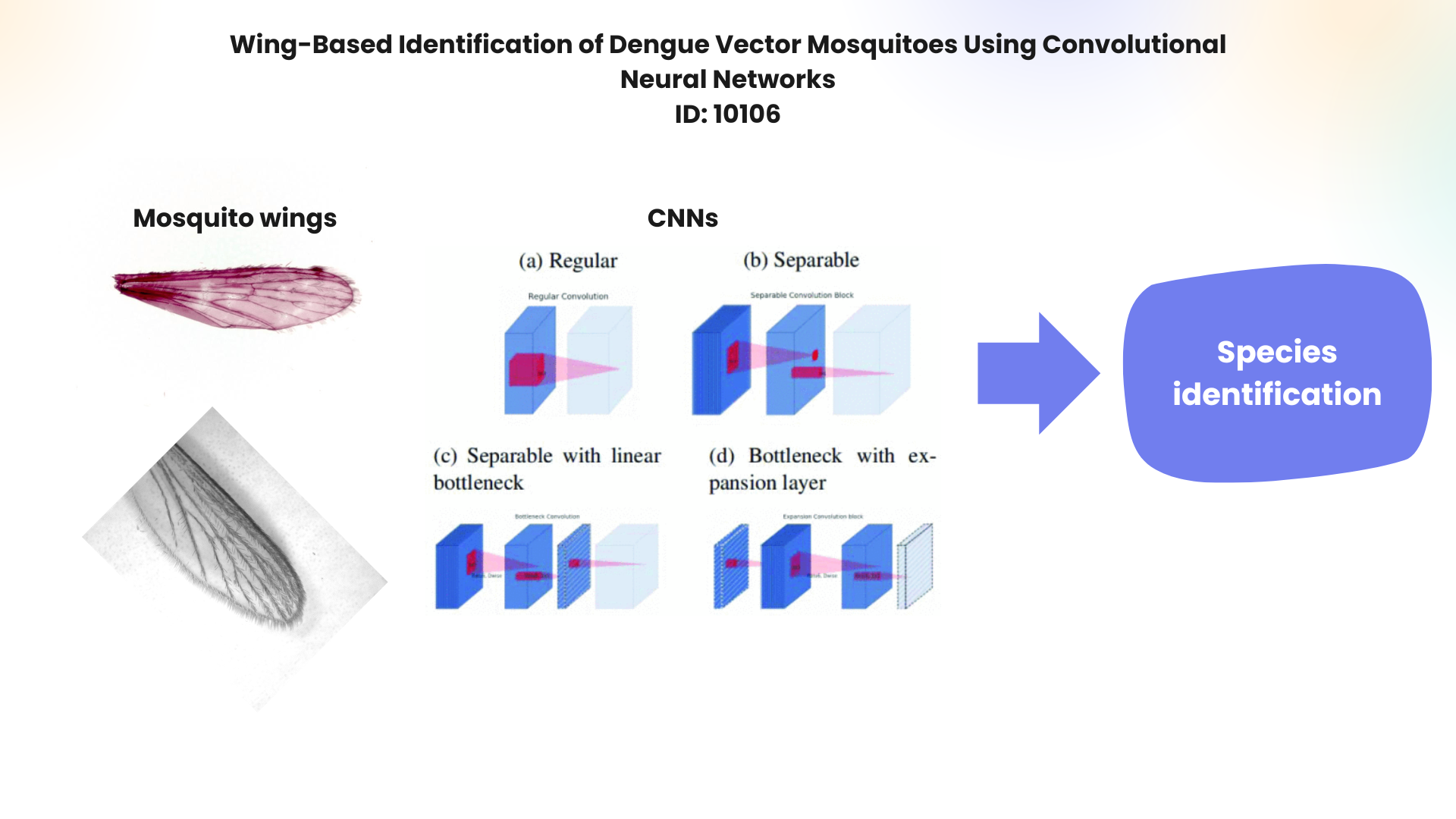
Given the increasing number of dengue cases in Brazil, accurately identifying vector mosquitoes is essential for effective control and prevention strategies. This study proposes a classification model capable of distinguishing Aedes aegypti and Aedes albopictus based on wing images from the WingBank database of the Butantan Institute. Two convolutional neural network architectures, MobileNetV2 and EfficientNet-B0, were evaluated. Data augmentation was applied to address the limited number of samples. The models were tested on a Cortex-A processor, demonstrating that high-accuracy mosquito classification can be achieved on embedded devices. These results highlight the potential of the proposed approach to support scalable, real-time mosquito monitoring and vector control systems.
Downloads
References
M. U. G. Kraemer et al., “The global distribution of the arbovirus vectors Aedes aegypti and Ae. albopictus,” eLife, vol. 4, 2015, doi: 10.7554/eLife.08347.
D. V. Viana and E. Ignotti, “The occurrence of dengue and meteorological variations in Brazil: A systematic review,” Revista Brasileira de Epidemiologia, vol. 16, no. 2, pp. 240–256, 2013, doi: 10.1590/S1415-790X2013000200002.
J. F. Day, “Mosquito oviposition behavior and vector control,” Insects, vol. 7, no. 4, p. 65, 2016, doi: 10.3390/insects7040065.
A. L. S. A. Zara et al., “Strategies for controlling Aedes aegypti: a review,” Epidemiologia e Serviços de Saúde, vol. 25, no. 2, pp. 391–404, 2016, doi: 10.5123/S1679-49742016000200017.
Sallum, M.A.M., Obando, R.G., Carrejo, N. et al. Identification keys to the Anopheles mosquitoes of South America (Diptera: Culicidae). II. Fourth-instar larvae. Parasites Vectors 13, 582 (2020). https://doi.org/10.1186/s13071-020-04299-5.
A. Richter, B. E. Boudinot, F. H. Garcia, J. Billen, E. P. Economo, and R. G. Beutel, “Wonderfully weird: the head anatomy of the armadillo ant, Tatuidris tatusia (Hymenoptera: Formicidae: Agroecomyrmecinae), with evolutionary implications,” Myrmecological News, vol. 33, pp. 35–75, 2023, doi: 10.25849/myrmecol.news_033:035.
G. A. Lima, “Computer vision system for automatic identification of potential Aedes aegypti mosquito breeding sites from drone-acquired images,” RISTI - Iberian Journal of Information Systems and Technologies, pp. 93–109, 2021, doi: 10.17013/risti.43.93109.
LARANJEIRA, Camila et al. Automatic mapping of high-risk urban areas for Aedes aegypti infestation based on building facade image analysis. medRxiv, Cold Spring Harbor Laboratory Press, 2023. doi: 10.1101/2023.11.30.23298876.
C. J. de Santana, A. C. A. Firmo, R. F. A. P. de Oliveira, P. J. B. Lins, G. A. de Lima, and R. A. de Lima, “A solution for counting Aedes aegypti and Aedes albopictus eggs in paddles from ovitraps using deep learning,” IEEE Latin America Transactions, vol. 17, no. 12, pp. 1987–1994, Dec. 2019, doi: 10.1109/TLA.2019.9011543.
I. Sanchez-Gendriz, G. F. de Souza, I. G. M. de Andrade et al., “Data-driven computational intelligence applied to dengue outbreak forecasting: a case study at the city of Natal, RN-Brazil scale,” Scientific Reports, vol. 12, p. 6550, 2022, doi: 10.1038/s41598-022-10512-5.
V. R. de Lima, M. C. C. de Morais, and K. Kirchgatter, “Integrating artificial intelligence and wing geometric morphometry to automate mosquito classification,” Acta Tropica, vol. 249, p. 107089, Jan. 2024, doi: 10.1016/j.actatropica.2023.107089.
J. Park, D. I. Kim, B. Choi, et al., “Classification and Morphological Analysis of Vector Mosquitoes using Deep Convolutional Neural Networks,” Scientific Reports, vol. 10, p. 1012, Jan. 2020, doi: 10.1038/s41598-020-57875-1.
F. G. Sauer, M. Werny, K. Nolte, et al., “A convolutional neural network to identify mosquito species (Diptera: Culicidae) of the genus Aedes by wing images,” Scientific Reports, vol. 14, p. 3094, Feb. 2024, doi: 10.1038/s41598-024-53631-x.
I. Torres, M. Nakano, J. A. Cime-Castillo, E. Escamilla-Hernandez, O. Lopez-Garcia, and H. Lanz Mendoza, “Dengue-Infected Mosquito Detection with Uncertainty Evaluation based on Monte Carlo Dropout,” IEEE Latin America Transactions, vol. 23, no. 2, pp. 135-143, Feb. 2025, doi: 10.1109/TLA.2025.10851361.
N. Manakitsa et al., “A review of machine learning and deep learning for object detection, semantic segmentation, and human action recognition in machine and robotic vision,” Technologies, vol. 12, no. 2, p. 15, 2024, doi: 10.3390/technologies12020015.
A. Khan, A. Sohail, U. Zahoora, and A. Qureshi, “A survey of the recent architectures of deep convolutional neural networks,” Artificial Intelligence Review, vol. 53, pp. 5455–5516, Dec. 2020, doi: 10.1007/s10462-020-09825-6.
J. Bobulski and M. Kubanek, “Waste classification system using image processing and convolutional neural networks,” in Advances in Computational Intelligence (IWANN 2019), I. Rojas, G. Joya, and A. Catala, Eds. Cham: Springer, 2019, vol. 11507, pp. 319–331, doi: 10.1007/978-3-030-20518-8_30.
Y. Zhu and S. Newsam, “DenseNet for dense flow,” in 2017 IEEE International Conference on Image Processing (ICIP), Beijing, China, pp. 790–794, 2017, doi: 10.1109/ICIP.2017.8296389.
M. Sandler, A. Howard, M. Zhu, A. Zhmoginov, and L.-C. Chen, “MobileNetV2: Inverted residuals and linear bottlenecks,” in Proc. IEEE/CVF Conf. Computer Vision and Pattern Recognition (CVPR), Salt Lake City, UT, USA, 2018, pp. 4510–4520, doi: 10.1109/CVPR.2018.00474.
B. Koonce, “EfficientNet,” in Convolutional Neural Networks with Swift for TensorFlow, Apress, Berkeley, CA, 2021, doi: 10.1007/978-1-4842-6168-2_10.
K. Dong, C. Zhou, Y. Ruan, and Y. Li, “MobileNetV2 Model for Image Classification,” in 2020 2nd International Conference on Information Technology and Computer Application (ITCA), Guangzhou, China, pp. 476–480, 2020, doi: 10.1109/ITCA52113.2020.00106.
K. Kansal, T. B. Chandra, and A. Singh, “ResNet-50 vs. EfficientNet-B0: Multi-Centric Classification of Various Lung Abnormalities Using Deep Learning,” Procedia Computer Science, vol. 235, pp. 70-80, 2024, doi: 10.1016/j.procs.2024.04.007.
S. Hymel, C. Banbury, D. Situnayake, A. Elium, C. Ward, M. Kelcey, et al., “Edge Impulse: An MLOps platform for tiny machine learning,” arXiv preprint arXiv:2212.03332, 2022, doi: 10.48550/arXiv.2212.03332.
M. De Franco and J. Kalil, “The Butantan Institute: History and future perspectives,” PLoS Neglected Tropical Diseases, vol. 8, no. 7, p. e2862, 2014, doi: 10.1371/journal.pntd.0002862.
F. Virginio, V. Domingues, L. C. G. da Silva, L. Andrade, K. R. Braghetto, and L. Suesdek, “WingBank: A wing image database of mosquitoes,” Frontiers in Ecology and Evolution, vol. 9, p. 660941, 2021, doi: 10.3389/fevo.2021.660941.
B. B. Das, S. K. Ram, K. S. Babu et al., “Person identification using autoencoder-CNN approach with multitask-based EEG biometric,” Multimedia Tools and Applications, vol. 83, pp. 83205–83225, 2024, doi: 10.1007/s11042-024-18693-z.
R. P. da Silva Neto and A. O. de Carvalho Filho, “Automatic classification of breast lesions using transfer learning,” IEEE Latin America Transactions, vol. 17, no. 12, pp. 1964–1969, Dec. 2019, doi: 10.1109/TLA.2019.9011540.
M. Alkanan and Y. Gulzar, “Enhanced corn seed disease classification: leveraging MobileNetV2 with feature augmentation and transfer learning,” Frontiers in Applied Mathematics and Statistics, vol. 9, 2024, doi: 10.3389/fams.2023.1320177.
L. Prechelt, “Early Stopping – But When?,” in Neural Networks: Tricks of the Trade, G. B. Orr and K. R. Müller, Eds., Berlin, Heidelberg: Springer, 1998, vol. 1524, pp. 55–69, doi: 10.1007/3-540-49430-8_3.
B. J. Bipin Nair, B. Arjun, S. Abhishek, N. M. Abhinav, and V. Madhavan, “Classification of Indian Medicinal Flowers using MobileNetV2,” in 2024 11th International Conference on Computing for Sustainable Global Development (INDIACom), New Delhi, India, 2024, pp. 1512–1518, doi: 10.23919/INDIACom61295.2024.10498274.
A. Richter, B. E. Boudinot, F. H. Garcia, J. Billen, E. P. Economo, and R. G. Beutel, “Wonderfully weird: the head anatomy of the armadillo ant, Tatuidris tatusia (Hymenoptera: Formicidae: Agroecomyrmecinae), with evolutionary implications,” Myrmecological News, vol. 33, pp. 35–75, 2023, doi: 10.25849/myrmecol.news 033:035.
F. Jourdain, M. Picard, T. Sulesco, et al., “Identification of mosquitoes (Diptera: Culicidae): an external quality assessment of medical entomology laboratories in the MediLabSecure Network,” Parasites and Vectors, vol. 11, p. 553, 2018, doi: 10.1186/s13071-018-3127-7.