Development of FPGA-Based Radar Back-End
Keywords:
reconfigurable radar, FPGA development, radar signal generation, correlator bankAbstract
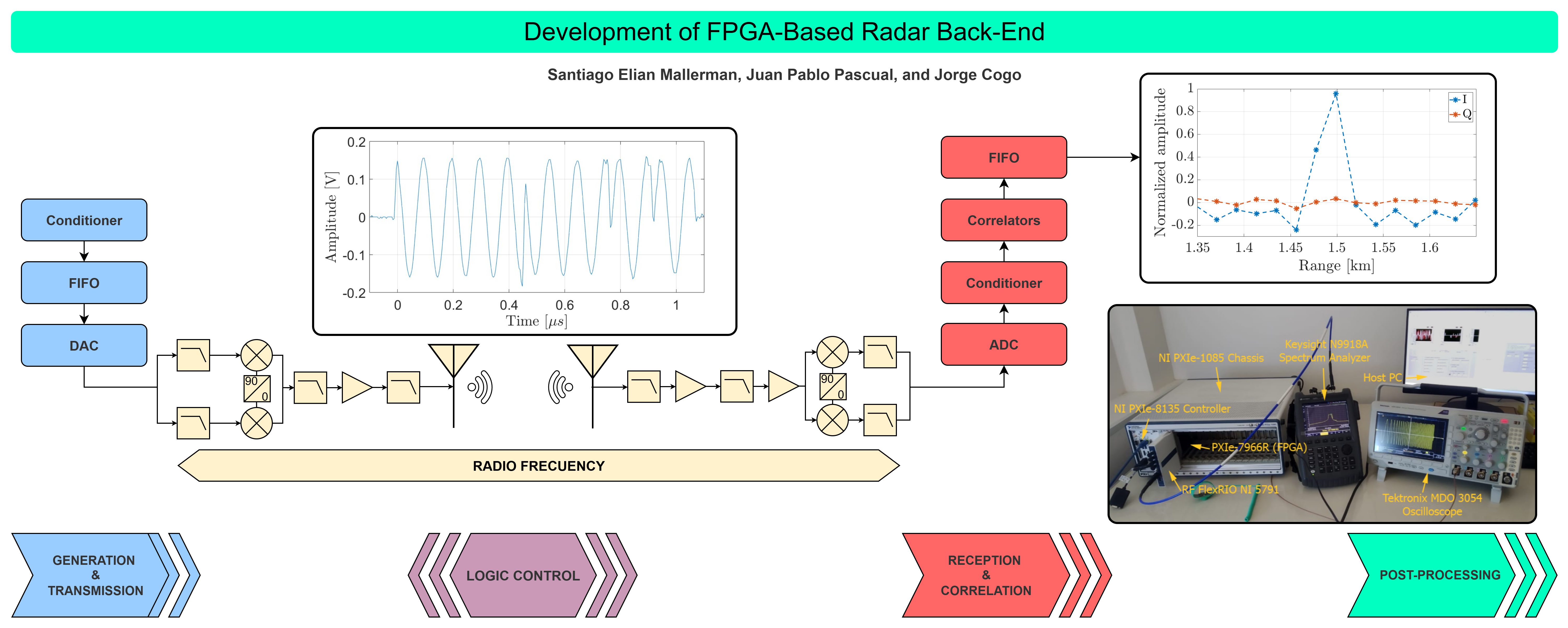
This work presents the development of the digital back-end of a pulsed radar based on Field Programmable Gate Array (FPGA) technology. The development includes the stages dedicated to the generation of diverse baseband signals, including square pulses, chirps, and Barker codes, and the processing of the received signal through a series of correlators with adaptable sampling rates for pulse compression and oversampling scenarios. The system is physically implemented taking advantage of the facilities offered by a FlexRIO® development platform, as well as the associated development environment. The system parameters, like pulse duration, guard interval, and pulse repetition period, as well as parameters specific to each modulation scheme, are widely adjustable to meet user requirements such as maximum range, Doppler resolution and sensitivity. The stages of signal generation are verified digitally through experimental tests using RF measurement equipment, demonstrating a high consistency between them and what is theoretically predicted. The correlation stage is validated using a synthetic target generated by a digital delay and including a noisy channel, showing a strong correlation between the obtained output and the theoretical expectation. These results constitute an important advance in the development of a low-power, reconfigurable monostatic pulsed radar platform that will serve as a versatile testbed for algorithmic experimentation.
Downloads
References
T. Brimeyer, C. L. Martin, E. Loew, G. Farquharson, S. Khatri, and S. Paul, “A generic radar processor design using software defined radio,” in 33rd Conf. Radar Meteorology Amer. Meteor. Soc.: Cairns, AU., vol. 29, jan 2007, pp. 796–806.
H. Nicolaisen, T. Holmboe, K. V. Hoel, and S. Kristoffersen, “High resolution range-Doppler radar demonstrator based on a commercially available FPGA card,” in Int. Conf. Radar, 2008, pp. 676–681. doi:
1109/RADAR.2008.4654006 .
C. Martin, E. Loew, and C. Burghart, “A general purpose FPGA based radar controller and signal processor,” in 92nd American Meteorological Society Annual Meeting, jan 2012.
S. Yoganand, S. S. Babu, and C. Madhu, “FPGA based RADAR signal emulator for signal processing test applications,” Int. Journal of Engineering Research and Applications, vol. 4, pp. 362–367, feb 2014.
A. Orduyilmaz, G. Kara, M. Serin, A. Yildirim, A. C. G¨urb¨uz, and M. Efe, “Real-time Pulse Compression Radar Waveform Generation and Digital Matched Filtering,” in IEEE Radar Conf., 2015, pp. 426–431. doi: 10.1109/RADAR.2015.7131037 .
Y. Zhang, Z. Wang, and J. Wang, “Integrated radar signal processing using FPGA dynamic reconfiguration,” in CIE Int. Conf. Radar, 2016, pp. 1–4. doi: 10.1109/RADAR.2016.8059575 .
F. Yinjuan, L. Yong, H. Qiongdan, and Z. Kunhui, “Design and analysis of LFM/Barker RF stealth signal waveform,” in IEEE 11th Conf. Ind. Electron. Appl., 2016, pp. 591–595. doi: 10.1109/ICIEA.2016.7603653 .
M. Yang, J. Yang, Y. Hou, and C. Jin, “Implementation architecture of signal processing in pulse doppler radar system based on FPGA,” The Journal of Engineering, no. 21, pp. 7335–7338, 2019.
Y. Zhao, H. You, and Y. Zhang, “An FPGA-based direct sampling and digital processing system for wideband and narrowband radar signal,” J. Phys.: Conf. Ser., no. 1624, 2020.
H. Wang, T. Shan, X. Qiao, and H. Cheng, “Research on the design of FPGA-based radar signal processing system,” in 2021 7th International Conference on Condition Monitoring of Machinery in Non-Stationary Operations (CMMNO), 2021, pp. 36–39.
A. Klilou, A. Arsalane, M. Najoui, and S. Belkouch, “An efficient and scalable parallel mapping of pulse doppler radar signal processing chain on a multi-core DSP,” Microprocessors and Microsystems, vol. 85, 2021.
V. Wasik, L. Casadebaig, B. Gabard, B. Gigleux, C. Loic, Y. Paichard, and H. Jeuland, “Prototyping a radar sensor based on a xilinx RFSoC device for detect-and-avoid onboard small UAV,” in EuMW : EuMC +EuMIC + EURAD 2023, sep 2023.
J. Xu, “Design of high-speed radar signal processor based on FPGA,” Journal of Combinatorial Mathematics and Combinatorial Computing, vol. 125, pp. 93–107, mar 2025.
T. Kashiwa, Y. Asada, and T. Kobayashi, “Weather radar: Design-to-deployment using the NI platform,” FURUNO, Tech. Rep., 2014.
N. Instruments, User Manual and Specifications NI 5791R RF Transceiver Adapter Module, may 2013.
N. Instruments, NI FlexRIO FPGA Module Installation Guide and Specifications, oct 2011.
M. A. Richards, Fundamentals of Radar Signal Processing. New York: McGraw-Hill, 2005.
N. Instruments, “The NI LabVIEW high-performance FPGA developer’s guide,” National Instruments, Tech. Rep., feb 2014.
I. R. Ivi´c, D. S. Zrni´c, and S. M. Torres, “Whitening in range to improve weather radar spectral moment estimates. part I: Formulation and simulation,” J. Atmos. Ocean. Technol., vol. 20, pp. 1422–1448, nov 2003. doi: 10.1175/1520-0426(2003)020¡1433:WIRTIW¿2.0.CO;2 .