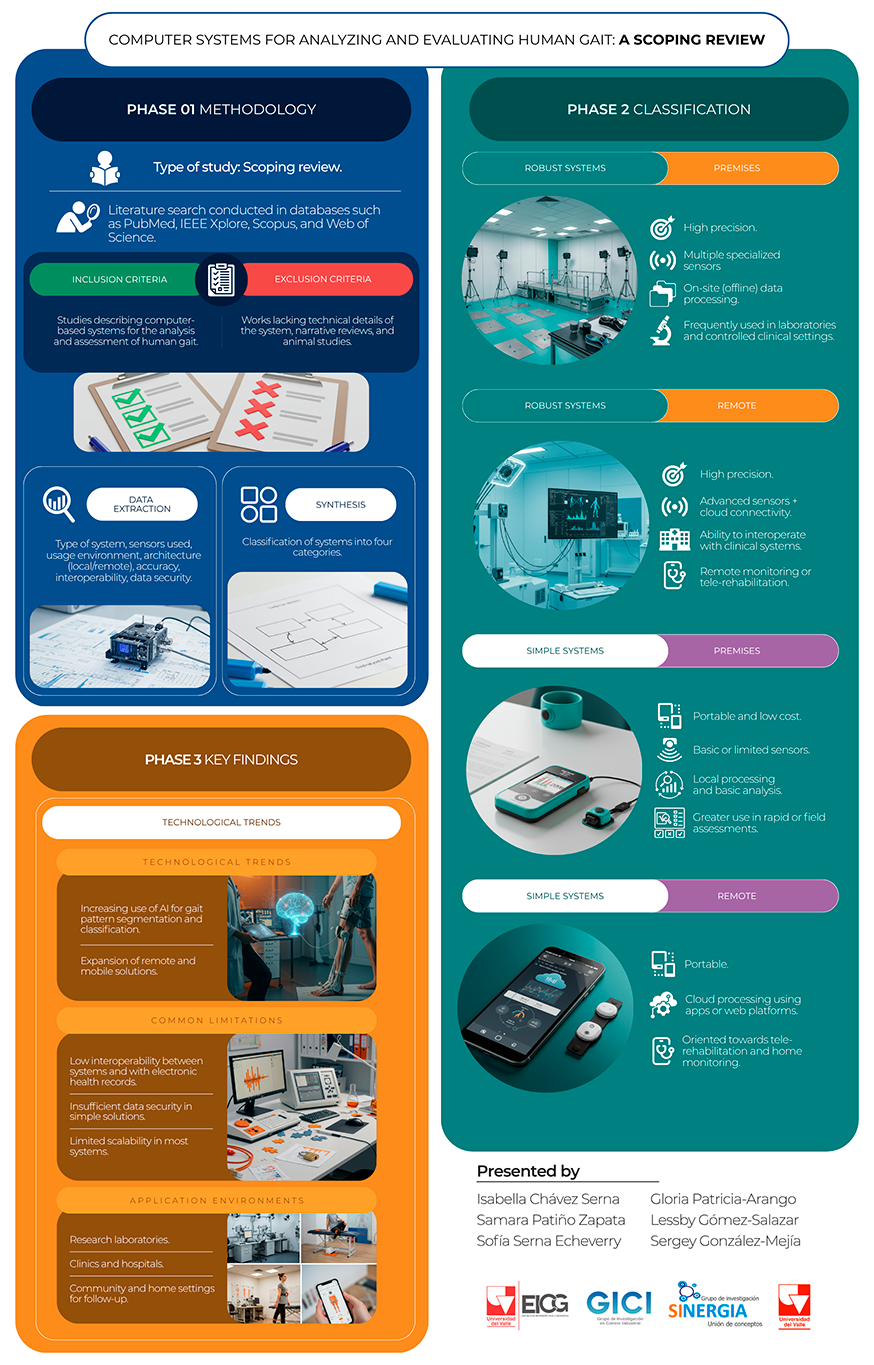
Computer systems for analyzing and evaluating human gait: A scoping review
Keywords:
Computer systems, Gait analysis, Information systems, Rehabilitation technology, Walking assessment, Wearable electronic devicesAbstract
Gait analysis is a key component in rehabilitation processes, enabling the detection of functional impairments and supporting personalized interventions. In recent years, the integration of computer-based systems has enhanced the objectivity, accuracy, and accessibility of gait evaluations. This scoping review maps the scientific evidence on the development and implementation of local and remote systems for gait assessment, published between 2016 and February 2025. The search was conducted in scientific databases (PubMed, Scopus, IEEE Xplore, ACM Digital Library, SpringerLink, ScienceDirect) and grey literature, following the Joanna Briggs Institute (JBI) methodology. A total of 100 documents were included. The identified systems were classified according to their technical complexity (robust or simple) and operational architecture (local or remote). The findings highlight current technological trends and reveal gaps in the implementation of these systems in clinical and community settings.
Downloads
References
D. P. Sánchez y L. T. Ordóñez, «EVALUACIÓN DE L A MARCHA Y L A LOCOMOCIÓN Evaluation of gait and - Studocu». Accedido: 10 de junio de 2024. [En línea]. Disponible en: https://www.studocu.com/es-mx/document/universidad-politecnica-del-valle-de-mexico/biologia-molecular/marcha-va/28958893
A. I. A. Mendoza, T. J. B. Santamaria, V. G. Urrego, J. P. R. Restrepo, y M. C. Z. García, «Marcha: descripción, métodos, herramientas de evaluación y parámetros de normalidad reportados en la literatura», CES Mov. Salud, vol. 1, n.o 1, Art. n.o 1, sep. 2013. Disponible en: https://revistas.ces.edu.co/index.php/movimientoysalud/article/view/2481
J. C. Arellano González, H. I. Medellín Castillo, y J. Cervantes Sánchez, «Identificación y análisis de los parámetros biomecánicos utilizados para la evaluación de la marcha humana normal y patológica», en Memorias Del XXV Congreso Internacional Anual de La SOMIM, 2019, pp. 1-9. Accedido: 10 de junio de 2024. [En línea]. Disponible en: http://somim.org.mx/memorias/memorias2019/articulos/A3_26.pdf
L. Alexander, E. Aromatarin, B. Barber, T. Barker, y C. Bennett, «Scoping Reviews», JBI Global Wiki. Accedido: 10 de junio de 2024. [En línea]. Disponible en: https://jbi-global-wiki.refined.site/space/MANUAL/355862573/10.1.2+Scoping+reviews+compared+to+other+types+of+review
Rayyan, «Rayyan – Intelligent Systematic Review - Rayyan». Accedido: 10 de junio de 2024. [En línea]. Disponible en: https://www.rayyan.ai/
M. J. Page et al., «Declaración PRISMA 2020: una guía actualizada para la publicación de revisiones sistemáticas», Rev. Esp. Cardiol., vol. 74, n.o 9, pp. 790-799, sep. 2021, doi: 10.1016/j.recesp.2021.06.016.
J. Xie et al., «Wearable multisource quantitative gait analysis of Parkinson’s diseases», Comput. Biol. Med., vol. 164, p. 107270, sep. 2023, doi: 10.1016/j.compbiomed.2023.107270.
W. Teufl et al., «Towards an Inertial Sensor-Based Wearable Feedback System for Patients after Total Hip Arthroplasty: Validity and Applicability for Gait Classification with Gait Kinematics-Based Features», Sensors, vol. 19, n.o 22, p. 5006, nov. 2019, doi: 10.3390/s19225006.
F. Lanotte, S. Okita, M. K. O’Brien, y A. Jayaraman, «Enhanced gait tracking measures for individuals with stroke using leg-worn inertial sensors», J. NeuroEngineering Rehabil., vol. 21, n.o 1, p. 219, dic. 2024, doi: 10.1186/s12984-024-01521-8.
R. R. Ileșan et al., «Proof of Concept in Artificial-Intelligence-Based Wearable Gait Monitoring for Parkinson’s Disease Management Optimization», Biosensors, vol. 12, n.o 4, p. 189, mar. 2022, doi: 10.3390/bios12040189.
G. Grouvel, L. Carcreff, F. Moissenet, y S. Armand, «A dataset of asymptomatic human gait and movements obtained from markers, IMUs, insoles and force plates», Sci. Data, vol. 10, n.o 1, p. 180, mar. 2023, doi: 10.1038/s41597-023-02077-3.
M. Cardona, J. Yúdice, F. Huguet, G. López, C. E. García Cena, y V. K. Solanki, «Gait Capture Systems», en SpringerBriefs in Applied Sciences and Technology, 2020, pp. 27-42. doi: 10.1007/978-981-15-4732-4_3.
«Compensating impaired movements: design principles for lower-limb exoskeletons - Research Collection». Accedido: 24 de junio de 2025. [En línea]. Disponible en: https://web.archive.org/web/20250318183528/https://www.research-collection.ethz.ch/handle/20.500.11850/476794
D. Carneros-Prado, S. González-Velázquez, C. C. Dobrescu, I. González, J. Fontecha, y R. Hervás, «Automation of observational gait assessment through an optical 3D motion system and transformers», Appl. Intell., vol. 55, n.o 4, pp. 1-21, feb. 2025, doi: 10.1007/s10489-024-06163-w.
«Walking with robots: how powered wearable devices assist human movement - Research Collection». Accedido: 24 de junio de 2025. [En línea]. Disponible en: https://web.archive.org/web/20250317124907/https://www.research-collection.ethz.ch/handle/20.500.11850/456566
«Robot-Aided Gait Assessment and Rehabilitation: an Assist-as-Needed Approach - Research Collection». Accedido: 24 de junio de 2025. [En línea]. Disponible en: https://web.archive.org/web/20241107132001/https://www.research-collection.ethz.ch/handle/20.500.11850/413148
«Algoritmo para la identificación automática de eventos de la marcha, a partir de información cinemática». Accedido: 23 de junio de 2025. [En línea]. Disponible en: https://repository.eia.edu.co/entities/publication/3e72b07c-b138-4945-ab2e-bde6db9823a3
M. Lee y S. Park, «Estimation of Three-Dimensional Lower Limb Kinetics Data during Walking Using Machine Learning from a Single IMU Attached to the Sacrum», Sensors, vol. 20, n.o 21, p. 6277, nov. 2020, doi: 10.3390/s20216277.
S.-H. Liu, C.-E. Ting, J.-J. Wang, C.-J. Chang, W. Chen, y A. K. Sharma, «Estimation of Gait Parameters for Adults with Surface Electromyogram Based on Machine Learning Models», Sensors, vol. 24, n.o 3, p. 734, ene. 2024, doi: 10.3390/s24030734.
X. Gu, Y. Guo, F. Deligianni, B. Lo, y G.-Z. Yang, «Cross-Subject and Cross-Modal Transfer for Generalized Abnormal Gait Pattern Recognition», IEEE Trans. Neural Netw. Learn. Syst., vol. 32, n.o 2, pp. 546-560, feb. 2021, doi: 10.1109/TNNLS.2020.3009448.
«Plataforma de realidad virtual para soportar el proceso de rehabilitación humana.» Disponible en: https://bibliotecadigital.univalle.edu.co/entities/publication/357b7fe7-838e-4f88-932e-06c37c9f7cea
H. Jin, I. Kang, G. Choi, D. D. Molinaro, y A. J. Young, «Wearable Sensor-Based Step Length Estimation During Overground Locomotion Using a Deep Convolutional Neural Network», en 2021 43rd Annual International Conference of the IEEE Engineering in Medicine & Biology Society (EMBC), nov. 2021, pp. 4897-4900. doi: 10.1109/EMBC46164.2021.9630060.
R. Rojas Herrera, «Sistema de Información para la administración y análisis de datos adquiridos de un exoesqueleto de marcha asistida.», jun. 2018, Accedido: 23 de junio de 2025. [En línea]. Disponible en: https://bibliotecadigital.univalle.edu.co/entities/publication/dspace-univalle.metabuscador.org
S. I. Materia, «BTS Bioengineering | Motion Capture Systems for Sport & Healthcare», BTS. Accedido: 23 de junio de 2025. [En línea]. Disponible en: https://www.btsbioengineering.com/
A. M. Tahir et al., «A Systematic Approach to the Design and Characterization of a Smart Insole for Detecting Vertical Ground Reaction Force (vGRF) in Gait Analysis», Sensors, vol. 20, n.o 4, p. 957, feb. 2020, doi: 10.3390/s20040957.
S. Potluri, A. B. Chandran, C. Diedrich, y L. Schega, «Machine Learning based Human Gait Segmentation with Wearable Sensor Platform», en 2019 41st Annual International Conference of the IEEE Engineering in Medicine and Biology Society (EMBC), Berlin, Germany: IEEE, jul. 2019, pp. 588-594. doi: 10.1109/EMBC.2019.8857509.
S. Scataglini, S. Verwulgen, E. Roosens, R. Haelterman, y D. Van Tiggelen, «Measuring Spatiotemporal Parameters on Treadmill Walking Using Wearable Inertial System», Sensors, vol. 21, n.o 13, p. 4441, jun. 2021, doi: 10.3390/s21134441.
«Personalized mobility assistance: from robot optimization to human adaptation - Research Collection». Accedido: 24 de junio de 2025. [En línea]. Disponible en: https://web.archive.org/web/20250318053056/https://www.research-collection.ethz.ch/handle/20.500.11850/648737
«Real-Time Gait Events Detection during Walking of Biped Model and Humanoid Robot through Adaptive Thresholds». Accedido: 7 de junio de 2025. [En línea]. Disponible en: https://ieeexplore.ieee.org/document/7781955
A. M. Joseph, A. Kian, y R. Begg, «Enhancing Intelligent Shoes with Gait Analysis: A Review on the Spatiotemporal Estimation Techniques», Sensors, vol. 24, n.o 24, p. 7880, dic. 2024, doi: 10.3390/s24247880.
F. J. S. Reyes, «INSTRUMENTACIÓN DE CUERPO COMPLETO PARA ANÁLISIS Y VALORACIÓN DE LA MARCHA HUMANA». Disponible en: https://ru.dgb.unam.mx/bitstream/20.500.14330/TES01000819234/3/0819234.pdf
J. M. Luna López, «Sistema electrónico para el análisis de la marcha humana en el plano sagital», 2017, Accedido: 23 de junio de 2025. [En línea]. Disponible en: https://bibliotecadigital.univalle.edu.co/entities/publication/dspace-univalle.metabuscador.org
«Laboratorio de Biomecanica BIOGAIT, estudio Biomecánico». Accedido: 23 de junio de 2025. [En línea]. Disponible en: https://www.biomec.com.co/biogait-laboratorio-de-biomecanica.html
R. J. Dongo Herrera, «Estudio preliminar del uso del kinect para el análisis de marcha humana en base a la cinemática de la rodilla». Disponible en: http://hdl.handle.net/20.500.12404/9331
«Smart footwear feedback system : sistema electrónico para realimentación y monitoreo de movimientos en extremidades inferiores.» Disponible en: http://hdl.handle.net/20.500.12209/16488
V. Agostini, L. Gastaldi, V. Rosso, M. Knaflitz, y S. Tadano, «A Wearable Magneto-Inertial System for Gait Analysis (H-Gait): Validation on Normal Weight and Overweight/Obese Young Healthy Adults», Sensors, vol. 17, n.o 10, p. 2406, oct. 2017, doi: 10.3390/s17102406.
J. Díaz-Arancibia, M. Córdova, J. Arango-López, D. Ahumada, y F. Moreira, «Automatic gait analysis through computer vision: a pilot study», Neural Comput. Appl., vol. 37, n.o 11, pp. 7619-7639, abr. 2025, doi: 10.1007/s00521-023-08549-2.
I. Klöpfer-Krämer, A. Brand, H. Wackerle, J. Müßig, I. Kröger, y P. Augat, «Gait analysis – Available platforms for outcome assessment», Injury, vol. 51, pp. S90-S96, 2020, doi: 10.1016/j.injury.2019.11.011.
T. M. Wiles et al., «NONAN GaitPrint: An IMU gait database of healthy older adults», Sci. Data, vol. 12, p. 143, ene. 2025, doi: 10.1038/s41597-024-04359-w.
M. C. Bisi, M. Fabbri, D. M. Cordelli, y R. Stagni, «Gait performance in toddlers born preterm: A sensor based quantitative characterization», Comput. Methods Programs Biomed., vol. 220, p. 106808, jun. 2022, doi: 10.1016/j.cmpb.2022.106808.
J. Zhou, Q. Mao, F. Yang, J. Zhang, M. Shi, y Z. Hu, «Development and Assessment of Artificial Intelligence-Empowered Gait Monitoring System Using Single Inertial Sensor», Sensors, vol. 24, n.o 18, p. 5998, sep. 2024, doi: 10.3390/s24185998.
L. D. Hughes, M. Bencsik, M. Bisele, y C. T. Barnett, «Using Lower Limb Wearable Sensors to Identify Gait Modalities: A Machine-Learning-Based Approach», Sensors, vol. 23, n.o 22, Art. n.o 22, ene. 2023, doi: 10.3390/s23229241.
M. I. Mokhlespour Esfahani y M. A. Nussbaum, «Using smart garments to differentiate among normal and simulated abnormal gaits», J. Biomech., vol. 93, pp. 70-76, ago. 2019, doi: 10.1016/j.jbiomech.2019.06.009.
J. Li, Z. Wang, C. Wang, y W. Su, «GaitFormer: Leveraging dual-stream spatial–temporal Vision Transformer via a single low-cost RGB camera for clinical gait analysis», Knowl.-Based Syst., vol. 295, p. 111810, jul. 2024, doi: 10.1016/j.knosys.2024.111810.
W.-C. Hsu et al., «Multiple-Wearable-Sensor-Based Gait Classification and Analysis in Patients with Neurological Disorders», Sensors, vol. 18, n.o 10, Art. n.o 10, oct. 2018, doi: 10.3390/s18103397.
R. J. Mobbs et al., «Gait metrics analysis utilizing single-point inertial measurement units: a systematic review», mHealth, vol. 8, pp. 9-9, ene. 2022, doi: 10.21037/mhealth-21-17.
Y. Celik, S. Stuart, W. L. Woo, y A. Godfrey, «Wearable Inertial Gait Algorithms: Impact of Wear Location and Environment in Healthy and Parkinson’s Populations», Sensors, vol. 21, n.o 19, p. 6476, sep. 2021, doi: 10.3390/s21196476.
M. V. Yazici, G. Çobanoğlu, y G. Yazici, «Test-retest reliability and minimal detectable change for measures of wearable gait analysis system (G-walk) in children with cerebral palsy.», Turk. J. Med. Sci., vol. 52, n.o 3, pp. 658-666, ene. 2022, doi: 10.55730/1300-0144.5358.
G. D’Addio, L. Donisi, G. Pagano, G. Improta, A. Biancardi, y M. Cesarelli, «Agreement between Opal and G-Walk Wearable Inertial Systems in Gait Analysis on Normal and Pathological Subjects», en 2019 41st Annual International Conference of the IEEE Engineering in Medicine and Biology Society (EMBC), Berlin, Germany: IEEE, jul. 2019, pp. 3286-3289. doi: 10.1109/EMBC.2019.8857841.
B. G. Contini et al., «A wearable gait analysis protocol to support the choice of the appropriate ankle-foot orthosis: A comparative assessment in children with Cerebral Palsy», Clin. Biomech., vol. 70, pp. 177-185, dic. 2019, doi: 10.1016/j.clinbiomech.2019.08.009.
D. Solanki y U. Lahiri, «Design of Instrumented Shoes for Gait Characterization: A Usability Study With Healthy and Post-stroke Hemiplegic Individuals», Front. Neurosci., vol. 12, p. 459, jul. 2018, doi: 10.3389/fnins.2018.00459.
«Implementación de un sistema basado en sensores inerciales para la caracterización biomecánica de la marcha normal y de pacientes con amputación del miembro inferior». 2021. Disponible en: http://repositorio.uan.edu.co/handle/123456789/5017.
A. Viswakumar, V. Rajagopalan, T. Ray, P. Gottipati, y C. Parimi, «Development of a Robust, Simple, and Affordable Human Gait Analysis System Using Bottom-Up Pose Estimation With a Smartphone Camera», Front. Physiol., vol. 12, p. 784865, ene. 2022, doi: 10.3389/fphys.2021.784865.
H. Zhang et al., «Validation of a Wearable System for Lower Extremity Assessment», Orthop. Surg., vol. 15, n.o 11, pp. 2911-2917, nov. 2023, doi: 10.1111/os.13836.
«Wayback Machine». Accedido: 24 de junio de 2025. [En línea]. Disponible en: https://web.archive.org/web/20240426004945/https://www.research-collection.ethz.ch/bitstream/handle/20.500.11850/316327/Diss_RC_DW.pdf?sequence=2&isAllowed=y
M. M. S. Hendriks, M. Vos-van Der Hulst, y N. L. W. Keijsers, «Feasibility of a Sensor-Based Technological Platform in Assessing Gait and Sleep of In-Hospital Stroke and Incomplete Spinal Cord Injury (iSCI) Patients», Sensors, vol. 20, n.o 10, p. 2748, may 2020, doi: 10.3390/s20102748.
«LiteGait -». Accedido: 24 de julio de 2025. [En línea]. Disponible en: https://www.litegait.com/product/gaitsens-20
«XSENSOR | Sensores y herramientas para el rendimiento humano». Accedido: 24 de julio de 2025. [En línea]. Disponible en: https://es.xsensor.com/solutions-and-platform/human-performance/human-performance
«AnyBody Technology», AnyBody Technology. Accedido: 24 de julio de 2025. [En línea]. Disponible en: https://www.anybodytech.com/
«OpenCap - Musculoskeletal forces from smartphone videos.» Accedido: 24 de julio de 2025. [En línea]. Disponible en: https://www.opencap.ai/
«SimGait - home». Accedido: 24 de julio de 2025. [En línea]. Disponible en: https://simgait.org/
«SimTK: Extendable OpenSim-Matlab Infrastructure Using Class Oriented C++ Mex Interface: Project Home». Accedido: 24 de julio de 2025. [En línea]. Disponible en: https://simtk.org/projects/opensimmatlab/
«SimTK: Matlab MOtion data elaboration TOolbox for NeuroMusculoSkeletal apps (MOtoNMS): Project Home». Accedido: 24 de julio de 2025. [En línea]. Disponible en: https://simtk.org/projects/motonms/
Caldas R, Mundt M, Potthast W, Buarque de Lima Neto F, Markert B. A systematic review of gait analysis methods based on inertial sensors and adaptive algorithms. Gait Posture. 2017 [citado 10 de junio de 2024]. 57:204-10. Disponible en: https://www.sciencedirect.com/science/article/abs/pii/S0966636217302424?via%3Dihub
Santos ACA dos, Junior PRF, Sousa MHG de, Uchiyama SST, Simis M, Battistella LR. Spatial-temporal gait parameters based on a wearable inertial sensor of healthy Brazilian subjects. Acta Fisiátrica. 2023 [citado 10 de junio de 2024]. 30(4):245-50. Disponible en: https://revistas.usp.br/actafisiatrica/article/view/219934
Brognara L, Mazzotti A, Di Martino A, Faldini C, Cauli O. Wearable Sensor for Assessing Gait and Postural Alterations in Patients with Diabetes: A Scoping Review. 2021 [citado 10 de junio de 2024]. 57(11):1145. Disponible en: https://www.mdpi.com/1648-9144/57/11/1145
Boekestijn RJ, van Gerven J, Geurts ACH, Smulders K. Objective gait assessment in individuals with knee osteoarthritis using inertial sensors: A systematic review and meta-analysis. Gait Posture. 2022 [citado 10 de junio de 2024]. 98:109-20. Disponible en: https://www.sciencedirect.com/science/article/pii/S0966636222005033?via%3Dihub
Morimoto T, Hirata H, Kobayashi T, Tsukamoto M, Yoshihara T, Toda Y, et al. Gait analysis using digital biomarkers including smart shoes in lumbar spinal canal stenosis: a scoping review. Front Med. 2023 [citado 10 de junio de 2024]. 10:1302136. Disponible en: https://www.frontiersin.org/journals/medicine/articles/10.3389/fmed.2023.1302136/full
Sharma Y, Cheung L, Patterson KK, Iaboni A. Factors influencing the clinical adoption of quantitative gait analysis technology with a focus on clinical efficacy and clinician perspectives: A scoping review. Gait Posture. 2024 [citado 10 de junio de 2024]. 108:228-42. Disponible en: https://www.sciencedirect.com/science/article/abs/pii/S0966636223015072?via%3Dihub
Garcia B, Mendez A, Muro de la Herran Á. Gait Analysis Methods: An Overview of Wearable and Non-Wearable Systems, Highlighting Clinical Applications. Sensors. 2014 [citado 17 de septiembre de 2024]. 14(2):3362-94. Disponible en: https://pmc.ncbi.nlm.nih.gov/articles/PMC3958266/
TarniŢă D. Wearable sensors used for human gait analysis. Rom J Morphol Embryol. 2016 [citado 17 de septiembre de 2024]. 57(2):373-82. Disponible en: https://pubmed.ncbi.nlm.nih.gov/27516008/
Fernández-González P, Koutsou A, Cuesta-Gómez A, Carratalá-Tejada M, Miangolarra-Page JC, Molina-Rueda F. Reliability of Kinovea® Software and Agreement with a Three-Dimensional Motion System for Gait Analysis in Healthy Subjects. Sensors. 2020 [citado 17 de septiembre de 2024]. 20(11):3154. Disponible en: https://pubmed.ncbi.nlm.nih.gov/32498380/
Díaz S, Stephenson JB, Labrador MA. Use of Wearable Sensor Technology in Gait, Balance, and Range of Motion Analysis. Appl Sci. 2020 [citado 17 de septiembre de 2024]. 10(1):234. Disponible en: https://www.mdpi.com/2076-3417/10/1/234
Soto APC, Ramirez EG, Arana JED, franco I soto, Saa PAC, Tello NC, et al. Editorial Universidad Santiago de Cali. [citado 17 de septiembre de 2024]. Modelos teóricos para fisioterapia. Disponible en: https://libros.usc.edu.co/index.php/usc/catalog/view/145/383/5764
Pío TVS, et al. Tratado de geriatría para residentes. s.f. [citado 17 de septiembre de 2024]. Alteraciones de la marcha, inestabilidad y caídas. Disponible en: https://www.academia.edu/15011665/ALTS_DE_LA_MARCHA_INESTABILIDAD_Y_CAIDAS
Cámara J. Scielo. 2024 [citado 10 de junio de 2024]. Análisis de la marcha: sus fases y variables espacio-temporales. Disponible en: http://www.scielo.org.co/scielo.php?script=sci_arttext&pid=S1900-38032011000100011
Hernández JC, Carrero MA. Interfaz gráfica para el análisis de los parámetros cinemáticos y espacio temporales de la marcha. 2017. [citado 17 de septiembre de 2024]. Disponible en: http://hdl.handle.net/11349/7303
Caicedo PE. ResearchGate. 2016 [citado 10 de junio de 2024]. Figura 1. Ciclo de Marcha y sus Fases. 3 Medición de Parámetros de la... Disponible en: https://www.researchgate.net/figure/Figura-1-Ciclo-de-Marcha-y-sus-Fases-3-Medicion-de-Parametros-de-la-Marcha-Humada_fig1_321492779
Rodríguez I. Entrenamiento robótico como medio de rehabilitación para la marcha. 2012 [citado 10 de junio de 2024]. Disponible en: https://www.medigraphic.com/pdfs/evidencia/eo-2012/eo122b.pdf
Simscape Multibody [Internet]. [citado 19 de junio de 2024]. Disponible en: https://la.mathworks.com/products/simscape-multibody.html
Delp SL, Anderson FC, Arnold AS, Loan P, Habib A, John CT, et al. OpenSim: open-source software to create and analyze dynamic simulations of movement. IEEE Trans Biomed Eng. 2007 [citado 19 de junio de 2024]. 54(11):1940-50. Disponible en: https://ieeexplore.ieee.org/document/4352056
Tay SK, Gibson I, Jagdish BN. Detailed spine modeling with LifeMODTM. En: Scopus [Internet]. 2009 [citado 19 de junio de 2024]. Disponible en: https://scholarbank.nus.edu.sg/handle/10635/73327
ORL [Internet]. [citado 19 de junio de 2024]. Kinematic Simulation. Disponible en: https://orl-inc.com/computational-analysis/kinematic-simulation/
Eskinazi I, Fregly BJ. An Open-Source Toolbox for Surrogate Modeling of Joint Contact Mechanics. IEEE Trans Biomed Eng. 2016 [citado 19 de junio de 2024]. 63(2):269-77. Disponible en: https://ieeexplore.ieee.org/document/7155491
Delp S, Loan JP. A computational framework for simulating and analyzing human and animal movement. Comput Sci Eng. 2000 [citado 19 de junio de 2024]. 2:46-55. Disponible en: https://nmbl.stanford.edu/publications/pdf/Delp2000a.pdf
Shippen J, May B. BoB – biomechanics in MATLAB. 2016 [citado 19 de junio de 2024]. Disponible en: https://pureportal.coventry.ac.uk/en/publications/bob-biomechanics-in-matlab
Felis ML. RBDL: an efficient rigid-body dynamics library using recursive algorithms. Auton Robots. 2017 [citado 19 de junio de 2024]. 41(2):495-511. Disponible en: https://link.springer.com/article/10.1007/s10514-016-9574-0
E. Klavins, D.E. Koditsche. Phase Regulation of Decentralized Cyclic Robotic Systems [Internet]. 2002 [citado 19 de junio de 2024]. Disponible en: https://journals.sagepub.com/doi/10.1177/027836402320556430
Osorio JH, Valencia MH. Bases para el entendimiento del proceso de la marcha humana. Arch Med. 2013 [citado 19 de junio de 2024]. Disponible en: https://www.redalyc.org/pdf/2738/273828094009.pdf
Alvarado YLP, Ramirez TAS. Parámetros espaciotemporales de la marcha en pacientes con fractura de tibia. 2017 [citado 19 de junio de 2024]. Disponible en: https://repositorio.udes.edu.co/entities/publication/7db6ff79-78e9-4ad3-9a50-344993351dbc
Soto MRB. Estudio de los parámetros cinéticos de la marcha del paciente hemipléjico mediante plataformas dinamométricas. [citado 19 de junio de 2024]. Disponible en: https://dialnet.unirioja.es/servlet/tesis?codigo=7162
Ramírez JRD, Mendoza AIA, Santamaría TJB, Urrego VG, Restrepo JPR, García MCZ. Descripción de los parámetros de referencia de la marcha en adultos de la población antioqueña entre 20 y 54 años de 2012. (2012) [citado 10 de junio de 2024]. Disponible en: https://repository.ces.edu.co/items/0fbda5b6-383b-4aa0-8f58-9d126fb36781
Sutherland DH. The evolution of clinical gait analysis. Part II kinematics. Gait Posture. 2002 [citado 10 de junio de 2024]. 16(2):159-79. Disponible en: https://pubmed.ncbi.nlm.nih.gov/12297257/
Cifuentes C, Martínez F, Romero E. Análisis teórico y computacional de la marcha normal y patológica: una revisión. Rev Med. 2010 [citado 10 de junio de 2024]. 18(2):182-96. Disponible en: http://www.scielo.org.co/pdf/med/v18n2/v18n2a05.pdf
Blog Biontech. Blog Biontech. 2024 [citado 10 de junio de 2024]. Qué es la biomecánica de la marcha. Disponible en: https://www.biontechworld.com/blog/que-es-biomecanica-marcha
Ergodinamica. Estudio biomecánico de la marcha y pisada - Metodología propia | Ergodinámica [Internet]. Ergodinamica. 2024 [citado 10 de junio de 2024]. Disponible en: https://www.ergodinamica.com/especialidades/biomecanica/estudio-biomecanico-marcha/
www.cognizant.com [Internet]. 2024 [citado 10 de junio de 2024]. Plataforma digital. Disponible en: https://www.cognizant.com/es/es/glossary/digital-platform
Enciclopedia Significados [Internet]. 2024 [citado 10 de junio de 2024]. Software. Disponible en: https://www.significados.com/software/
Camargo E, Garzón Y, Camacho V. Sistema portátil de captura de movimiento para el análisis cinemático de la marcha humana. 2012 [Internet]. 10 de junio de 2024 [citado 10 de junio de 2024];16(34). Disponible en: http://www.scielo.org.co/scielo.php?script=sci_arttext&pid=S0123-921X2012000400006
. Amazon Web Services, Inc. Amazon Web Services, Inc. 2024 [citado 10 de junio de 2024]. ¿Qué es una base de datos? Disponible en: https://aws.amazon.com/es/what-is/database/
. Je-Nam, Mun-Ho, Ho-Rim, Yoon. Development and Functional Evaluation of an Upper Extremity Rehabilitation System Based on Inertial Sensors and Virtual Reality [Internet]. 2013 [citado 10 de junio de 2024]. Disponible en: https://journals.sagepub.com/doi/10.1155/2013/168078?icid=int.sj-full-text.similar-articles.9
Manchado Garabito R, Tamames Gómez S, López González M, Mohedano Macías L, D´Agostino M, Veiga de Cabo J. Revisiones Sistemáticas Exploratorias. Med Segur Trab. 2009 [citado 30 de junio de 2025]. 55(216):12-9. Disponible en: https://scielo.isciii.es/scielo.php?script=sci_arttext&pid=S0465-546X2009000300002
SAS R. www.redjurista.com. [citado 30 de junio de 2025]. Resolución 8430 de 1993 - Colombia. Disponible en: https://www.redjurista.com/Documents/resolucion_8430_de_1993.aspx
Propuesta de definición del impacto en la marcha humana utilizando señales de acelerometría y fuerza para el pie dominante. 2024 [citado 23 de junio de 2025]. Disponible en: https://repositorio.escuelaing.edu.co/entities/publication/1c953dc9-ffc3-42b6-8f7e-d3573baa493b
Guffanti D, Brunete A, Hernando M, Rueda J, Navarro E. ROBOGait: A Mobile Robotic Platform for Human Gait Analysis in Clinical Environments. Sensors. 2021 [citado 23 de junio de 2025]. 21(20):6786. Disponible en: https://www.mdpi.com/1424-8220/21/20/6786
Rudisch J, Jöllenbeck T, Vogt L, Cordes T, Klotzbier TJ, Vogel O, et al. Agreement and consistency of five different clinical gait analysis systems in the assessment of spatiotemporal gait parameters. Gait Posture. 2021 [citado 7 de junio de 2025]. 85:55-64. Disponible en: https://www.sciencedirect.com/science/article/abs/pii/S0966636221000151?via%3Dihub