A Capacitor Coupled On-board Bi-directional Vehicle-to-Vehicle Charging System
Keywords:
Battery charging, Bi-directional power transfer, Conductive charging, Electric Vehicle, Vehicle-to-Vehicle (V2V)Abstract
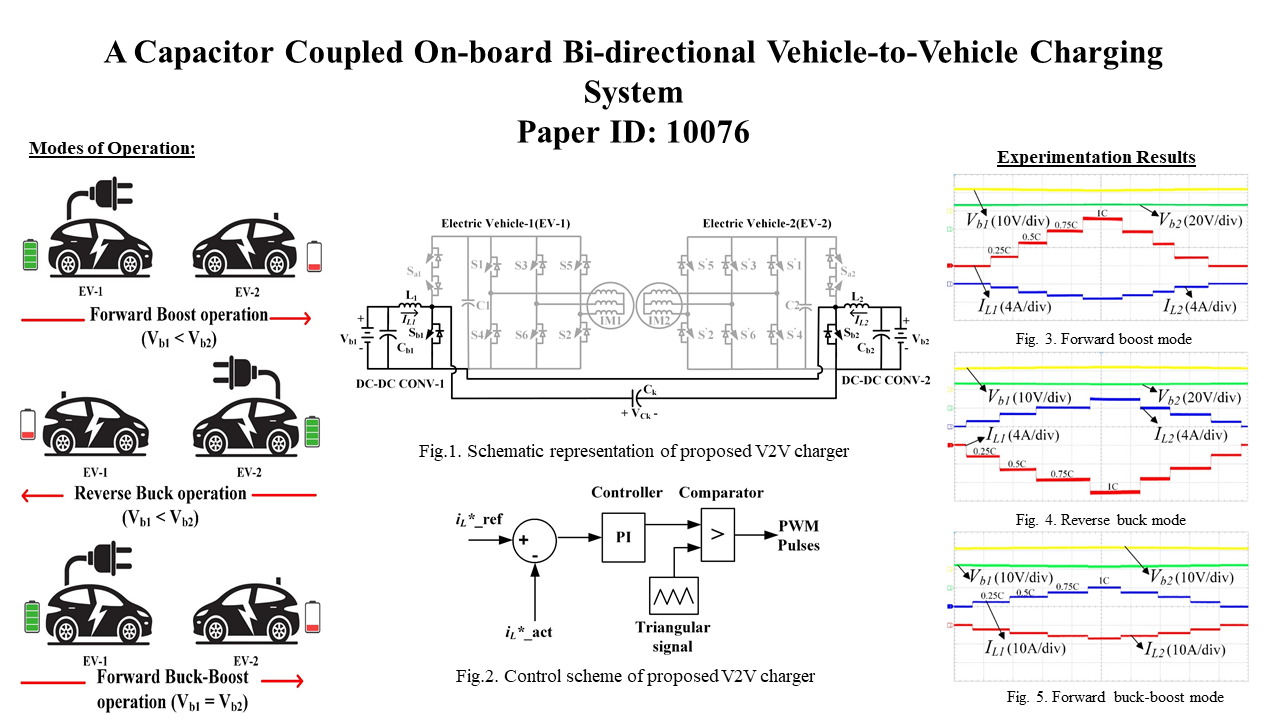
In recent times, Vehicle-to-Vehicle (V2V) chargers have gained popularity to transfer the energy between two Electric Vehicles (EV). In this paper, a new direct V2V charger is proposed that uses a capacitor coupling and an on-board DC-DC converter in each EV to enable the energy transfer between them. Importantly, this charger differentiates itself from other V2V chargers by eliminating the requirement for motor winding and inverter circuit from an EV. The charger operation is verified through simulation studies (via MATLAB/Simulink®) in three operating modes: Forward Boost, Reverse Buck and Forward Buck-Boost mode for EV’s with battery voltage of 350 V and 450 V. The simulation studies are validated through the OPAL-RT® Real-Time simulator. The proposed charger achieves an efficiency of 96.57 % in the forward boost mode, 96.56 % in the reverse buck mode, and 96.26 % in the forward buck–boost mode of operation at a rated power level of 20 kW, while demonstrating a 25 % to 76 % reduction in component count compared to existing topologies. Further, a laboratory proof of concept is developed and tested with battery voltages of 12 V and 25.6 V in all modes of operation. Experimental results under static and dynamic discharge currents are presented.
Downloads
References
H. H. Kore and S. Koul, “Electric vehicle charging infrastructure: positioning in India,” Management of Environmental Quality: An International Journal, vol. ahead-of-print, no. ahead-of-print, Feb. 2022, doi:https://doi.org/10.1108/meq-10-2021-0234.
A. Ghosh, “Possibilities and Challenges for the Inclusion of the Electric Vehicle (EV) to Reduce the Carbon Footprint in the Transport Sector: A Review,” Energies, vol. 13, no. 10, p. 2602, May 2020, doi:
https://doi.org/10.3390/en13102602.
B. V. Kumar and A. F. M A, “A Review of Technical Impact of Electrical Vehicle Charging Stations on Distribution Grid,” 2023 International Conference on Recent Advances in Electrical, Electronics & Digital
Healthcare Technologies (REEDCON), pp. 559–564, May 2023, doi:https://doi.org/10.1109/reedcon57544.2023.10150680.
M. R. Khalid, I. A. Khan, S. Hameed, M. S. J. Asghar, and J.-S. Ro, “A Comprehensive Review on Structural Topologies, Power Levels, Energy Storage Systems, and Standards for Electric Vehicle Charging Stations and Their Impacts on Grid,” IEEE Access, vol. 9, pp. 128069–128094,
, doi: https://doi.org/10.1109/ACCESS.2021.3112189.
A. G. Boulanger, A. C. Chu, S. Maxx, and D. L. Waltz, “Vehicle Electrification: Status and Issues,” Proceedings of the IEEE, vol. 99, no. 6, pp.
–1138, Jun. 2011, doi: https://doi.org/10.1109/jproc.2011.2112750.
S. Haghbin, S. Lundmark, M. Alakula, and O. Carlson, “Grid-Connected Integrated Battery Chargers in Vehicle Applications: Review and New Solution,” IEEE Transactions on Industrial Electronics, vol. 60, no. 2, pp. 459–473, Feb. 2013, doi: https://doi.org/10.1109/tie.2012.2187414.
S. Das, P. Acharjee, and A. Bhattacharya, “Charging Scheduling of Electric Vehicle incorporating Grid-to-Vehicle (G2V) and Vehicle-to-Grid (V2G) technology considering in Smart-Grid,” IEEE Transactions on Industry Applications, pp. 1–1, 2020, doi: https://doi.org/10.1109/tia.2020.3041808.
K. M.Tan, V.K.Ramachandaramurthy, and J.Y.Yong, “Bidirectional battery charger for electric vehicle,” 2014 IEEE Innovative Smart Grid Technologies - Asia (ISGT ASIA), May 2014, doi: https://doi.org/10.1109/isgt-asia.2014.6873826.
E. Martinez-Vera and P. B. Sanchez, “Review of Bidirectional DC-DC Converters and Trends in Control Techniques for Applications in Electric Vehicles,” IEEE Latin America Transactions, vol. 22, no. 2, pp. 144–155, Jan. 2024, doi: https://doi.org/10.1109/TLA.2024.10412031
S. S. Sayed and A. M. Massoud, “Review on State-of-the-Art Unidirectional Non-Isolated Power Factor Correction Converters for Short-/LongDistance Electric Vehicles,” IEEE Access, vol. 10, pp. 11308–11340, 2022, doi: https://doi.org/10.1109/access.2022.3146410.
V. M. Iyer, S. Gulur, G. Gohil, and S. Bhattacharya, “An Approach Towards Extreme Fast Charging Station Power Delivery for Electric Vehicles with Partial Power Processing,” IEEE Transactions on Industrial Electronics, vol. 67, no. 10, pp. 8076–8087, Oct. 2020, doi:https://doi.org/10.1109/tie.2019.2945264.
J. Anzola, I. Aizpuru, and A. Arruti, “Partial Power Processing Based Converter for Electric Vehicle Fast Charging Stations,” Electronics, vol. 10, no. 3, p. 260, Jan. 2021, doi:https://doi.org/10.3390/electronics10030260.
Radha Kushwaha, Vinod Khadkikar, and Bashar Zahawi, “11 kW Integrated On-Board Fast Charger Using Partial Power Conversion,” IEEE Industry Applications Society Annual Meeting (IAS), pp. 1–6, Oct. 2024, doi: https://doi.org/10.1109/ias55788.2024.11023797.
Radha Kushwaha, Vinod Khadkikar, S. Singh, H. H. Zeineldin, Rabeb Mizouni, and Hadi Otrok, “An Efficient Three-Port Partial Power Converter based EV On-board Fast Charger,” IEEE International Conference on Power Electronics, Drives and Energy Systems (PEDES), pp. 1–6,
Dec. 2022, doi: https://doi.org/10.1109/pedes56012.2022.10080032.
Tiago, L. Machado, D. Pedrosa, C. Martins, and J. L. Afonso, “Comparative Analysis of Vehicle-to-Vehicle (V2V) Power Transfer Configurations without Additional Power Converters,” IEEE 14th International Conference on Compatibility, Power Electronics and Power Engineering (CPEPOWERENG), pp. 88–93, Jul. 2020, doi: https://doi.org/10.1109/CPEPOWERENG48600.2020.9161697.
T. Sousa, V. Monteiro, J. O. Fernandes, C. Couto, A. A. Nogueiras, and J. L. Afonso, “New Perspectives for Vehicle-to-Vehicle (V2V) Power Transfer,” Conference of the Industrial Electronics Society, Oct. 2018, doi:https://doi.org/10.1109/iecon.2018.8591209.
M. A. Masrur et al., “Military-Based Vehicle-to-Grid and Vehicleto-Vehicle Microgrid—System Architecture and Implementation,” IEEE Transactions on Transportation Electrification, vol. 4, no. 1, pp. 157–171, Mar. 2018, doi: https://doi.org/10.1109/tte.2017.2779268.
G. Li, L. Boukhatem, L. Zhao and J. Wu, "Direct Vehicle-to-Vehicle Charging Strategy in Vehicular Ad-Hoc Networks," 2018 9th IFIP International Conference on New Technologies, Mobility and Security (NTMS), Paris, France, 2018, pp. 1-5, doi: 10.1109/NTMS.2018.8328689.
T. J. C. Sousa, V. Monteiro, S. Coelho, L. Machado, D. Pedrosa, and J. L. Afonso, “Electric Vehicle Battery Charging Station based on Bipolar dc Power Grid with Grid-to-Vehicle, Vehicle-to-Grid and Vehicle-to-Vehicle Capabilities,” EAI Endorsed Transactions on Energy Web, vol. 9, no. 5,
p. e5, Feb. 2023, doi: https://doi.org/10.4108/ew.v9i5.3049.
A. Namadmalan, K. Rouzbehi, J. M. Escano, and C. Bordons, “Dual- ˜Active Bridge Series Resonant Electric Vehicle Charger: A SelfTuning Method,” Electronics, vol. 9, no. 2, p. 253, Feb. 2020, doi:
https://doi.org/10.3390/electronics9020253.
S. S. Trivedi and A. V. Sant, “Comparative analysis of dual active bridge dc–dc converter employing Si, SiC and GaN MOSFETs for G2V and V2G operation,” Energy Reports, vol. 8, pp. 1011–1019, Nov. 2022, doi:https://doi.org/10.1016/j.egyr.2022.08.100.
N. D. Dao, D.-C. Lee, and Q. D. Phan, “High-Efficiency SiC-Based Isolated Three-Port DC/DC Converters for Hybrid Charging Stations,” IEEE Transactions on Power Electronics, vol. 35, no. 10, pp. 10455–10465, Oct. 2020, doi: https://doi.org/10.1109/tpel.2020.2975124.
Md Safayatullah, Reza Rezaii, Fahad Alaq, and I. Batarseh, “A ThreePort DC-DC-DC Converter based on Dual Active Bridge Series Resonant Topology for Electric Vehicle DC Fast Charging Applications,” 2022
IEEE Energy Conversion Congress and Exposition (ECCE), pp. 1–7, Oct. 2022, doi:https://doi.org/10.1109/ecce50734.2022.9947971.
G. R. Chandra Mouli, J. Schijffelen, M. van den Heuvel, M. Kardolus, and P. Bauer, “A 10 kW Solar-Powered Bidirectional EV Charger Compatible With Chademo and COMBO,” IEEE Transactions
on Power Electronics, vol. 34, no. 2, pp. 1082–1098, Feb. 2019, doi:https://doi.org/10.1109/tpel.2018.2829211.
M. O. Badawy et al., “Design and Implementation of a 75-kW Mobile Charging System for Electric Vehicles,” IEEE Transactions on Industry Applications, vol. 52, no. 1, pp. 369–377, Jan. 2016, doi:
https://doi.org/10.1109/tia.2015.2469775.
U. B S, V. M. Khadkikar, H. Zeineldin, S. Singh, H. Otrok, and R. Mizouni, “Direct Electric Vehicle to Vehicle (V2V) Power Transfer Using On-board Drivetrain and Motor Windings,”
IEEE Transactions on Industrial Electronics, pp. 1–1, 2021, doi:https://doi.org/10.1109/tie.2021.3121707.
G. Qiu and Vinod Khadkikar, “Electric Vehicle-to-Vehicle (V2V) Energy Transfer Using Motor Inverter and Winding,” IEEE Transactions on Transportation Electrification, vol. 11, no. 5, pp. 11967–11976, Jun. 2025, doi: https://doi.org/10.1109/tte.2025.3584550.
G. Qiu, V. Khadkikar, and B. Zahawi, “Capacitively Isolated Dual Active Bridge Converter for On-Board Charger Applications,” IEEE Transactions on Industrial Electronics, vol. 72, no. 6, pp. 5833–5845, Jun. 2025, doi: https://doi.org/10.1109/tie.2024.3497328.
S. Taghizadeh, M. J. Hossain, N. Poursafar, J. Lu, and G. Konstantinou, “A Multifunctional Single-Phase EV On-Board Charger With a New V2V Charging Assistance Capability,” IEEE Access, vol. 8, pp.
–116823, 2020, doi: https://doi.org/10.1109/access.2020.3004931.
A. Shafiqurrahman, B. S. Umesh, N. A. Sayari, and V. Khadkikar, “Electric Vehicle-to-Vehicle Energy Transfer Using On-Board Converters,” IEEE Transactions on Transportation Electrification, vol. 9, no. 1, pp. 1263–1272, Mar. 2023, doi: https://doi.org/10.1109/TTE.2022.3172029.
Y. Xu, M. Hu, C. Fu, K. Cao, Z. Su, and Z. Yang, “State of Charge Estimation for Lithium-Ion Batteries Based on Temperature-Dependent Second-Order RC Model,” Electronics, vol. 8, no. 9, p. 1012, Sep. 2019,
doi: https://doi.org/10.3390/electronics8091012.
M.-K. Tran, A. DaCosta, A. Mevawalla, S. Panchal, and M. Fowler, “Comparative Study of Equivalent Circuit Models Performance in Four Common Lithium-Ion Batteries: LFP, NMC, LMO, NCA,” Batteries, vol. 7, no. 3, p. 51, Jul. 2021, doi: https://doi.org/10.3390/batteries7030051.
Mounika Reddimalla, Srinivsan Pradabane and K. Dahal, ”Electric Vehicle to Vehicle (V2V) Power Transfer with On-Board Network and Capacitor-Link,” 2024 Third International Conference on Power, Control and Computing Technologies (ICPC2T), Raipur, India, 2024, pp. 565-568, doi:
1109/ICPC2T60072.2024.10474760.