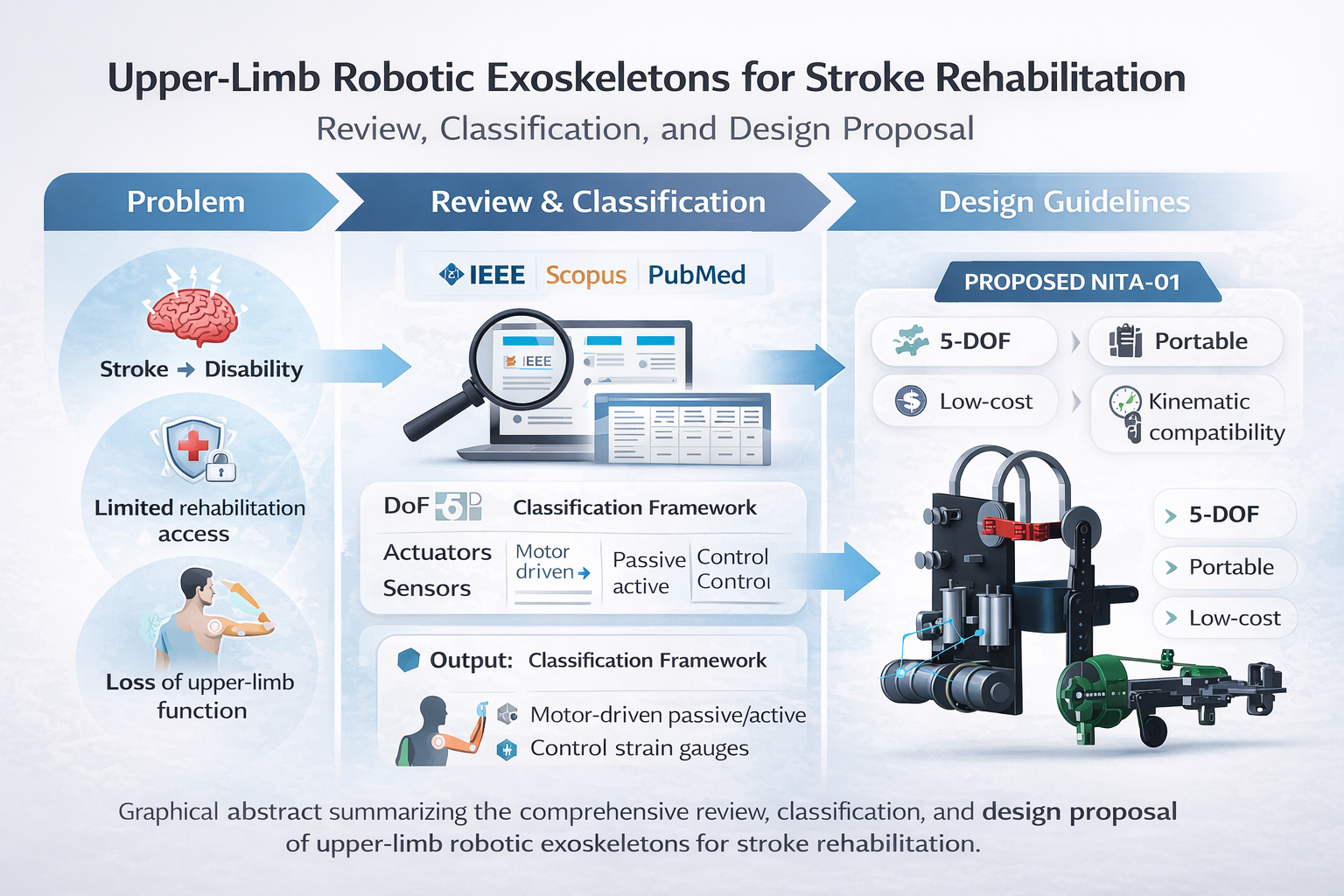
Upper-Limb robotic exoskeletons for stroke rehabilitation: A comprehensive review, comparative classification, and design guidelines
Keywords:
upper-limb exoskeleton, stroke rehabiliation, assistive technology, workspace optimization, human machine interfaceAbstract
This paper presents a structured review of upper-limb robotic exoskeletons for post-stroke rehabilitation, focusing on mechanical design principles, biomechanical compatibility, control strategies, actuation systems, and mechanical human–machine interfaces. State of the art developments were analyzed through major scientific databases and classified according to degrees of freedom, portability, sensing modalities, and rehabilitation objectives. The review highlights current design trends, limitations in commercial systems, and challenges related to kinematic alignment, workspace validation, and ergonomic integration.Based on the identified research gaps, particularly in cost-effectiveness, portability, and anthropometric adaptability—a 5-degree-of-freedom upper-limb exoskeleton, is presented as a case oriented design proposal. The architecture incorporates forward and inverse kinematic modeling to ensure compatibility with physiological ranges of motion of the shoulder, elbow, and wrist. Lightweight materials such as Polyoxymethylene and aluminum are considered to reduce distal inertia and improve wearability. This work contributes a comparative classification framework and biomechanically grounded design guidelines aimed at facilitating accessible and scalable neurorehabilitation technologies.
Downloads
References
United Nations Department of Economic & Social Affairs, Social Inclusion Demographic Yearbook. 2023
K. L. Moore, A. F. Dailey, and A. M. R. Agur, “Human Anatomy with Clinical Guidance”, 7th ed. W. Kluwer, ISBN:9788415684770, 2015.
R. L. Drake, W. Vogl, and A. W. M. Mitchell, Gray – “Anatomy for Students”, 3th ed. ESP: ISBN: 0-443-06612-4, 2005.
T. T. Choudhury, M. M. Rahman, A. Khorshidtalab, and M. R. Khan, “Modeling of Human Arm Movement: A Study on Daily Movement,” 2013 Fifth Int. Conf. on Comp. Intelligence, Mod. and Sim., Seoul, KOR, pp. 63-68, Sep 2013, doi: 10.1109/CIMSIM.2013.19
INEGI, People with Disabilities in Mexico, a Vision for 2010, MEX, 2010, ISBN: 978-607-739-055-8.
INEGI, “Group 2 Motor Disabilities,” Disability Type Classification, pp. 1–55, MEX, 2010, ISBN: 978-607-739-055-8.
R. A. R. C. Gopura and K. Kiguchi, “Mechanical Designs of Active Upper-Limb Exoskeleton Robots,” IEEE 11th Int. Conf. on Rehab. Robot., pp. 178–187, Kyoto, JPN, 2009.
M. Babaiasl, A. Ghanbari, and S. M. R. Noorani, “Mechanical design, simulation and nonlinear control of a new exoskeleton robot for use in upper-limb rehabilitation after stroke,” 20th Iran. Conf. Biomed. Eng., pp.18–20, Tehran, IRN, 2013, doi: 10.1109/ICORR.2009.5209519.
I. Healthcare, “Stroke treatment”, pp. 1–2 doi: 10.1001/archneur.61.7. 1066.Ischemic, USA, 2004.
J. Alvarez Sabín et al., “Stroke health care plan” (ICTUS II. 2011), Neurología, pp 1-17, ESP, 2011, doi: 10.1016/j.nrleng.2010.05.001.
Secretaria de Salud, “National Rehabilitation Institute”, MEX, 2013.
T. D. Lalitharatne, Y. Hayashi, K. Teramoto, and K. Kiguchi, “A study on effects of muscle fatigue on EMG-based control for human upper-limb power-assist,” IEEE 6th Int. Conf. Inf. Autom. Sustain., pp. 124–128, Beijing, CHN, 2012, doi: 10.1109/ICIAFS.2012.6419892.
D. S. Andreasen, S. K. Allen, and S. H. Sprigle, “Exoskeleton for forearm pronation and supination rehabilitation,” 26th Ann. Inter. Conf. of the IEEE, pp. 2714–2717, 2004, doi: 10.1109/IEMBS.2004.1403778.
H. Yu, I. S. Choi, K. L. Han, J. Y. Choi, G. Chung, and J. Suh, “Development of a upper-limb exoskeleton robot for refractory construction,” Ctrl. Eng. Pract., vol. 72, pp. 104–113, March 2018, doi: 10.1016/j.conengprac.2017.09.003.
G. Zhang, P. Yang, J. Wang, and J. Sun, “Multivariable Finite-Time Control of 5 DoF Upper-Limb Exoskeleton Based on Linear Extended Observer,” IEEE Access, 6, pp. 43213–43221, 2018, doi: 10.1109/ACCESS.2018.2863384
J. Kuhn, T. Hu, M. Schappler, and S. Haddadin, “Dynamics simulation for an upper-limb human-exoskeleton assistance system in a latent-space controlled tool manipulation task,” IEEE Int. Conf. Simulation, Model. Prog. Auton. Robot, pp.158–165, Brisbane, AUS, Jul. 2018, doi: 10.1109/SIMPAR.2018.8376286.
A. Ali, S. F. Ahmed, K. A. Kadir, M. K. Joyo, and S. R. N. Yarooq, “Fuzzy PID Controller for Upper Limb Rehabilitation Robotic System,” IEEE Int. Conf. Innov. Res. Dev., pp.1–5, Jun 2018, doi: 10.1109/ICIRD.2018.8376291.
N. Rehmat, J. Zuo, W. Meng, Q. Liu, S. Q. Xie, and H. Liang, “Upper limb rehabilitation using robotic exoskeleton systems: a systematic review”, Int. J. Intell. Robot. Appl., vol. 2, no. 3, pp. 283–295, 2018, doi: 10.1007/s41315-018-0064-8.
D. Buongiorno, E. Sotgiu, D. Leonardis, S. Marcheschi, M. Solazzi, and A. Frisoli, “WRES: A Novel 3 DoF WRist ExoSkeleton With Tendon-Driven Differential Transmission for Neuro-Rehabilitation and Teleoperation,” IEEE Robot. Autom. Lett., vol.3, no. 3, pp. 2152–2159, 2018, doi:10.1109/LRA.2018.2810943
Q. Wu, X. Wang, B. Chen, and H. Wu, “Development of an RBFN-based neural-fuzzy adaptive control strategy for an upper limb rehabilitation exoskeleton,” Mechatronics, vol. 53, no. 1, pp. 85–94, 2018, doi: 10.1016/j.mechatronics.2018.06.002.
Y. Ogiri, Y. Yamanoi, W. Nishino, R. Kato, T. Takagi, and H. Yokoi, “Development of an upper limb neuroprosthesis to voluntarily control elbow and hand,” Adv. Robot., vol.32, no.16, pp. 298–303 2018, doi:10.1109/ROMAN.2017.8172317
Y. Onozuka, R. Suzuki, Y. Yamada, and T. Nakamura, “An Exoskeleton Type 4-DoF Force Feedback Device Using Magnetorheological Fluid Clutches and Artificial Muscles,” IEEE/ASME Int. Conf. Adv. Intell. Mechatronics, pp. 869–874, 2018, doi: 10.1109/AIM.2018.8452696.
Y. Su, K. Wu, C. Lin, Y. Yu, and C. Lan, “Design of a Lightweight Forearm Exoskeleton for Fine-Motion Rehabilitation,” Int. Conf. Adv. Intell. Mechatronics, pp. 438–443, 2018, doi: 10.1109/AIM.2018.8452243.
L. Min, W. Guo, G. X. Member, Y. Jia, J. X. Member, and X. Z. Member, “A Tendon-driven Upper-limb Rehabilitation Robot,” 15th Int. Conf. Ubiquitous Robot., pp. 302–308, 2018, doi: 10.1109/URAI.2018.8441920.
D. Sosa-Mendez, “Development of an exoskeleton for shoulder rehabilitation,” Mixteca Technological University, Oax, MEX. 2017, doi: 10.1109/CSPA.2015.7225642.
C. A. Anirudh Sharma, A. S. Karthik Sai Vishnu Kumar, A. Prasad, R. Begum, G. S. Sharvani, and A. E. Manjunath, “Multifaceted bio-medical applications of exoskeleton: A review,” Proc. 2nd Int. Conf. Inv. Sys. Control, pp. 11–15, 2018, doi: 10.1109/ICISC.2018.8399053.
N. Yagn, “Apparatus for facilitating walking, running, and jumping,” Pat. 420.179, US420179A, Jan 28, 1890.
L. C. Kelley, “Pedomotor,” US1308675 A, 1919.
Y. Horiuchi, T. Kishi, J. Gonzalez, and W. Yu, “A study on classification of upper limb motions from around-shoulder muscle activities,” IEEE Int. Conf. Rehabil. Robot., 311–315, 2009, doi: 10.1109/ICORR.2009.5209477.
B. Ugurlu, M. Nishimura, K. Hyodo, M. Kawanishi, and T. Narikiyo, “Proof of Concept for Robot-Aided Upper Limb Rehabilitation Using Disturbance Observers,” IEEE Trans. Human-Machine Syst., vol. 45, no. 1, pp. 110–118, Nov 2014, doi:10.1109/THMS.2014.2362816
M. H. Rahman, M. Saad, J. P. Kenné, and P. S. Archambault, “Exoskeleton Robot for Rehabilitation of Elbow and Forearm Movements,” 18th Mediterr. Conf. Control Autom., pp. 1567–1572, 2010, doi: 10.1109/MED.2010.5547826.
V. Crocher, N. Jarrassé, A. Sahbani, A. Roby-Brami, and G. Morel, “Changing human upper-limb synergies with an exoskeleton using viscous fields,” IEEE Int. Conf. Robot. Autom., pp, 4657–4663, 2011, doi: 10.1109/ICRA.2011.5979626.
A. L. Delis, L. M. Revilla, D. D. Rodriguez, and A. F. R. Olaya, “On the use of surface EMG for recognizing forearm movements: Towards the control of an upper extremity exoskeleton,” 6th Andean Reg. Int. Conf., pp. 181–184, 2012, doi: 10.1109/CIBEC.2012.6424146.
Y. Morita, T. Yamamoto, R. Tanioku, M. Uchida, H. Ukai, and N. Matsui, “Analysis and modeling of upper limb motion during sanding training,” Int. Conf. Control. Autom. Syst., pp. 1585–1590, 2007, doi: 10.1109/ICCASE.2007.4406613.
K. Kiguchi, T. Tanaka, and T. Fukuda, “Neuro-fuzzy control of a robotic exoskeleton with EMG signals,” IEEE Trans. Fuzzy Syst., vol. 12, no. 4, pp. 481–490, 2004, doi:10.1109/TFUZZ.2004.832525
Z. G. Xiao, A. M. Elnady, and C. Menon, “Control an exoskeleton for forearm rotation using FMG,” 5th IEEE RAS/EMBS Int. Conf. Biomed. Robot Biomechatronics, pp. 591–596, 2014, doi: 10.1109/BIOROB.2014.6913842.
A. U. Pehlivan, S. Lee, and M. K. O’Malley, “Mechanical Design of RiceWrist-S: a Forearm-Wrist Exoskeleton for Stroke and Spinal Cord Injury Rehabilitation,” 4th IEEE RAS & EMBS, pp. 1573–1578, 2012, doi: 10.1109/BioRob.2012.6290912.
M. R. Islam, C. Spiewak, M. H. Rahman, and R. Fareh, “A Brief Review on Robotic Exoskeletons for Upper Extremity Rehabilitation to Find the Gap between Research Porotype and Commercial Type,” Adv. Robot. Autom., vol.6, no.3, 2017, doi:10.4172/2168-9695.1000177.
F. Blaya, P. S. Pedro, J. L. Silva, R. D’Amato, E. S. Heras, and J. A. Juanes, “Design of an Orthopedic Product by Using Additive Manufacturing Technology: The Arm Splint,” J. Med. Syst., vol. 42, no. 3, 2018, doi:10.1007/s10916-018-0909-6.
J. Garrido, W. Yu, and A. Soria, “Modular Design and Modeling of an Upper Limb Exoskeleton,” 5th IEEE RAS/EMBS Int. Conf. Biomed. Robot. Biomechatronics, pp. 508–513, Sao Paulo, BRA, Oct 2014, doi: 10.1109/BIOROB.2014.6913828.
N. Klopčar and J. Lenarčič, “Kinematic model for determination of human arm reachable workspace,” Meccanica, vol. 40, no. 2, pp. 203-219, 2005, doi:10.1007/s11012-005-3067–0.
J. C. Perry, J. Rosen, and S. Burns, “Upper-limb powered exoskeleton design,” IEEE/ASME Trans. Mechatron., vol. 12, no. 4, pp. 408–417, 2017, doi:10.1109/TMECH.2007.901934.
K. L. Moore, A. F. Dailey, and A. M. R. Agur, “Anatomy with clinical orientation” vol. 53, no. 9, 2023, ISBN: 978-1975209544.
J. M. P. Gunasekara, R. a. R. C. Gopura, T. S. S. Jayawardane, and S. W. H. M. T. D. Lalitharathne, “Control methodologies for upper limb exoskeleton robots,” IEEE/SICE Int. Symp. Syst. Integr., pp. 19–24, Fokouka, JPN, Dec 2012, doi: 10.1109/SII.2012.6427387.
R. A. R. C. Gopura, D. S. V. Bandara, K. Kiguchi, and G. K. I. Mann, “Developments in hardware systems of active upper-limb exoskeleton robots: A review,” Rob. Auton. Syst., vol. 75, pp. 203–220, 2016, doi: 10.1016/j.robot.2015.10.001.
R. Arachchilage, R. Chandra, and K. Kiguchi, “EMG-Based Control of an Exoskeleton Robot for Human Forearm and Wrist Motion Assist,” IEEE Int. Conf. Robot. Autom., 731–736, Pasadena, USA, May 2008 doi: 10.1109/ROBOT.2008.4543292.
J. Lee, M. Kim, S. Oh, and K. Kim, “Integrated Control Method for Power-Assisted Rehabilitation: Ellipsoid Regression and Impedance Control,” Int. Conf. Intell. Robot. Sys., pp. 2101-2106, Chicago, USA, Sep 2014 doi: 10.1109/IROS.2014.6942844.
C.-W. Chu, O. C. Jenkins, and M. J. Matarié, “Markerless kinematic model and motion capture from volume sequences,” IEEE Comput. Soc. Conf. Comput. Vis. Pattern Recognition., vol. 2, pp. 475–482, Madison, USA, Jul 2003, doi: 10.1109/CVPR.2003.1211505.
J. C. Perry, J. M. Powell, and J. Rosen, “Isotropy of an upper limb exoskeleton and the kinematics and dynamics of the human arm,” Appl. Bionics Biomech., vol. 6, no. 2, pp. 175–191, 2009, doi: 10.1080/11762320902920575.
A. U. Pehlivan, C. Rose, and M. K. O’Malley, “System Characterization of RiceWrist-S : a Forearm-Wrist Exoskeleton For Upper Extremity Rehabilitation,” IEEE Int. Conf. Rehabil. Robot., 2, 1-6, doi:10.1109/ICORR.2013.6650462 (2013).
Rehabilitation,” IEEE Int. Conf. Rehabil. Robot., vol. 2, pp. 1-6, Seattle, USA, Oct 2013.
Y. Li, Z. Guo, and K. Wang, “A BP Neural Network Based Method for Upper Limb Motion Intensity Evaluation,” Int. Conf. Cloud Comput. Big Data, pp. 171–176, Fuzhou, CHN, May 2014, doi: 10.1109/ROBIO.2009.5420466.
M. A. Destarac, C. E. García, J. García, R. Espinoza, and R. J. Saltarén, “ORTE : Robot for Upper Limb Rehabilitation . Biomechanical Analysis of Human Movements,” IEEE Lat. Am. Trans., vol.16 no. 6, pp. 1638–1643, 2018, doi:10.1109/TLA.2018.8444160
A. S. Niyetkaliyev, S. Hussain, M. H. Ghayesh, and G. Alici, “Review on Design and Control Aspects of Robotic Shoulder Rehabilitation Orthoses,” IEEE Trans. Human-Machine Syst., vol. 47, no.6, pp. 1134–1145, 2017, doi:10.1109/THMS.2017.2700634.
J. Rosen, M. Brand, M. Fuchs, and M. Arcan, “A myosignal-based powered exoskeleton system,” IEEE Trans. Syst. Man, Cybern. - Part A Syst. Humans, vol. 31, no. 3, pp. 210–222, 2001, doi: 10.1109/3468.925661.
H. Guo et al., “Prediction of twist angle for assistive exoskeleton based on EMG signals,” IEEE 3rd Int. Conf. Data Sci. Cyberspace, pp. 819–823, Guangzhou, CHN, Jul 2018, doi: 10.1109/DSC.2018.00131.
P. Marian, I. Danuţ, P. Nirvana, and P. Dorin, “Engineered devices to support stroke rehabilitation,” 19th Int. Conf. Control Syst. Comput. Sci., pp. 289–295, Bucharest, ROU, Jul 2013, doi: 10.1109/CSCS.2013.44.
S. Bembli, N. K. Haddad, and S. Belghith, “Robustness analysis of an upper-limb exoskeleton using Monte Carlo simulation,” Int. Conf. Adv. Syst. Electr. Technol., pp. 78–84, Hammamet, TT, Jun 2018, doi: 10.1109/ASET.2018.8379838.
B. Brahmi, M. Saad, C. Ochoa Luna, M. H. Rahman, and A. Brahmi, “Adaptive Tracking Control of an Exoskeleton robot with Uncertain Dynamics Based on Estimated Time Delay Control,” IEEE/ASME Trans. Mechatronics, vol. 23, no. 2, pp. 575–585, 2018, doi: 10.1109/TMECH.2018.2808235.
E. Sánchez, A. Luviano, and A. Rosales, “A robust GPI controller for trajectory tracking tasks in the limbs of a walking robot,” Int. J. Control. Autom. Syst., vol. 15, no. 6, pp. 2786-2795, 2017, doi:10.1007/s12555-015-0387-2.
T. Proietti, V. Crocher, A. Roby-Brami, and N. Jarrasse, “Upper-limb robotic exoskeletons for neurorehabilitation: A review on control strategies,” IEEE Rev. Biomed. Eng., vol. 9, pp. 4–14, 2016, doi: 10.1109/RBME.2016.2552201.
A. Gupta, M. K. O’Malley, V. Patoglu, and C. Burgar, “Design, Control and Performance of RiceWrist: A Force Feedback Wrist Exoskeleton for Rehabilitation and Training,” Int. J. Rob. Res., vol. 27, pp. 233–251, 2008, doi:10.1177/0278364907084261.
Y. Jung and J. Bae, “Kinematic analysis of a 5-DoF upper-limb exoskeleton with a tilted and vertically translating shoulder joint,” IEEE/ASME Trans. Mechatronics, vol. 20, no. 3, pp. 1428–1439, 2015, doi:10.1109/TMECH.2014.2346767.
A. Kinematc and D. Requirements, “Design and development of a human-machine interactive-force controlled powered upper-limb exoskeleton for human augmentation and physical rehabilitation,” Int. Conf. Biomed. Eng. Scien., pp. 465–470, Langkawi, Dec 2012, doi: 10.1109/ICM.2017.8013349.
M. B. Hong, S. J. Kim, and K. Kim, “Development of a 10-DoF robotic system for upper-limb power assistance,” 9th Int. Conf. Ubiquitous Robots. Amb. Intell., pp. 61–62, Daejeon, KOR 2012, doi: 10.1109/URAI.2012.6462931.
M. H. Rahman, M. Saad, J. P. Kenné, and P. S. Archambault, “Control of a powered exoskeleton for elbow, forearm and wrist joint movements,” IEEE 11th Int. Conf. Robot. Biomimetics, pp. 1561–1566, Karon, TH, April 2012, doi: 10.1109/ROBIO.2011.6181511.
S. Zhang, S. Guo, M. Qu, and M. Pang, “Development of a Bilateral Rehabilitation Training System Using the Haptic Device and Inertia Sensors,” IEEE Int. Conf. Mechatronics Autom., pp. 606–611, Tianjin, CHN, August 2014, doi: 10.1109/ICMA.2014.6885766.
W. Wei, S. Guo, W. Zhang, J. Guo, and Y. Wang, “A novel VR-based upper limb rehabilitation robot system,” ICME Int. Conf. Complex Med. Eng. C., vol. 5, pp.302–306, Beijing, CHN, Jun 2013, doi: 10.1109/ICCME.2013.6548259.
Z. Song, S. Guo, M. Pang, and S. Zhang, “ULERD-based active training for upper limb rehabilitation,” IEEE Int. Conf. Mechatronics Autom., pp. 569-574, Chengdu, CHN, Aug 2012, doi: 10.1109/ICMA.2015.7237937.
H. Kimura, E. Genda, K. Nakamura, H. Tanaka, and H. Kawasaki, “Development of Upper-Limb Motion-Assist Device for High Cervical Spinal Cord Injury,” SICE Annu. Conf., pp. 1–6, Sapporo, JPN, Oct, 2014, doi: 10.1109/ROBIO.2012.6491040.
H.-B. Kang, J.-H. Wang, L.-Y. Yu, L. Xu, and Ieee, “Adaptive controller design for upper-limb rehabilitation robot,” 25th Chinese Control Decis. Conf., pp. 2626–2631, Guiyang, CHN, Jul, 2013, doi: 10.1109/CCDC.2013.6561384.
Y. J. Kim, C. K. Park, and K. G. Kim, “An EMG-based variable impedance control for elbow exercise: preliminary study,” Adv. Robot., vol. 31, no. 15, pp. 809–820, 2017, doi:10.1080/01691864.2017.1353440
Y. J. Kim, C. K. Park, and K. G. Kim, “An EMG-based variable impedance control for elbow exercise: preliminary study,” Adv. Robot., vol. 31, no. 15, pp. 809–820, 2017, doi:10.1080/01691864.2017.1353440
A. Abooee, M. M. Arefi, F. Sedghi, and V. Abootalebi, “Robust nonlinear control schemes for finite-time tracking objective of a 5-DoF robotic exoskeleton,” Int. J. Control, vol. 7179, pp. 1–16, 2018, doi:10.1080/00207179.2018.1430379.
V. Crocher, J. Fong, T. Bosch, Y. Tan, I. Mareels, and D. Oetomo, “Upper Limb Deweighting using Underactuated End-effector based Backdrivable Manipulanda,” IEEE Robot. Autom. Lett., vol. 3, no. 3, pp. 2116–2122, 2018, doi:10.1109/LRA.2018.2809605.
J. Zheng, P. Shi, and H. Yu, “A Virtual Reality Rehabilitation Training System Based on Upper Limb Exoskeleton Robot,” 10th Int. Conf. Intell. Human-Machine Syst. Cybern., pp. 220–223, Hangzhou, CHN, Nov 2018, doi: 10.1109/IHMSC.2018.00058.
S. Pei, J. Wang, J. Guo, et al, “A Human-like Inverse Kinematics Algorithm of an Upper Limb Rehabilitation Exoskeleton”, Symmetry, vol. 15, no. 1657, pp. 1-17, 2023, doi: 10.3390/sym15091657
I. Abdallah, Y. Boutera., “An Optimized Stimulation Control System for Upper Limb Exoskeleton Robot-Assisted Rehabilitation Using a Fuzzy Logic-Based Pain Detection Approach”, Sensors, vol. 24, pp. 2-17, 2024, doi: 10.3390/s24041047.
H. Li, S. Guo, H. Wang. D. Bu, “Preliminary Exploration of Haptic-enabled Therapist-in-the-Loop Telerehabilitation System for Exoskeleton-assisted Upper Limb Training,” Int. Conf. Mechatronics Autom., vol.9, pp 1984-1989, Heilongjiang, CHN, Aug 2023, doi: 10.1109/ICMA57826.2023.10216246.
P. Ni, J. Sun, J Dong, “Design and Control of an Upper Limb Bionic Exoskeleton Rehabilitation Device Based on Tensegrity Structure”, Wiley, vol.2024, pp. 1-15,2024, doi:10.1155/2024/5905225.
Q. Meng, Q. Xie, H. Shao, et.al,” Pilot study of a Powered Exoskeleton for Upper Limb Rehabilitation Based on the Wheelchair”, Hindawi, Vol. 2019, pp 1-11, doi.org/10.1155/2019/9627438.
M. Burns, Z. Zavoda, R. Nataraj, et. al, “HERCULES: A Three Degree-of-Freedom Pneumatic Upper Limb Exoskeleton for Stroke Rehabilitation,” Ann. Inter. Conf. Eng. Medicine and Biology Soc. pp. 4459-4462 doi:10.1109/EMBC44109.2020.9176549, Jul. 2022.
P. Rangan, J. Johnson, R. Babu, et al, “Desing and Modelling of a Human Upper Limb for Rehabilitation Exoskeleton,” JESTR, vol. 17, num. 2, pp. 9-15, 2024, doi:10.25103/jestr.172.02.
S. Hu, X. Zhou, and J. Bao, “Graded Optimization of Upper Limb Exoskeleton Parts for Grid Operations,” IEEEAccess, vol. 11, pp. 14409-14417, 2023, doi: 10.1109/ACCESS.2023.3243942.
J. Gou, P. Li, and S. Gou, “Design and Analysis of a Wearable Exoskeleton Upper Limb Rehabilitation Robot,” Int. Conf. Mechatronics Autom., pp. 1564-1569, doi: 10.1109/ICMA49215.2020.9233873, Beijing, CHN, 2020
J. Nuñez, D. Campusano, et. al., "Performance comparison between PD and PID Controller in an upper limb Exoskeleton by analyzing an arm trajectory modeled with Image Recognition," Eng. Int. Res. Conf. (EIRCON), pp. 1-4, doi: 10.1109/EIRCON51178.2020.9254082. Lima, PE, 2020.
D. Chiaradia, G. Rinaldi, M. Solazzi, et.al., “Design and Control of the Rehab-Exos, a Joint Torque-Controlled Upper Limb Exoskeleton,” Robotics, vol. 13, num. 32, pp. 1-29 doi: 10.3390/robotics13020032, 2024.
D. Ito, M. Fukuda, Y. Hosoi, et.al., “Optimizing shoulder elevation assist rate in exoskeletal rehabilitation based on muscular activity indices: a clinical feasibility study,” BMC Neurology, vol. 24, num. 144, pp.1-10, doi:10.1186/s12883-024-03651-x, 2024.
T. Ahmed, R. Islam, B Brahmi, M Rahman, “Robustness and Tracking Performance Evaluation of PID Motion Control of 7 DoF Anthropomorphic Exoskeleton Robot Assisted Upper Limb Rehabilitation,” Sensors, vol. 22, num. 3747, pp. 1-26, doi: 10.3390/s22103747, 2022.
S. Pei, J. Wang, J. Guo, H. Yin, Y. Yao, “A Human-like Inverse Kinematics Algorithm of an Upper Limb Rehabilitation Exoskeleton,” Symmetry, vol. 15, num. 1657, pp 1-17, doi: 10.3390/sym15091657, 2023.
T.M. Kwok, T. Li. And H. Yu, “A Reliable Kinematic Measurement of Upper Limb Exoskeleton for VR Therapy with Visual-inertial Sensors”. Int. Conf. on Adv. Intel. Mechatronic, pp 584-590, Seattle, USA, Jun 2023. Doi: 10.1109/AIM46323.2023.10196192
H. Morishita, T Murakami, “Assistance Torque Control Based on Musculoskeletal Hexagon Output Distribution for Upper Limb Exoskeleton”, Int. Conf. on Mechatronics, pp 1-6, Loughborough, UK, March 2023, doi: 10.1109/ICM54990.2023.10101922
M.H. Yen, L. H. Yao et al. “Development of an Upper Limb Exoskeleton System with Integrated Electromyography Signals”, Int. Sym. On Computer, consumer and Control, pp. 244-248, Taichung, TW, Jun/Jul 2023, doi: 10.1109/IS3C57901.2023.00072
M. Abdallah, R. Fareh, Y. Kali, and M. Bettayeb, “Reinforcement Learning Human Inverse Kinematics of a Upper Limb Exoskeleton Robot”, Adv in Scs. Tech. Int. Conf. pp. 1-6, Dubai, UAE, doi: 10.1109/ROBIO.2018.8665249.
C. Liu, J. wen, P Zhu,”Upper limb and Back Rehabilitation Exoskeleton”, Inter. Cenf. On Electrical, Automation and Eng. Pp 206-212, Changchun, CH, Dec. 2023. doi: 10.1109/ICEACE60673.2023.10442916
R. F. Chandler, C. E. Clauser, J. T. McConville, H. M. Reynolds, and J. W. Young, “Investigation of inertial properties of the human body,” Natl. Highw. Traffic Saf. Adm., vol. 3, pp. 1–169, 1975, doi:10.1017/CBO9781107415324.004.
S. H. Elwardany, W. H. El-Sayed, and M. F. Ali, “Reliability of Kinovea Computer Program in Measuring Cervical Range of Motion in Sagittal Plane,” Open Access Libr. J., vol. 2. No. 9, pp. 1–10, 2015, doi:10.4236/oalib.1101916.
J. L. Guzmán-Valdivia, C.H., Blanco-Ortega, A., Oliver-Salazar, M.A.y Carrera-Escobedo, “Therapeutic Motion Analysis of Lower Limbs Using Kinovea,” Int. J. Soft Comput. Eng., vol. 3, no. 2, pp. 359–365, 2013, doi:10.1016/S0032-9592(96)00006–4.
W. Wei, S. Guo, W. Zhang, J. Guo, and Y. Wang, “A novel VR-based upper limb rehabilitation robot system,” ICME Int. Conf. Complex Med. Eng. C., vol. 5, pp.302–306, Beijing, CHN, Jun 2013, doi: 10.1109/ICCME.2013.6548259.
H.-B. Kang, J.-H. Wang, L.-Y. Yu, L. Xu, and Ieee, “Adaptive controller design for upper-limb rehabilitation robot,” 25th Chinese Control Decis. Conf., pp. 2626–2631, 2013, doi:.
H. A. Al-Hajjar, S. A. Ahmad, M. H. Marhaban, A. J. Ishak “An Optimized Stimulation Control System for Upper Limb Exoskeleton Robot-Assisted Rehabilitation Using a Fuzzy Logic-Based Pain Detection Approach,” IEEE Access, vol. 10, pp. 106093–106108, (2022), doi: 10.1109/ACCESS.2022.3211516