Genre-Sensitive Prediction of Emotional Arousal in Virtual Reality: A Neural Modeling Approach Using Skin Conductance Peaks
Keywords:
Galvanic Skin Response, Virtual Reality Games, Emotional Arousal, Skin Conductance Response, Predictive ModelingAbstract
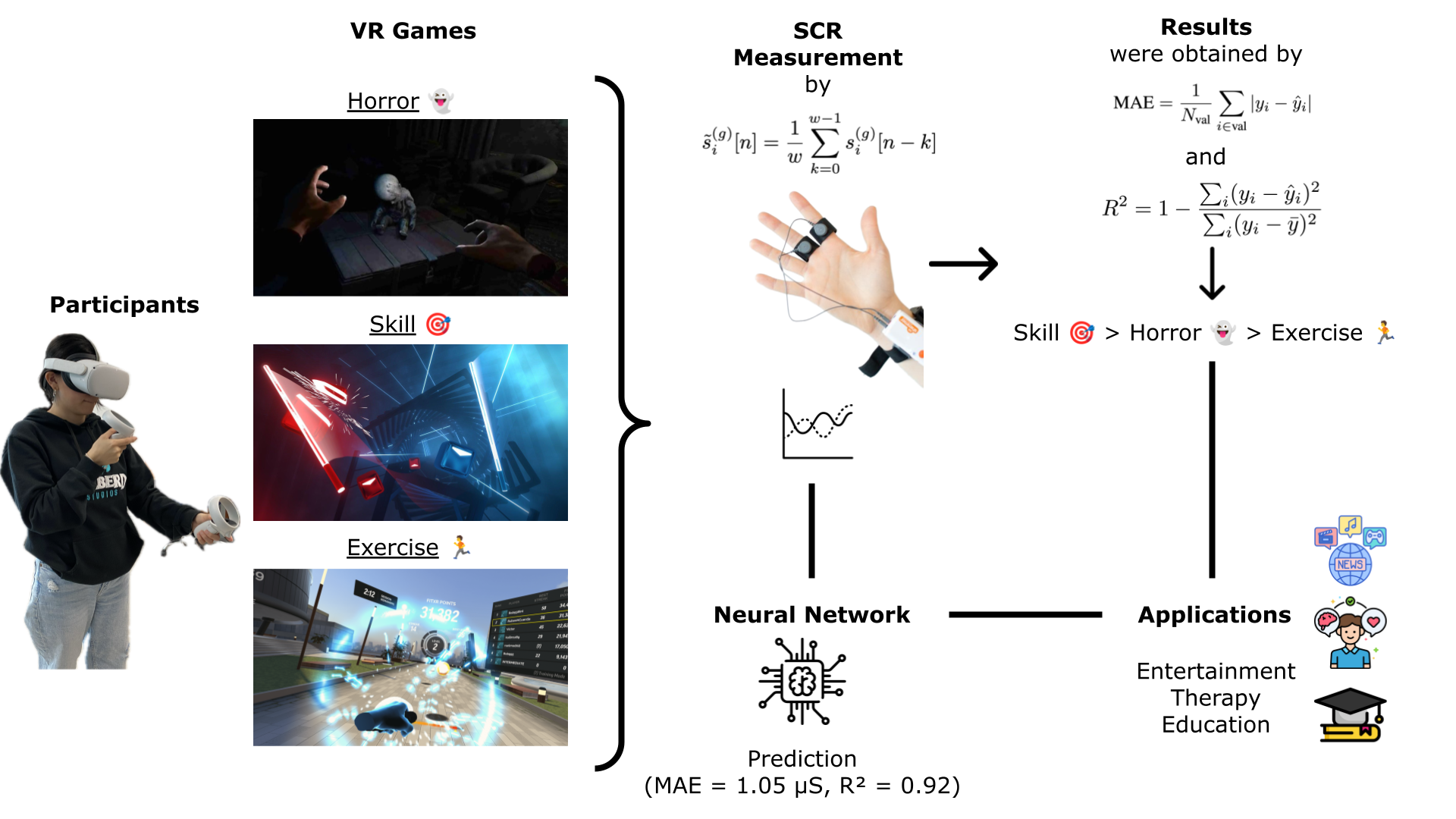
Understanding how different virtual reality (VR) game genres modulate physiological arousal is crucial for designing emotionally adaptive immersive systems. This study introduces a novel experimental framework combining high-resolution Skin Conductance Response (SCR) data and neural predictive modeling to compare emotional activation across horror, skill-based, and exercise VR games. Using Galvanic Skin Response (GSR) sensors, we recorded phasic peaks in SCR from 25 university-aged participants during gameplay sessions with controlled exposure times and standardized transitions. However, given the minimal difference relative to the large variability, this observation should be considered preliminary and specific to the tested games and cohort. A feed-forward neural network was developed to forecast individual arousal levels based solely on genre-induced features, achieving strong predictive performance. This dual contribution—empirical genre comparison and lightweight predictive modeling—offers a scalable tool for integrating emotional responsiveness into VR systems without continuous biosignal monitoring. The findings not only advance the state of the art in affective computing but also open new avenues for therapeutic, educational, and entertainment applications grounded in physiological adaptation.
Downloads
References
E. Kruijff, A. Marquardt, C. Trepkowski, J. Schild, and A. Hinkenjann,
“Designed emotions: challenges and potential methodologies for
improving multisensory cues to enhance user engagement in immersive
systems,” The Visual Computer, vol. 33, no. 4, pp. 471–488, 2017, doi:
1007/s00371-016-1294-0.
S. Ahmed, T. Sharif, D. H. Ting, and S. J. Sharif, “Crafting emotional
engagement and immersive experiences: Comprehensive scale
development for and validation of hospitality marketing storytelling
involvement,” Psychology & Marketing, vol. 41, no. 7, pp. 1514–1529,
, doi: 10.1002/mar.21994.
Y. Gao and C. Spence, “Enhancing presence, immersion, and interaction
in multisensory experiences through touch and haptic feedback,” in
Virtual Worlds, vol. 4, no. 1. MDPI, 2025, p. 3, doi: 10.3390/virtualworlds4010003.
S. Balters and M. Steinert, “Capturing emotion reactivity through
physiology measurement as a foundation for affective engineering
in engineering design science and engineering practices,” Journal of
Intelligent Manufacturing, vol. 28, no. 7, pp. 1585–1607, 2017, doi:
1007/s10845-015-1145-2.
D. Wu, Z. Yang, P. Zhang, R. Wang, B. Yang, and X. Ma, “Virtual-reality
interpromotion technology for metaverse: A survey,” IEEE Internet
of Things Journal, vol. 10, no. 18, pp. 15 788–15 809, 2023, doi:
1109/JIOT.2023.3265848.
N. Pop-Jordanova and J. Pop-Jordanov, “Electrodermal activity and
stress assessment,” Prilozi, vol. 41, no. 2, pp. 5–15, 2020, doi:
2478/prilozi-2020-0028.
N. Mateos-Garc´ıa, A.-B. Gil-Gonz´alez, A. Luis-Reboredo, and B. P´erez-
Lancho, “Driver stress detection from physiological signals by virtual
reality simulator,” Electronics, vol. 12, no. 10, p. 2179, 2023, doi:
3390/electronics12102179.
L. S. Meinel and C. Bullerjahn, “More horror due to specific music
placement? effects of film music on psychophysiological responses to a
horror film,” Psychology of Music, vol. 50, no. 6, pp. 1837–1852, 2022,
doi: 10.1177/03057356211073478.
J. Mar´ın-Morales, J. L. Higuera-Trujillo, J. Guixeres, C. Llinares,
M. Alca˜niz, and G. Valenza, “Heart rate variability analysis for the
assessment of immersive emotional arousal using virtual reality: Comparing
real and virtual scenarios,” PloS one, vol. 16, no. 7, p. e0254098,
, doi: 10.1371/journal.pone.0254098.
R. Vatsal, S. Mishra, R. Thareja, M. Chakrabarty, O. Sharma, and
J. Shukla, “An analysis of physiological and psychological responses
in virtual reality and flat screen gaming,” IEEE Transactions on
Affective Computing, vol. 15, no. 3, pp. 1696–1710, 2024, doi:
1109/TAFFC.2024.3368703.
P. L. Indrasiri, B. Kashyap, C. Kolambahewage, B. Nakisa, K. Ijaz, and
P. N. Pathirana, “Vr based emotion recognition using deep multimodal
fusion with biosignals across multiple anatomical domains,” arXiv
preprint arXiv:2412.02283, 2024, doi: 10.48550/arXiv.2412.02283.
M. Nazemi, B. Rababah, D. Ramos, T. Zhao, and B. Farooq, “Decoding
pedestrian stress on urban streets using electrodermal activity monitoring
in virtual immersive reality,” Transportation Research Part C: Emerging
Technologies, vol. 171, p. 104952, 2025, doi: 10.1016/j.trc.2024.104952.
P. Hanlon, L. Hannigan, J. Rodriguez-Perez, C. Fischbacher, N. J.
Welton, S. Dias, F. S. Mair, B. Guthrie, S. Wild, and D. A. McAllister,
“Representation of people with comorbidity and multimorbidity in
clinical trials of novel drug therapies: an individual-level participant
data analysis,” BMC medicine, vol. 17, no. 1, p. 201, 2019, doi:
1186/s12916-019-1427-1.
G. J. Heng, “A neurocognitive approach to understand the role of
familiarity with musical style and individual differences in music-evoked
emotions,” 2021, doi: 10.32657/10356/152983.
Y. Shi, M. Boffi, B. E. Piga, L. Mussone, and G. Caruso, “Perception
of driving simulations: can the level of detail of virtual scenarios
affect the driver’s behavior and emotions?” IEEE Transactions
on Vehicular Technology, vol. 71, no. 4, pp. 3429–3442, 2022, doi:
1109/TVT.2022.3152980.
K. Dora, T. Suga, K. Tomoo, T. Sugimoto, E. Mok, H. Tsukamoto,
S. Takada, T. Hashimoto, and T. Isaka, “Effect of very low-intensity
resistance exercise with slow movement and tonic force generation
on post-exercise inhibitory control,” Heliyon, vol. 7, no. 2, 2021, doi:
1016/j.heliyon.2021.e06261.
A. Bolouki, O. McAnirlin, M. HEM Browning, and A. Maynard,
“Optimizing virtual nature for psychological and physiological wellbeing:
a systematic review of the moderating effects of duration, nature
type, sample characteristics, and immersiveness and potential risks of
bias,” International Journal of Human–Computer Interaction, vol. 41,
no. 1, pp. 775–791, 2025, doi: 10.1080/10447318.2024.2338327.
J. G. Vuijk, J. Klein Brinke, and N. Sharma, “Utilising emotion
monitoring for developing music interventions for people with dementia:
a state-of-the-art review,” Sensors, vol. 23, no. 13, p. 5834, 2023, doi:
3390/s23135834.
R. Yupanqui, J. Sohn, Y. Kim, R. Flores, H. Lee, J. Kim, S. Lee, Y. Ham,
C. Lee, and T. Chaspari, “A multimodal analysis of environmental stress
experienced by older adults during outdoor walking trips: Implications
for designing new intelligent technologies to enhance walkability in
low-income latino communities,” in Proceedings of the 26th International
Conference on Multimodal Interaction, 2024, pp. 302–311, doi:
1145/3678957.3685703.