Expert Selection for Wordlist-Based DGA Detection
Keywords:
Domain Generation Algorithms, Expert Selection, Cybersecurity, Real-time Detection, Model ComparisonAbstract
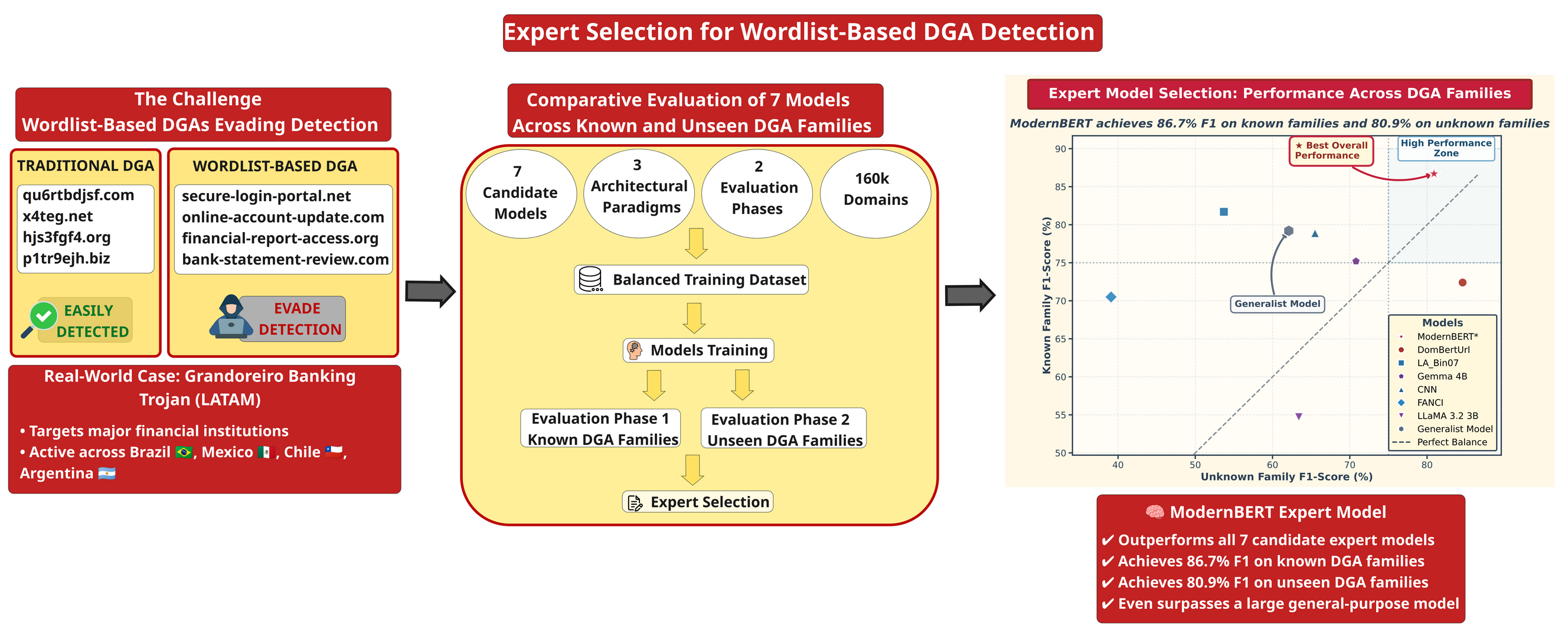
Domain Generation Algorithms (DGAs) have evolved beyond traditional pseudorandom patterns, with wordlist-based variants generating linguistically coherent domains that evade conventional detection methods. While previous research has primarily focused on generalist detection approaches across multiple DGA types, systematic expert model selection specifically targeting wordlist-based variants remains largely unexplored. This work addresses expert model selection for wordlist-based DGA detection, where expert models refer to specialized architectures trained exclusively on specific DGA categories. We conduct systematic evaluation of seven candidate models across transformer, convolutional neural network (CNN), and traditional machine learning approaches. Models were trained on a balanced dataset of 160,000 domains spanning eight wordlist-based DGA families and evaluated using a rigorous two-phase protocol that measures both performance on training families and generalization to previously unseen variants. Our comparative analysis identifies fine-tuned ModernBERT as the optimal expert model, achieving 86.7% F1-score on known families while maintaining 80.9% performance on unknown families with 26ms inference time on NVIDIA Tesla T4 GPUs, enabling processing of approximately 38 domains per second. The study validates that domain-specific expert training significantly outperforms generalist approaches trained on diverse DGA families, with F1-score improvements of 9.4% on familiar variants and 30.2% on unseen families. This performance gain indicates that focused expertise develops transferable linguistic patterns rather than memorization of specific family characteristics.
Downloads
References
Plohmann, D., Yakdan, K., Klatt, M., Bader, J., & Gerhards-Padilla, E. (2016). A comprehensive measurement study of domain generating malware. In 25th USENIX Security Symposium (USENIX Security 16) (pp. 263–278). https://www.usenix.org/conference/usenixsecurity16/technical-sessions/presentation/plohmann
Yang, L., Zhai, J., Liu, W., Ji, X., Bai, H., Liu, G., & Dai, Y. (2019). Detecting word-based algorithmically generated domains using semantic analysis. Symmetry, 11(2), 176. https://doi.org/10.3390/sym11020176
IBM X-Force. (2024). Grandoreiro banking trojan unleashed: X-force observing emerging global campaigns. https://www.ibm.com/think/x-force/grandoreiro-banking-trojan-unleashed
Catania, C., García, S., & Torres, P. (2019). Deep convolutional neural networks for DGA detection. In Computer Science – CACIC 2018 (pp. 327–340). Springer. https://doi.org/10.1007/978-3-030-20787-8_23
Ferreira, E. W. T., Carrijo, G. A., de Oliveira, R., & de Souza Araujo, N. V. (2011). Intrusion detection system with wavelet and neural artificial network approach for networks computers. IEEE Latin America Transactions, 9(5), 832–837. https://doi.org/10.1109/TLA.2011.6030997
Cebere, B., Flueren, J., Sebastián, S., Plohmann, D., & Rossow, C. (2024). Down to earth! Guidelines for DGA-based malware detection. ACM. https://doi.org/10.1145/3678890.3678913
da Silveira Lopes, R., Duarte, J. C., & Goldschmidt, R. R. (2023). False positive identification in intrusion detection using XAI. IEEE Latin America Transactions, 21(6), 745–751. https://doi.org/10.1109/TLA.2023.10172140
Plohmann, D. (2015). DGAArchive – A deep dive into domain generating malware. https://dga-archive.benjaminbp.de
Fu, Y., Yu, L., Hambolu, O., Ozcelik, I., Husain, B., Sun, J., ... & Brooks, R. R. (2017). Stealthy domain generation algorithms. IEEE Transactions on Information Forensics and Security, 12(6), 1430–1443. https://doi.org/10.1109/TIFS.2017.2668361
Yu, B., Pan, J., Hu, J., Nascimento, A., & De Cock, M. (2018). Character level based detection of DGA domain names. In 2018 International Joint Conference on Neural Networks (IJCNN) (pp. 1–8). IEEE. https://doi.org/10.1109/IJCNN.2018.8489147
Breiman, L. (2001). Random forests. Machine Learning, 45, 5–32. https://doi.org/10.1023/A:1010933404324
Highnam, K., Puzio, D., Luo, S., & Jennings, N. R. (2021). Real-time detection of dictionary DGA network traffic using deep learning. SN Computer Science, 2(2), 110. https://doi.org/10.1007/s42979-021-00507-w
Woodbridge, J., Anderson, H. S., Ahuja, A., & Grant, D. (2016). Predicting domain generation algorithms with long short-term memory networks. arXiv:1611.00791. https://doi.org/10.48550/arXiv.1611.00791
Curtin, R. R., Gardner, A. B., Grzonkowski, S., Kleymenov, A., & Mosquera, A. (2019). Detecting DGA domains with recurrent neural networks and side information. In 14th International Conference on Availability, Reliability and Security (pp. 1–10). https://doi.org/10.1145/3339252.3339258
Sayed, M. A., Rahman, A., Kiekintveld, C., & Garcia, S. (2024). Fine-tuning large language models for DGA and DNS exfiltration detection. arXiv:2410.21723. https://doi.org/10.48550/arXiv.2410.21723
La O, R. L., Catania, C. A., & Parlanti, T. (2024). LLMs for domain generation algorithm detection. arXiv:2411.03307. https://doi.org/10.48550/arXiv.2411.03307
Koh, J. J., & Rhodes, B. (2018). Inline detection of domain generation algorithms with context-sensitive word embeddings. In 2018 IEEE International Conference on Big Data (pp. 2966–2971). IEEE. https://doi.org/10.1109/BigData.2018.8622066
Huang, W., Zong, Y., Shi, Z., Wang, L., & Liu, P. (2022). PEPC: A deep parallel convolutional neural network model with pre-trained embeddings for DGA detection. In 2022 International Joint Conference on Neural Networks (IJCNN) (pp. 1–8). IEEE. https://doi.org/10.1109/IJCNN55064.2022.9892081
Morbidoni, C., Cucchiarelli, A., & Spalazzi, L. (2025). Mixed-embeddings and deep learning ensemble for DGA classification with limited training data. IEEE Access. https://doi.org/10.1109/ACCESS.2025.3565022
Tran, D., Mac, H., Tong, V., Tran, H. A., & Nguyen, L. G. (2018). A LSTM-based framework for handling multiclass imbalance in DGA botnet detection. Neurocomputing, 275, 2401–2413. https://doi.org/10.1016/j.neucom.2017.11.018
Tuan, T. A., Long, H. V., & Taniar, D. (2022). On detecting and classifying DGA botnets and their families. Computers & Security, 113, 102549. https://doi.org/10.1016/j.cose.2021.102549
Hossin, M., & Sulaiman, M. N. (2015). A review on evaluation metrics for data classification evaluations. International Journal of Data Mining & Knowledge Management Process, 5(2), 1. https://doi.org/10.5121/ijdkp.2015.5201
Powers, D. M. (2020). Evaluation: From precision, recall and F-measure to ROC, informedness, markedness and correlation. arXiv:2010.16061. https://doi.org/10.48550/arXiv.2010.16061
NetLab. (2023). 360NetLab DGA dataset. https://data.netlab.360.com
Zago, M., Pérez, M. G., & Pérez, G. M. (2020). UMUDGA: A dataset for profiling algorithmically generated domain names in botnet detection. Data in Brief, 30, 105400. https://doi.org/10.1016/j.dib.2020.105400
Peck, J., Nie, C., Sivaguru, R., Grumer, C., Olumofin, F., Yu, B., Nascimento, A., & De Cock, M. (2019). Charbot: A simple and effective method for evading DGA classifiers. IEEE Access, 7, 91759–91771. https://doi.org/10.1109/ACCESS.2019.2927075
Snyder, P., Taylor, C., & Kanich, C. (2020). The 2020 Tranco list: Improving the Alexa ranking. https://tranco-list.eu
Google DeepMind. (2024). Gemma documentation. https://ai.google.dev/gemma/docs/core
Google. (2025). Gemma 3 4B IT. Hugging Face. https://huggingface.co/google/gemma-3-4b-it
Meta AI. (2024). LLaMA 3.2 3B Instruct. Hugging Face. https://huggingface.co/meta-llama/Llama-3.2-3B-Instruct
Answer.AI. (2024). ModernBERT-base. Hugging Face. https://huggingface.co/answerdotai/ModernBERT-base
Mahdaouy, A. E., Lamsiyah, S., Idrissi, M. J., Alami, H., Yartaoui, Z., & Berrada, I. (2024). DomURLs BERT: Pre-trained BERT-based model for malicious domains and URLs detection and classification. arXiv:2409.09143. https://doi.org/10.48550/arXiv.2409.09143
Schüppen, S., Teubert, D., Herrmann, P., & Meyer, U. (2018). FANCI: Feature-based automated NXDomain classification and intelligence. In 27th USENIX Security Symposium (USENIX Security 18) (pp. 1165–1181). https://www.usenix.org/conference/usenixsecurity18/presentation/schuppen
Google. (2023). Google Colaboratory: A cloud-based collaborative notebook environment. https://colab.research.google.com
La O, R. L. (2024). MoE-word-list-DGA-detection. GitHub. https://github.com/reypapin/MoE-word-list-dga-detection
Cochran, W. G. (1977). Sampling Techniques (3rd ed.). John Wiley & Sons. https://www.academia.edu/download/68847310/COCHRAN_W._Sampling_techniques_compressed.pdf
Lundberg, S. M., & Lee, S.-I. (2017). A unified approach to interpreting model predictions. In Advances in Neural Information Processing Systems, 30. https://proceedings.neurips.cc/paper_files/paper/2017/file/8a20a8621978632d76c43dfd28b67767-Paper.pdf
Jacobs, R. A., Jordan, M. I., Nowlan, S. J., & Hinton, G. E. (1991). Adaptive mixtures of local experts. Neural Computation, 3(1), 79–87. https://doi.org/10.1162/neco.1991.3.1.79